
Catalogue Search | MBRL


Are you sure you want to remove the book from the shelf?

{{itemTitle}}
18,387
result(s) for
"Oceanography Research."
Sort by:

Data analysis methods in physical oceanography
A practical reference to established and modern data analysis techniques in earth and ocean sciences. Its five major sections address data acquisition and recording, data processing and presentation, statistical methods and error handling, analysis of spatial data fields, and time series analysis methods.
Book

Sea Change
Ocean science connects a global community of scientists in many disciplines - physics, chemistry, biology, geology and geophysics. New observational and computational technologies are transforming the ability of scientists to study the global ocean with a more integrated and dynamic approach. This enhanced understanding of the ocean is becoming ever more important in an economically and geopolitically connected world, and contributes vital information to policy and decision makers charged with addressing societal interests in the ocean.
Science provides the knowledge necessary to realize the benefits and manage the risks of the ocean. Comprehensive understanding of the global ocean is fundamental to forecasting and managing risks from severe storms, adapting to the impacts of climate change, and managing ocean resources. In the United States, the National Science Foundation (NSF) is the primary funder of the basic research which underlies advances in our understanding of the ocean. Sea Change addresses the strategic investments necessary at NSF to ensure a robust ocean scientific enterprise over the next decade. This survey provides guidance from the ocean sciences community on research and facilities priorities for the coming decade and makes recommendations for funding priorities.
eBook


Data analysis methods in physical oceanography
Data Analysis Methods in Physical Oceanography, Third Edition is a practical reference to established and modern data analysis techniques in earth and ocean sciences.Its five major sections address data acquisition and recording, data processing and presentation, statistical methods and error handling, analysis of spatial data fields, and time.
eBook

Under the ocean
This book explores the research being done under the ocean, ranging from habitats and biodiversity to pollution and climate change, and the many STEM career possibilities for those interested in such research. Photographs of the latest technology and scientists at work show readers an exciting world they can be part of.
Book

Climate and the Oceans
The oceans exert a vital moderating influence on the Earth's climate system. They provide inertia to the global climate, essentially acting as the pacemaker of climate variability and change, and they provide heat to high latitudes, keeping them habitable. Climate and the Oceans offers a short, self-contained introduction to the subject. This illustrated primer begins by briefly describing the world's climate system and ocean circulation and goes on to explain the important ways that the oceans influence climate. Topics covered include the oceans' effects on the seasons, heat transport between equator and pole, climate variability, and global warming. The book also features a glossary of terms, suggestions for further reading, and easy-to-follow mathematical treatments. Climate and the Oceans is the first place to turn to get the essential facts about this crucial aspect of the Earth's climate system. Ideal for students and nonspecialists alike, this primer offers the most concise and up-to-date overview of the subject available. The best primer on the oceans and climate Succinct and self-contained Accessible to students and nonspecialists Serves as a bridge to more advanced material
eBook

Mysteries of the deep : how seafloor drilling expeditions revolutionized our understanding of earth history
\"This book tells the story of how scientific ocean drilling, a crowning achievement of science and engineering in the 20th century, transformed our understanding of Earth's history\"-- Provided by publisher.
Book
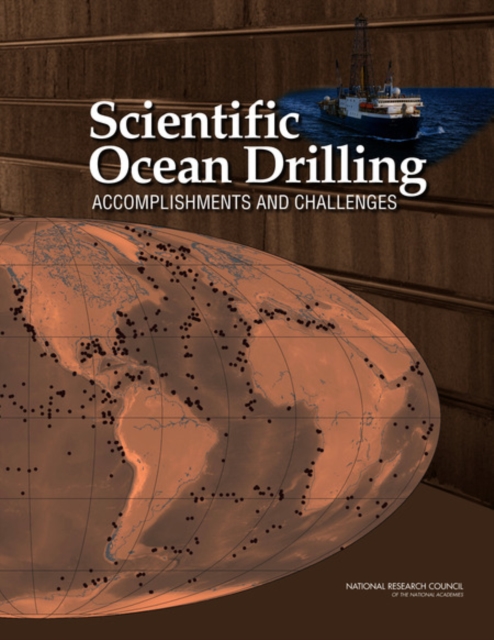
Scientific Ocean Drilling
Through direct exploration of the subseafloor, U.S.-supported scientific ocean drilling programs have significantly contributed to a broad range of scientific accomplishments in Earth science disciplines, shaping understanding of Earth systems and enabling new fields of inquiry. Scientific Ocean Drilling: Accomplishments and Challenges reviews the scientific
accomplishments of U.S.-supported scientific ocean
drilling over the past four decades. The book evaluates how the programs (Deep Sea Drilling Project [DSDP], 1968-1983, Ocean Drilling Program [ODP], 1984-2003, and Integrated Ocean Drilling Program [IODP], 2003-2013) have shaped understanding of Earth systems and Earth history and assessed the role of scientific ocean drilling in enabling new fields of inquiry. This book also assesses the potential for transformative discoveries for the next proposed phase of scientific ocean drilling, which is scheduled to run from 2013 to 2023.
The programs' technological innovations have played a strong role in these accomplishments. The science plan for the proposed 2013-2023 program presents a strong case for the continuation of scientific ocean drilling. Each of the plan's four themes identifies compelling challenges with potential for transformative science that could only be addressed through scientific ocean drilling, although some challenges appear to have greater potential than others. Prioritizing science plan challenges and integrating multiple objectives into single expeditions would help use resources more effectively, while encouraging technological innovations would continue to increase the potential for groundbreaking science.
eBook


Critical Infrastructure for Ocean Research and Societal Needs in 2030
The United States has jurisdiction over 3.4 million square miles of ocean in its exclusive economic zone, a size exceeding the combined land area of the 50 states. This expansive marine area represents a prime national domain for activities such as maritime transportation, national security, energy and mineral extraction, fisheries and aquaculture, and tourism and recreation. However, it also carries with it the threat of damaging and outbreaks of waterborne pathogens. The 2010 Gulf of Mexico Deepwater Horizon oil spill and the 2011 Japanese earthquake and tsunami are vivid reminders that ocean activities and processes have direct human implications both nationally and worldwide, understanding of the ocean system is still incomplete, and ocean research infrastructure is needed to support both fundamental research and societal priorities.
Given current struggles to maintain, operate, and upgrade major infrastructure elements while maintaining a robust research portfolio, a strategic plan is needed for future investments to ensure that new facilities provide the greatest value, least redundancy, and highest efficiency in terms of operation and flexibility to incorporate new technological advances. Critical Infrastructure for Ocean Research and Societal Needs in 2030 identifies major research questions anticipated to be at the forefront of ocean science in 2030 based on national and international assessments, input from the worldwide scientific community, and ongoing research planning activities. This report defines categories of infrastructure that should be included in planning for the nation's ocean research infrastructure of 2030 and that will be required to answer the major research questions of the future.
Critical Infrastructure for Ocean Research and Societal Needs in 2030 provides advice on the criteria and processes that could be used to set priorities for the development of new ocean infrastructure or replacement of existing facilities. In addition, this report recommends ways in which the federal agencies can maximize the value of investments in ocean infrastructure.
eBook