
Catalogue Search | MBRL


Are you sure you want to remove the book from the shelf?

{{itemTitle}}
3,863
result(s) for
"Official secrets"
Sort by:


Secret Leviathan
The Soviet Union was one of the most secretive states that ever
existed. Defended by a complex apparatus of rules and checks
administered by the secret police, the Soviet state had seemingly
unprecedented capabilities based on its near monopoly of productive
capital, monolithic authority, and secretive decision making. But
behind the scenes, Soviet secrecy was double-edged: it raised
transaction costs, incentivized indecision, compromised the
effectiveness of government officials, eroded citizens' trust in
institutions and in each other, and led to a secretive society and
an uninformed elite. The result is what this book calls the
secrecy/capacity tradeoff: a bargain in which the Soviet state
accepted the reduction of state capacity as the cost of ensuring
its own survival.
This book is the first comprehensive, analytical, multi-faceted
history of Soviet secrecy in the English language. Harrison
combines quantitative and qualitative evidence to evaluate the
impact of secrecy on Soviet state capacity from the 1917 Bolshevik
Revolution to the collapse of the Soviet Union in 1991. Based on
multiple years of research in once-secret Soviet-era archives, this
book addresses two gaps in history and social science: one the core
role of secrecy in building and stabilizing the communist states of
the twentieth century; the other the corrosive effects of secrecy
on the capabilities of authoritarian states.
eBook

Blacked out : government secrecy in the information age
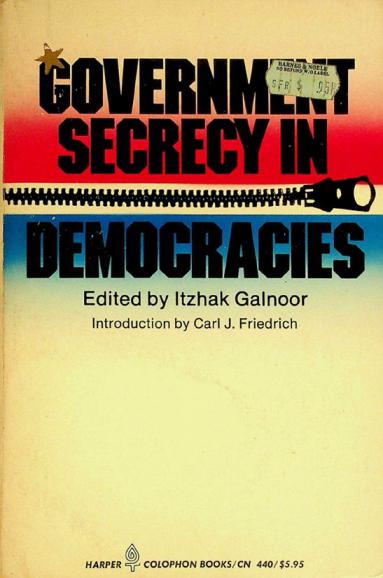
Nearly forty years ago the US Congress passed the landmark Freedom of Information Act (FOIA) giving the public the right to government documents. This 'right to know' has been used over the past decades to challenge overreaching Presidents and secretive government agencies. The example of transparency in government has served as an example to nations around the world spawning similar statutes in fifty-nine countries. This 2006 book examines the evolution of the move toward openness in government. It looks at how technology has aided the disclosure and dissemination of information. The author tackles the question of whether the drive for transparency has stemmed the desire for government secrecy and discusses how many governments ignore or frustrate the legal requirements for the release of key documents. Blacked Out is an important contribution during a time where profound changes in the structure of government are changing access to government documents.
eBook

Jericho's fall : a novel
Summoned to the deathbed of former CIA head Jericho Ainsley, Beck DeForde, an agent whose career was marked by a scandal that ended Ainsley's career, learns of an explosive secret involving foreign governments, powerful corporations, and a meltdown of the world's financial system.
Book

Secret Power
*Winner of the European Award for Investigative And Judicial Journalism 2021*
*Winner of the Premio Alessandro Leogrande Award for Investigative Journalism 2022*
*Winner of the Premio Angelo Vassallo Award 2022*
'I want to live in a society where secret power is accountable to the law and to public opinion for its atrocities, where it is the war criminals who go to jail, not those who have the conscience and courage to expose them.'
It is 2008, and Stefania Maurizi, an investigative journalist with a growing interest in cryptography, starts looking into the little-known organization WikiLeaks. Through hushed meetings, encrypted files, and explosive documents, what she discovers sets her on a life-long journey that takes her deep into the realm of secret power.
Working closely with WikiLeaks' founder Julian Assange and his organization for her newspaper, Maurizi has spent over a decade investigating state criminality protected by thick layers of secrecy, while also embarking on a solitary trench warfare to unearth the facts underpinning the cruel persecution of Assange and WikiLeaks.
With complex and disturbing insights, Maurizi's tireless journalism exposes atrocities, the shameful treatment of Chelsea Manning and Edward Snowden, on up to the present persecution of WikiLeaks: a terrifying web of impunity and cover-ups.
At the heart of the book is the brutality of secret power and the unbearable price paid by Julian Assange, WikiLeaks, and truthtellers.
eBook


Splendour
In the opulent drawing room of the Presidential Palace, a Western photojournalist awaits the return of the dictator. She is here to take his portrait. The dictator's wife, her best friend and an interpreter wait with her. Prada shoes, vodka glasses and light fingers tap out the time. He is late, very late… All four women harbour secrets and suspicions. All four are in danger. This is the day that revolution comes to the streets. Abi Morgan's devastating play allows us a glimpse into the minds of four women as their world turns.
eBook

The king's deception
When escalating political tensions between the United States and England put his son, Gary, in the hands of a man with a shadowy and intensely personal agenda, Cotton Malone finds himself confronting a baffling historical mystery that questions the legitimacy of Elizabeth I.
Book

Beyond Snowden
Safeguarding Our Privacy and Our Values in an Age of Mass Surveillance
America's mass surveillance programs, once secret, can no longer be ignored. While Edward Snowden began the process in 2013 with his leaks of top secret documents, the Obama administration's own reforms have also helped bring the National Security Agency and its programs of signals intelligence collection out of the shadows. The real question is: What should we do about mass surveillance?
Timothy Edgar, a long-time civil liberties activist who worked inside the intelligence community for six years during the Bush and Obama administrations, believes that the NSA's programs are profound threat to the privacy of everyone in the world. At the same time, he argues that mass surveillance programs can be made consistent with democratic values, if we make the hard choices needed to bring transparency, accountability, privacy, and human rights protections into complex programs of intelligence collection. Although the NSA and other agencies already comply with rules intended to prevent them from spying on Americans, Edgar argues that the rules-most of which date from the 1970s-are inadequate for this century. Reforms adopted during the Obama administration are a good first step but, in his view, do not go nearly far enough.
Edgar argues that our communications today-and the national security threats we face-are both global and digital. In the twenty first century, the only way to protect our privacy as Americans is to do a better job of protecting everyone's privacy.Beyond Surveillance: Privacy, Mass Surveillance, and the Struggle to Reform the NSAexplains both why and how we can do this, without sacrificing the vital intelligence capabilities we need to keep ourselves and our allies safe. If we do, we set a positive example for other nations that must confront challenges like terrorism while preserving human rights. The United States already leads the world in mass surveillance. It can lead the world in mass surveillance reform.
eBook