
Catalogue Search | MBRL


Are you sure you want to remove the book from the shelf?

{{itemTitle}}
84
result(s) for
"Ohio Histoire."
Sort by:

There's always this year : on basketball and ascension
\"While Hanif Abdurraqib is an acclaimed author, a gifted poet, and one of our culture's most insightful music critics, he is most of all, at heart, an Ohioan. Growing up in Columbus in the '90s, Abdurraqib witnessed a golden era of basketball, one in which legends like LeBron were forged, and countless others weren't. His lifelong love of the game leads Abdurraqib into a lyrical, historical, and emotionally rich exploration of what it means to make it, who we think deserves success, the tensions between excellence and expectation, and the very notion of role-models, all of which he expertly weaves together with memoir: \"Here is where I would like to tell you about the form on my father's jumpshot,\" Abdurraqib writes. \"The truth, though, is that I saw my father shoot a basketball only one time.\"\"-- Provided by publisher.
Book

Letters Written from the Banks of the Ohio
First published in French in 1792, Letters Written from the Banks of the Ohio tells the fascinating story of French aristocrat Claude-François de Lezay-Marnésia and the utopia he attempted to create in what is now Ohio.
Looking to build a perfect society based on what France might have become without the Revolution, Lezay-Marnésia bought more than twenty thousand acres of land along the banks of the Ohio River from the Scioto Company, which promised French aristocrats a fertile, conflict-free refuge. But hostilities between the U.S. Army and the Native American tribes who still lived on the land prevented the marquis from taking possession. Ruined and on the verge of madness, Lezay-Marnésia returned to France just as the Revolution was taking a more radical turn. He barely escaped the guillotine before dying a few years later in poverty and desperation.
This edition of the Letters, introduced and edited by Benjamin Hoffmann and superbly translated by Alan J. Singerman, presents the work for the first time since the beginning of the nineteenth century—and the first time ever in English. The volume features a rich collection of supplementary documents, including texts by Lezay-Marnésia's son, Albert de Lezay-Marnésia, and the American novelist Hugh Henry Brackenridge. This fresh perspective on the young United States as it was represented in French literature casts new light on a captivating and tumultuous period in the history of two nations.
eBook
We demand
This title is part of American Studies Now and available as an e-book first. Visit ucpress.edu/go/americanstudiesnow to learn more.
In the post-World War II period, students rebelled against the university establishment. In student-led movements, women, minorities, immigrants, and indigenous people demanded that universities adapt to better serve the increasingly heterogeneous public and student bodies. The success of these movements had a profound impact on the intellectual landscape of the twentieth century: out of these efforts were born ethnic studies, women's studies, and American studies.
In We Demand, Roderick A. Ferguson demonstrates that less than fifty years since this pivotal shift in the academy, the university is moving away from \"the people\" in all their diversity. Today the university is refortifying its commitment to the defense of the status quo off campus and the regulation of students, faculty, and staff on campus. The progressive forms of knowledge that the student-led movements demanded and helped to produce are being attacked on every front. Not only is this a reactionary move against the social advances since the '60s and '70s-it is part of the larger threat of anti-intellectualism in the United States.
eBook

Free Black Communities and the Underground Railroad
This enlightening study employs the tools of archaeology to uncover a new historical perspective on the Underground Railroad. Unlike previous histories of the Underground Railroad, which have focused on frightened fugitive slaves and their benevolent abolitionist accomplices, Cheryl Janifer LaRoche focuses instead on free African American communities, the crucial help they provided to individuals fleeing slavery, and the terrain where those flights to freedom occurred. This study foregrounds several small, rural hamlets on the treacherous southern edge of the free North in Illinois, Indiana, and Ohio. LaRoche demonstrates how landscape features such as waterways, iron forges, and caves played a key role in the conduct and effectiveness of the Underground Railroad. Rich in oral histories, maps, memoirs, and archaeological investigations, this examination of the \"geography of resistance\" tells the new, powerful, and inspiring story of African Americans ensuring their own liberation in the midst of oppression.
eBook

The Loyal West
A free region deeply influenced by southern mores, the Lower Middle West represented a true cultural and political median in Civil War-era America. Here grew a Unionism steeped in the mythology of the Loyal West--a myth rooted in regional and racial animosities and the belief that westerners had won the war. Matthew E. Stanley's intimate study explores the Civil War, Reconstruction, and sectional reunion in this bellwether region. Using the lives of area soldiers and officers as a lens, Stanley reveals a place and a strain of collective memory that was anti-rebel, anti-eastern, and anti-black in its attitudes--one that came to be at the forefront of the northern retreat from Reconstruction and toward white reunion. The Lower Middle West's embrace of black exclusion laws, origination of the Copperhead movement, backlash against liberalizing war measures, and rejection of Reconstruction were all pivotal to broader American politics. And the region's legacies of white supremacy--from racialized labor violence to sundown towns to lynching--found malignant expression nationwide, intersecting with how Loyal Westerners remembered the war.
eBook

The Creation of a Crusader
The story of one Ohio senator's impact on the early abolition movement More than 175 years after his death, Senator Thomas Morris has remained one of the few early national champions of political and constitutional antislavery without a biography devoted to him.In this first expansive study of Morris's life and contributions, David C.
eBook
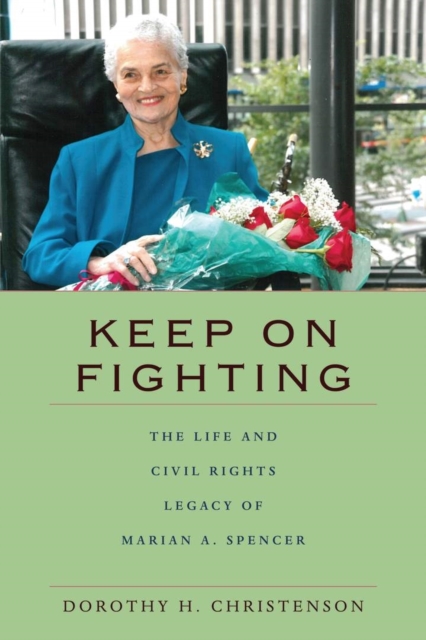
Keep on Fighting
Marian Alexander Spencer was born in 1920 in the Ohio River town of Gallipolis, Ohio, one year after the Red Summer of 1919 that saw an upsurge in race riots and lynchings. Following the example of her grandfather, an ex-slave and community leader, Marian joined the NAACP at thirteen and grew up to achieve not only a number of civic leadership firsts in her adopted home city of Cincinnati, but a legacy of lasting civil rights victories.Of these, the best known is the desegregation of Cincinnatis Coney Island amusement park. She also fought to desegregate Cincinnati schools and to stop the introduction of observers in black voting precincts in Ohio. Her campaign to raise awareness of industrial toxic-waste practices in minority neighborhoods was later adapted into national Superfund legislation.In 2012, Marians friend and colleague Dot Christenson sat down with her to record her memories. The resulting biography not only gives us the life story of remarkable leader but encapsulates many of the twentieth centurys greatest struggles and advances. Spencers story will prove inspirational and instructive to citizens and students alike.
eBook

The Untried Life
Told in unflinching detail, this is the story of the Twenty-Ninth Ohio Volunteer Infantry, also known as the Giddings Regiment or the Abolition Regiment, after its founder, radical abolitionist Congressman J. R. Giddings. The men who enlisted in the Twenty-Ninth OVI were, according to its lore, handpicked to ensure each was as pure in his antislavery beliefs as its founder. Whether these soldiers would fight harder than other soldiers, and whether the people of their hometowns would remain devoted to the ideals of the regiment, were questions that could only be tested by the experiment of war.The Untried Lifeis the story of these men from their very first regimental formation in a county fairground to the devastation of Gettysburg and the march to Atlanta and back again, enduring disease and Confederate prisons. It brings to vivid life the comradeship and loneliness that pervaded their days on the march. Dozens of unforgettable characters emerge, animated by their own letters and diaries: Corporal Nathan Parmenter, whose modest upbringing belies the eloquence of his writings; Colonel Lewis Buckley, one of the Twenty-Ninth's most charismatic officers; and Chaplain Lyman Ames, whose care of the sick and wounded challenged his spiritual beliefs.The Untried Lifeshows how the common soldier lived-his entertainments, methods of cooking, medical treatment, and struggle to maintain family connections-and separates the facts from the mythology created in the decades after the war.
eBook

Front Line of Freedom
The Underground Railroad, an often misunderstood antebellum institution, has been viewed as a simple combination of mainly white \"conductors\" and black \"passengers.\" Keith P. Griffler takes a new, battlefield-level view of the war against American slavery as he reevaluates one of its front lines: the Ohio River, the longest commercial dividing line between slavery and freedom. In shifting the focus from the much discussed white-led \"stations\" to the primarily black-led frontline struggle along the Ohio, Griffler reveals for the first time the crucial importance of the freedom movement in the river's port cities and towns. Front Line of Freedom fully examines America's first successful interracial freedom movement, which proved to be as much a struggle to transform the states north of the Ohio as those to its south. In a climate of racial proscription, mob violence, and white hostility, the efforts of Ohio Valley African Americans to establish and maintain communities became inextricably linked to the steady stream of fugitives crossing the region. As Griffler traces the efforts of African Americans to free themselves, Griffler provides a window into the process by which this clandestine network took shape and grew into a powerful force in antebellum America.
eBook

Holocene hunter-gatherers of the lower Ohio River Valley
By the Early Holocene (10,000 to 8,000 B.P.), small wandering bands of Archaic hunter-gatherers began to annually follow the same hunting trails, basing their temporary camps on seasonal conditions and the presence of food. The Pleistocene glaciers had receded by this time, making food more plentiful in some areas and living conditions less hazardous. Although these Archaic peoples have long been known from their primary activities as hunters and gatherers of wild food resources, recent evidence has been found that indicates they also began rudimentary cultivation sometime during the Middle Holocene. Richard Jefferies—an Archaic specialist—comprehensively addresses the approximately 7,000 years of the prehistory of eastern North America, termed the Archaic Period by archaeologists. Jefferies centers his research on a 380-mile section of the Lower Ohio River Valley, an area rife with both temporary and long-term Archaic sites. He covers the duration of the Holocene and provides a compendium of knowledge of the era, including innovative research strategies and results. Presenting these data from a cultural-ecological perspective emphasizing the relationships between hunter-gatherers and the environments in which they lived, Jefferies integrates current research strategies with emerging theories that are beginning to look at culture history in creative ways
eBook