
Catalogue Search | MBRL


Are you sure you want to remove the book from the shelf?

{{itemTitle}}
40,709
result(s) for
"Ohio."
Sort by:
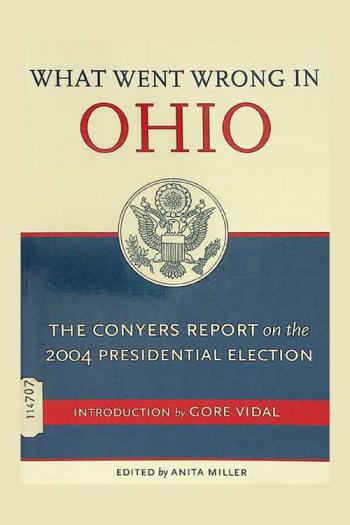
What went wrong in Ohio : the Conyers report on the 2004 presidential election
Report of an investigation into irregularities reported in the 2004 Presidential election in Ohio, compiled by the Democratic staff of the House Judiciary Committee.

Amish paradox
Winner, 2011 Dale Brown Book Award for Outstanding Scholarship in Anabaptist and Pietist Studies. Young Center for Anabaptist and Pietist Studies at Elizabethtown College
Holmes County, Ohio, is home to the largest and most diverse Amish community in the world. Yet, surprisingly, it remains relatively unknown compared to its famous cousin in Lancaster, Pennsylvania. Charles E. Hurst and David L. McConnell conducted seven years of fieldwork, including interviews with over 200 residents, to understand the dynamism that drives social change and schism within the settlement, where Amish enterprises and nonfarming employment have prospered. The authors contend that the Holmes County Amish are experiencing an unprecedented and complex process of change as their increasing entanglement with the non-Amish market causes them to rethink their religious convictions, family practices, educational choices, occupational shifts, and health care options.
The authors challenge the popular image of the Amish as a homogeneous, static, insulated society, showing how the Amish balance tensions between individual needs and community values. They find that self-made millionaires work alongside struggling dairy farmers; successful female entrepreneurs live next door to stay-at-home mothers; and teenagers both embrace and reject the coming-of-age ritual, rumspringa.
An Amish Paradox captures the complexity and creativity of the Holmes County Amish, dispelling the image of the Amish as a vestige of a bygone era and showing how they reinterpret tradition as modernity encroaches on their distinct way of life.
eBook

Fire in the big house : America's deadliest prison disaster
\"On April 21, 1930-Easter Monday-some rags caught fire under the Ohio Penitentiary's dry and aging wooden roof, shortly after inmates had returned to their locked cells after supper. In less than an hour, 320 men who came from all corners of Prohibition-era America and from as far away as Russia had succumbed to fire and smoke in what remains the deadliest prison disaster in United States history. Within 24 hours, moviegoers were watching Pathé's newsreel of the fire, and in less than a week, the first iteration of the weepy ballad 'Ohio Prison Fire' was released. The deaths brought urgent national and international focus to the horrifying conditions of America's prisons (at the time of the fire, the Ohio Penitentiary was at almost three times its capacity). Yet, amid darkening world politics and the first years of the Great Depression, the fire receded from public concern. In Fire in the Big House, Mitchel P. Roth does justice to the lives of convicts and guards and puts the conflagration in the context of the rise of the Big House prison model, local and state political machinations, and American penal history and reform efforts. The result is the first comprehensive account of a tragedy whose circumstances-violent unrest, overcrowding, poorly trained and underpaid guards, unsanitary conditions, inadequate food-will be familiar to prison watchdogs today\"-- Provided by publisher.
Book
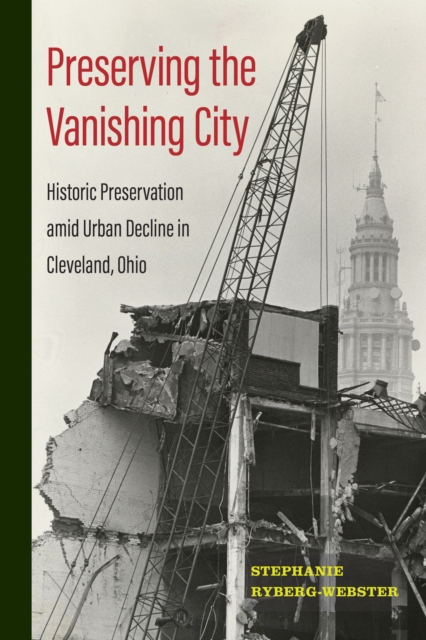
Preserving the vanishing city : historic preservation amid urban decline in Cleveland, Ohio
Preserving the Vanishing City considers the unique challenges, conditions, and opportunities facing Cleveland's historic preservation community during the 1970s and 1980s.While pro-preservationists argued for the economic and revitalization benefits stemming from saving and repurposing older buildings, population loss and economic contraction.
eBook

There's always this year : on basketball and ascension
\"While Hanif Abdurraqib is an acclaimed author, a gifted poet, and one of our culture's most insightful music critics, he is most of all, at heart, an Ohioan. Growing up in Columbus in the '90s, Abdurraqib witnessed a golden era of basketball, one in which legends like LeBron were forged, and countless others weren't. His lifelong love of the game leads Abdurraqib into a lyrical, historical, and emotionally rich exploration of what it means to make it, who we think deserves success, the tensions between excellence and expectation, and the very notion of role-models, all of which he expertly weaves together with memoir: \"Here is where I would like to tell you about the form on my father's jumpshot,\" Abdurraqib writes. \"The truth, though, is that I saw my father shoot a basketball only one time.\"\"-- Provided by publisher.
Book

Punishing schools
In a society increasingly dominated by zero-tolerance thinking, Punishing Schools argues that our educational system has become both the subject of legislative punishment and an instrument for the punishment of children. William Lyons and Julie Drew analyze the connections between state sanctions against our schools (the diversion of funding to charter schools, imposition of unfunded mandates, and enforcement of dubious forms of teacher accountability) and the schools' own infliction of punitive measures on their students—a vicious cycle that creates fear and encourages the development of passive and dependent citizens.
eBook


Sacred games, death, and renewal in the ancient Eastern Woodlands
The book presents an account of the Ohio Middle Woodland period embankment earthworks, ca 100 B.C. to A.D. 400, that is radically different from the prevailing theory. Byers critically addresses all the arguments and characterizations that make up the current treatment of the embankment earthworks and then presents an alternative interpretation. This unconventional view hinges on two basic social characterizations: the complementary heterarchical community model and the cult sodality heterarchy model. Byers posits that these two models interact to characterize the Ohio Middle Woodland period settlement pattern; the community was constituted by autonomous social formations: clans based on kinship and sodalities based on companionship. The individual communities of the region each have their clan components dispersed within a fairly well-defined zone while the sodality components of the same set of region-wide communities ally with each other and build and operate the embankment earthworks. This dichotomy is possible only because the clans and sodalities respect each other as relatively autonomous; the affairs of the clans, focusing on domestic and family matters, remain outside the concerns of the sodalities and the affairs of the sodalities, focusing on world renewal and sacred games, remain outside the concerns of the clans. Therefore, two models are required to understand the embankment earthworks and no individual earthwork can be identified with any particular community. This radical interpretation grounded in empirical archaeological data, as well as the in-depth overview of the current theory of the Ohio Middle Woodland period, make this book a critically important addition to the perspective of scholars of North American archaeology and scholars grappling with prehistoric social systems.
eBook


SunWatch
Focuses on the development of village social structure
within a broad geographic and temporal framework, recognizing
border areas as particularly dynamic contexts of social
change The last prehistoric cultures to inhabit the
Middle Ohio Valley (ca. A.D. 1000–1650) are referred to as
Fort Ancient societies, which exhibited a wide variety of
Mississippian period characteristics. What is less well-known and
little understood are the social processes by which Mississippian
characteristics spread to Fort Ancient communities. Through a
comprehensive study of SunWatch, one of the few thoroughly
excavated Fort Ancient settlements, the author focuses on the
development of village social structure within a broad geographic
and temporal framework, recognizing border areas as particularly
dynamic contexts of social change. As a fundamental study of
social patterning of Fort Ancient villages, this work reveals the
interrelationships of small social units in culture change and
social structure development and provides a full reconsideration
of the Mississippian dimensions of Fort Ancient societies and a
model for future investigations of larger patterning in the
lateprehistory of the region.
eBook