
Catalogue Search | MBRL


Are you sure you want to remove the book from the shelf?

{{itemTitle}}
524
result(s) for
"Ojibwa"
Sort by:


Treaty No. 9
For more than a century, the vast lands of Northern Ontario have been shared among the governments of Canada, Ontario, and the First Nations who signed Treaty No. 9 in 1905. For just as long, details about the signing of the constitutionally recognized agreement have been known only through the accounts of two of the commissioners appointed by the Government of Canada. Treaty No. 9 provides a truer perspective on the treaty by adding the neglected account of a third commissioner and tracing the treaty’s origins, negotiation, explanation, interpretation, signing, implementation, and recent commemoration.
eBook


Ojibwe Discourse Markers
Brendan Fairbanks examines the challenging subject of discourse markers in Ojibwe, one of the many indigenous languages in the Algonquian family. Mille Lacs elder Jim Clark once described the discourse markers as \"little bugs that are holding on for dear life.\" For example, discourse markers such asmiiandgoshaexist only on the periphery of sentences to provide either cohesion or nuance to utterances. Fairbanks focuses on the discourse markers that are the most ubiquitous and that exist most commonly within Ojibwe texts.Much of the research on Algonquian languages has concentrated primarily on the core morphological and syntactical characteristics of their sentence structure. Fairbanks restricts his study to markers that are far more elusive and difficult in terms of semantic ambiguity and their contribution to sentences and Ojibwe discourse.Ojibwe Discourse Markersis a remarkable study that interprets and describes the Ojibwe language in its broader theoretical concerns in the field of linguistics. With a scholarly and pedagogical introductory chapter and a glossary of technical terms, this book will be useful to instructors and students of Ojibwe as a second language in language revival and maintenance programs.
eBook


Bawaajimo
Bawaajimo:A Dialect of Dreams in Anishinaabe Language and Literaturecombines literary criticism, sociolinguistics, native studies, and poetics to introduce an Anishinaabe way of reading. Although nationally specific, the book speaks to a broad audience by demonstrating an indigenous literary methodology. Investigating the language itself, its place of origin, its sound and structure, and its current usage provides new critical connections between North American fiction, Native American literatures, and Anishinaabe narrative. The four Anishinaabe authors discussed in the book, Louise Erdrich, Jim Northrup, Basil Johnston, and Gerald Vizenor, share an ethnic heritage but are connected more clearly by a culture of tales, songs, and beliefs. Each of them has heard, studied, and written in Anishinaabemowin, making their heritage language a part of the backdrop and sometimes the medium, of their work. All of them reference the power and influence of the Great Lakes region and theAnishinaabeakiing, and they connect the landscape to the original language. As they reconstruct and deconstruct theaadizookaan, the traditional tales of Nanabozho and other mythic figures, they grapple with the legacy of cultural genocide and write toward a future that places ancient beliefs in the center of the cultural horizon.
eBook

The Ojibwe : the past and present of the Anishinaabe
\"Explains Ojibwe history and highlights Ojibwe life in modern society\"-- Provided by publisher.
Book
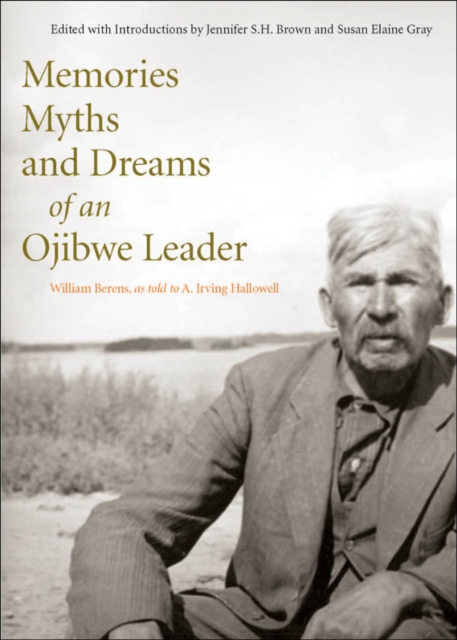
Memories, Myths, and Dreams of an Ojibwe Leader
Because the elderly chief wanted his visitor to understand the Ojibwe world, and because Hallowell was deeply interested in his subject matter and was such a good listener, Berens freely related his dreams and other stories about encounters with powerful beings. The fact that he also shared traditional myths in summer, when Ojibwe people thought it dangerous to discuss such things, shows the depth of his relationship with Hallowell. Berens' reminiscences and story and myth texts are unparalleled as sources for the life, experiences, and outlook of this important Ojibwe leader, and for the insights they provide into the history and culture of his people.
eBook


Making the Carry
An extraordinary illustrated biography of a Métis man and Anishinaabe woman navigating great changes in their homeland along the U.S.–Canada border in the early twentieth century John Linklater, of Anishinaabeg, Cree, and Scottish ancestry, and his wife, Tchi-Ki-Wis, of the Lac La Croix First Nation, lived in the canoe and border country of Ontario and Minnesota from the 1870s until the 1930s. During that time, the couple experienced radical upheavals in the Quetico–Superior region, including the cutting of white and red pine forests, the creation of Indian reserves/reservations and conservation areas, and the rise of towns, tourism, and mining. With broad geographical sweep, historical significance, and biographical depth, Making the Carry tells their story, overlooked for far too long. John Linklater, a renowned game warden and skilled woodsman, was also the bearer of traditional ecological knowledge and Indigenous heritage, both of which he was deeply committed to teaching others. He was sought by professors, newspaper reporters, museum personnel, and conservationists—among them Sigurd Olson, who considered Linklater a mentor. Tchi-Ki-Wis, an extraordinary craftswoman, made a sweeping array of necessary yet beautiful objects, from sled dog harnesses to moose calls to birch bark canoes. She was an expert weaver of large Anishinaabeg cedar bark mats with complicated geometric designs, a virtually lost art. Making the Carry traces the routes by which the couple came to live on Basswood Lake on the international border. John’s Métis ancestors with deep Hudson’s Bay Company roots originally came from Orkney Islands, Scotland, by way of Hudson Bay and Red River, or what is now Winnipeg. His family lived in Manitoba, northwest Ontario, northern Minnesota, and, in the case ofJohn and Tchi-Ki-Wis, on Isle Royale. A journey through little-known Canadian history, the book provides an intimate portrait of Métis people. Complete with rarely seen photographs of activities from dog mushing to guiding to lumbering, as well as of many objects made by Tchi-Ki-Wis, such as canoes, moccasins, and cedar mats, Making the Carry is a window on a traditional way of life and a restoration of two fascinating Indigenous people to their rightful place in our collective past.
eBook