
Catalogue Search | MBRL


Are you sure you want to remove the book from the shelf?

{{itemTitle}}
84
result(s) for
"Old age -- Europe -- History"
Sort by:
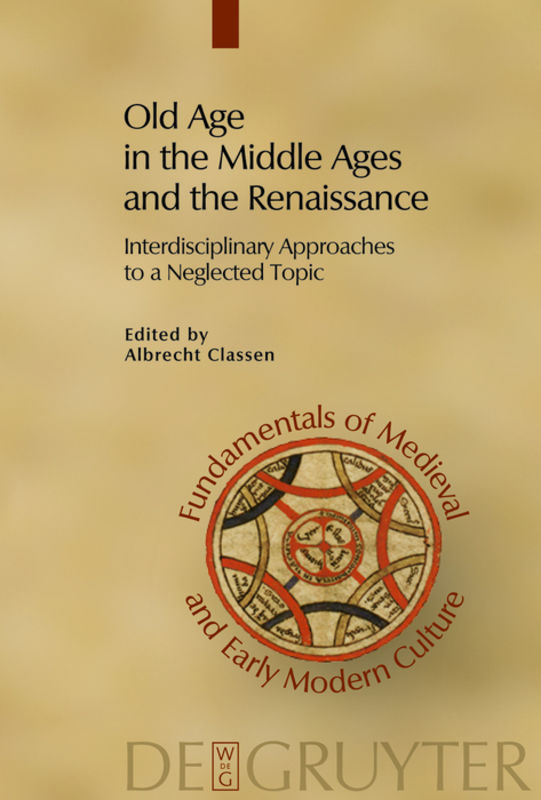
Old Age in the Middle Ages and the Renaissance
After an extensive introduction that takes stock of the relevant research literature on Old Age in the Middle Ages and the early modern age, the contributors discuss the phenomenon of old age in many different fields of late antique, medieval, and early modern literature, history, and art history. Both Beowulf and the Hildebrandslied, both Wolfram von Eschenbach's Parzival and Titurel, both the figure of Merlin and the trans-European tradition of Perceval/Peredur/Parzival, then the figure of the vetula in a variety of medieval French, English, and Spanish texts, and of the Old Man in The Stricker's Daniel, both the treatment of old age in Langland's Piers the Plowman and in Jean Gerson's sermons are dealt with. Other aspects involve late-antique epistolary literature, early modern French farce in light of Disability Studies, the social role of old, impotent men in sixteenth- and seventeenth-century Netherlandish paintings, and the scientific discourse of old age and health since the 1500s. The discourse of Old Age proves to have been of central importance throughout the ages, so the critical examination of the issues involved sheds intriguing light on the cultural history from late antiquity to the seventeenth century.
eBook

Iron Age Myth and Materiality
Iron Age Myth and Materiality: an Archaeology of Scandinavia AD 400-1000 considers the relationship between myth and materiality in Scandinavia from the beginning of the post-Roman era and the European Migrations up until the coming of Christianity. It pursues an interdisciplinary interpretation of text and material culture and examines how the documentation of an oral past relates to its material embodiment.
While the material evidence is from the Iron Age, most Old Norse texts were written down in the thirteenth century or even later. With a time lag of 300 to 900 years from the archaeological evidence, the textual material has until recently been ruled out as a usable source for any study of the pagan past. However, Hedeager argues that this is true regarding any study of a society's short-term history, but it should not be the crucial requirement for defining the sources relevant for studying long-term structures of the longue durée, or their potential contributions to a theoretical understanding of cultural changes and transformation. In Iron Age Scandinavia we are dealing with persistent and slow-changing structures of worldviews and ideologies over a wavelength of nearly a millennium. Furthermore, iconography can often date the arrival of new mythical themes anchoring written narratives in a much older archaeological context.
Old Norse myths are explored with particular attention to one of the central mythical narratives of the Old Norse canon, the mythic cycle of Odin, king of the Norse pantheon. In addition, contemporaneous historical sources from late Antiquity and the early European Middle Age - the narratives of Jordanes, Gregory of Tours, and Paul the Deacon in particular - will be explored. No other study provides such a broad ranging and authoritative study of the relationship of myth to the archaeology of Scandinavia.
eBook

Uprooted
With the stroke of a pen at the Potsdam Conference following the Allied victory in 1945, Breslau, the largest German city east of Berlin, became the Polish city of Wroclaw. Its more than six hundred thousand inhabitants--almost all of them ethnic Germans--were expelled and replaced by Polish settlers from all parts of prewar Poland.Uprootedexamines the long-term psychological and cultural consequences of forced migration in twentieth-century Europe through the experiences of Wroclaw's Polish inhabitants.
In this pioneering work, Gregor Thum tells the story of how the city's new Polish settlers found themselves in a place that was not only unfamiliar to them but outright repellent given Wroclaw's Prussian-German appearance and the enormous scope of wartime destruction. The immediate consequences were an unstable society, an extremely high crime rate, rapid dilapidation of the building stock, and economic stagnation. This changed only after the city's authorities and a new intellectual elite provided Wroclaw with a Polish founding myth and reshaped the city's appearance to fit the postwar legend that it was an age-old Polish city. Thum also shows how the end of the Cold War and Poland's democratization triggered a public debate about Wroclaw's \"amputated memory.\" Rediscovering the German past, Wroclaw's Poles reinvented their city for the second time since World War II.
Uprootedtraces the complex historical process by which Wroclaw's new inhabitants revitalized their city and made it their own.
eBook

Early-Life Assets in Oldest-Old Age: Evidence From Primary Care Reform in Early Twentieth Century Sweden
Do early-life effects of investments in public health persist to the oldest-old ages? This article answers this question by using the primary care reform in rural Sweden that between 1890 and 1917 led to the establishment of local health districts, together with openings of hospitals and recruitments of medical personnel, as a natural experiment in early-life environmental conditions. The initiatives undertaken within these districts targeted control of infectious diseases, including various isolation and disinfection measures. This study applies a difference-in-differences method combined with propensity score matching to register-based individual-level data for Sweden from 1968 to 2012 and to multisource, purposely collected data on the reform implementation. Providing pioneering evidence for such a distal relationship (ages 78–95), this study finds that treatment through primary care in the year of birth leads to a significant reduction in all-cause mortality (4 % to 6%) and mortality from cardiovascular diseases (5 % to 6 %) and to an increase in average incomes (2 % to 3 %). The effects are universal and somewhat stronger among individuals from poor socioeconomic backgrounds and at higher baseline levels of disease burden.
Journal Article

The Introduction of Bismarck's Social Security System and its Effects on Marriage and Fertility in Prussia
Economists have long argued that introducing social insurance will reduce fertility. The hypothesis relies on standard models: if children are desirable in part because they provide security in case of disability or old age, then State programs that provide insurance against these events should induce couples to substitute away from children in the allocation of wealth. We test this claim using the introduction of social insurance in Germany in the period 1881–1910. Bismarck's social insurance scheme had three pillars: health insurance, workplace accident insurance, and an old‐age pension. Earlier studies typically focus on the pension alone; we consider all three pillars. We find that Bismarck's social insurance system affected fertility overall only via its effects on the incentive to marry. The old‐age insurance by itself tended to reduce marriages, but the health and accident insurance components had the opposite effect. For people exposed to all three pillars of social insurance, the two effects cancelled each other and the aggregate effect on fertility was muted. fertility transition; economics; social insurance
Journal Article

Man and Bird in the Palaeolithic of Western Europe
Man and Bird in the Palaeolithic of Western Europe
considers the nature of the interaction between birds and
hunter-gatherers. It examines aspects of avian behaviour and the
qualities that could be (and were) targeted at different periods by
hunter-gatherers, who recognised the utility of the diversity of
avian groups in various applications of daily life and thought. It
is clear from the records of excavated sites in western Europe that
during the evolution of both the Neanderthal period and the
subsequent occupations of Homo sapiens, avian demographics
fluctuated with the climate along with other aspects of both flora
and fauna. Each was required to adapt to these changes. The present
study considers these changes through the interactions of man and
bird as evidenced in the remains attached to Middle and Upper
Palaeolithic occupation sites in western Europe and touches on a
variety of prey/predator relationships across other groups of plant
and animal species. The book describes a range of procurement
strategies that are known from the literature and artistic record
of later cultures to have been used in the trapping, enticement and
hunting of birds for consumption and the manufacture of weapons,
domestic items, clothing, ceremony and cultural activities. It also
explores how bird images and depictions engraved or painted on the
walls of caves or on the objects of daily use during the Upper
Palaeolithic may be perceived as communications of a more profound
significance for the temporal, seasonal or social life of the
members of the group than the simple concept of animal. Certain
bird species have at different times held a special significance in
the everyday consciousness of particular peoples and a group of
Late Glacial, Magdalenian settlements in Aquitaine, France, appear
to be an example of such specialised culling. A case study of the
treatment of snowy owl at Arancou in the Atlantic Pyrenees seems to
illustrate such a specialisation. Discussion of the problems of
reconciling dating and research methods, of the last two hundred
years of Palaeolithic research, and of possible directions for
future research offer an open conclusion to the work.
eBook
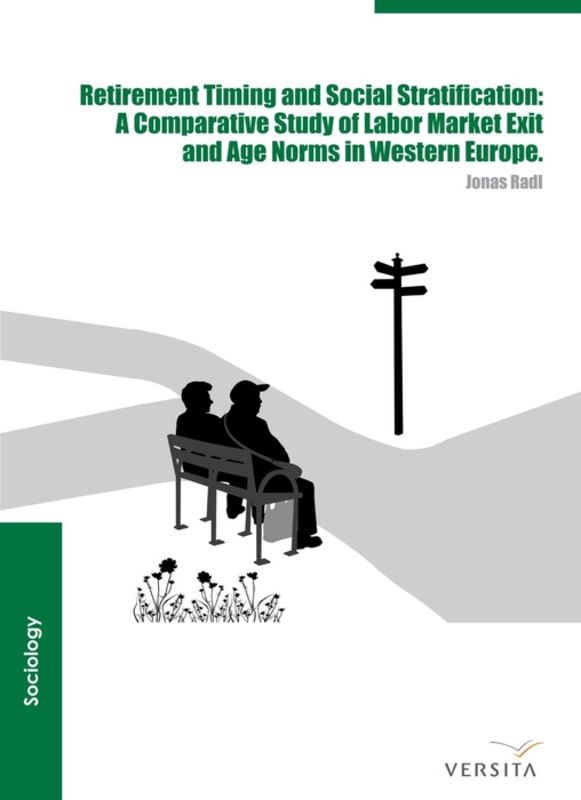
Retirement Timing and Social Stratification
The monograph disseminates the very topical issue of retirement and its timing as the key to one of the greatest challenges facing ageing societies. Postponing retirement is now almost universally regarded as indispensable in order to relieve European welfare states from the demography-related financial pressures. This seminal study, derived from a statistical analysis of a large-scale survey data, provides a thorough understanding of the micro- and macro-level determinants of retirement timing in contemporary Western Europe. The book is the first monograph to combine the analysis of the retirement attitudes with the analysis of the retirement behaviour within one research. It tackles the question as to whether early retirement can be explained by “early exit culture”, triangulating life course theory with a social stratification approach. The author used a novel and innovative approach to obtain the results. The methodology includes: tobit models of proscriptive age norms; simulations of the impact of class structure on a country’s average retirement age; competing risks models of different work-exit modalities; duration selection models of retirement timing.
eBook

In Their Own Write
Few subjects in European welfare history attract as much attention as the nineteenth-century English and Welsh New Poor Law. Its founding statute was considered the single most important piece of social legislation ever enacted, and at the same time, the coming of its institutions – from penny-pinching Boards of Guardians to the dreaded workhouse – has generally been viewed as a catastrophe for ordinary working people.
Until now it has been impossible to know how the poor themselves felt about the New Poor Law and its measures, how they negotiated its terms, and how their interactions with the local and national state shifted and changed across the nineteenth century. In Their Own Write exposes this hidden history. Based on an unparalleled collection of first-hand testimony – pauper letters and witness statements interwoven with letters to newspapers and correspondence from poor law officials and advocates – the book reveals lives marked by hardship, deprivation, bureaucratic intransigence, parsimonious officialdom, and sometimes institutional cruelty, while also challenging the dominant view that the poor were powerless and lacked agency in these interactions. The testimonies collected in these pages clearly demonstrate that both the poor and their advocates were adept at navigating the new bureaucracy, holding local and national officials to account, and influencing the outcomes of relief negotiations for themselves and their communities.
Fascinating and compelling, the stories presented in In Their Own Write amount to nothing less than a new history of welfare from below.
eBook

Guilds and middle-class welfare, 1550-1800: provisions for burial, sickness, old age, and widowhood
Guilds provided for masters' and journeymen's burial, sickness, old age, and widowhood. Guild welfare was of importance to artisans, to the functioning of guilds, to the myriad of urban social relations, and to the political economy. However, it is an understated and neglected aspect of guild activities. This article looks at welfare provision by guilds, with the aim of addressing four questions. Firstly, for which risks did guild welfare arrangements exist in the Netherlands between 1550 and 1800, and what were the coverage, contributions, benefit levels, and conditions? Secondly, can guild welfare arrangements be regarded as insurance? Thirdly, to what extent and how did guilds overcome classic insurance problems such as adverse selection, moral hazards, and correlated risks? Finally, what was the position of guild provision in the Dutch political economy and vis-à-vis poor relief?
Journal Article
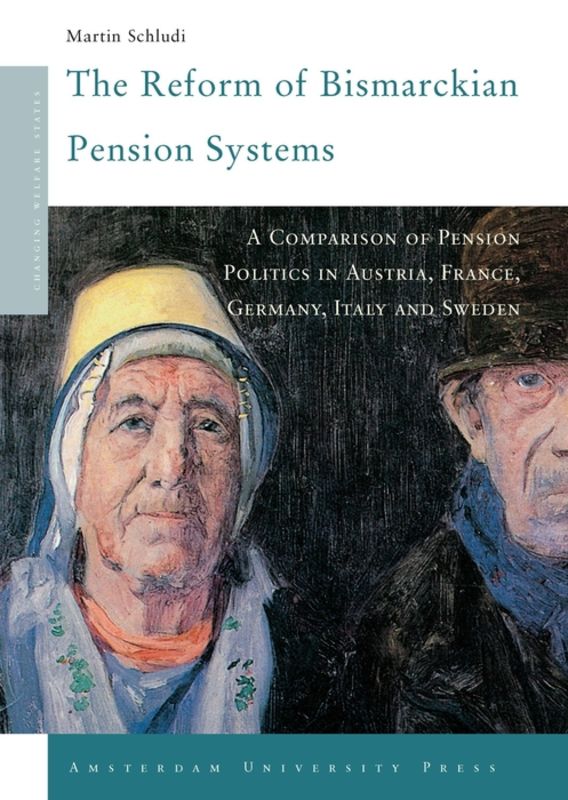
The reform of bismarckian pension systems
Pension reform has emerged as a major political issue in most advanced welfare states. Sluggish economic growth and rising unemployment put public pension systems under increasing financial pressure. In combination with a rapidly ageing population in the decades to come, these pressures render major adjustements in pension policy design inevitable, especially in countries with costly earnings-related benefit arrangements. However, timely and successful adjustement is anything but guaranteed.
eBook