
Catalogue Search | MBRL


Are you sure you want to remove the book from the shelf?

{{itemTitle}}
14
result(s) for
"OpenCV (Computer program language)"
Sort by:

Java image processing recipes : with OpenCV and JVM
Quickly obtain solutions to common Java image processing problems, learn best practices, and understand everything OpenCV has to offer for image processing. You will work with a JVM image wrapper to make it very easy to run image transformation through pipelines and obtain instant visual feedback. This book makes heavy use of the Gorilla environment where code can be executed directly in the browser, and image transformation results can also be visualized directly in the browser. Java Image Processing Recipes includes recipes on more advanced image manipulation techniques, such as image smoothing, cartooning, sketching, and mastering masks to apply changes only to parts of the image. You'll see how OpenCV features provide instant solutions to problems such as edges detection and shape finding. Finally, the book contains practical recipes dealing with webcams and various video streams, giving you ready-made code with which to do real-time video analysis. You will: Create your personal real-time image manipulation environment Manipulate image characteristics with OpenCV Work with the Origami image wrapper Apply manipulations to webcams and video streams.
Book
OpenCV 3 computer vision with Python cookbook
OpenCV 3 is a native cross-platform library for computer vision, machine learning, and image processing. OpenCV's convenient high-level APIs hide very powerful internals designed for computational efficiency that can take advantage of multicore and GPU processing. This book will help you tackle increasingly challenging computer vision problems by providing a number of recipes that you can use to improve your applications. In this book, you will learn how to process an image by manipulating pixels and analyze an image using histograms. Then, we'll show you how to apply image filters to enhance image content and exploit the image geometry in order to relay different views of a pictured scene. We’ll explore techniques to achieve camera calibration and perform a multiple-view analysis. Later, you’ll work on reconstructing a 3D scene from images, converting low-level pixel information to high-level concepts for applications such as object detection and recognition. You’ll also discover how to process video from files or cameras and how to detect and track moving objects. Finally, you'll get acquainted with recent approaches in deep learning and neural networks. By the end of the book, you’ll be able to apply your skills in OpenCV to create computer vision applications in various domains.
eBook

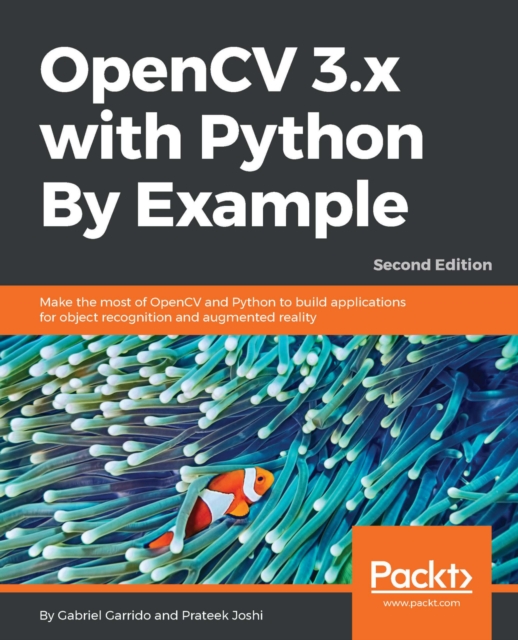
OpenCV 3.x with Python By Example
Learn the techniques for object recognition, 3D reconstruction, stereo imaging, and other computer vision applications using examples on different functions of OpenCV. Key Features Learn how to apply complex visual effects to images with OpenCV 3.x and Python Extract features from an image and use them to develop advanced applications Build algorithms to help you understand image content and perform visual searches Get to grips with advanced techniques in OpenCV such as machine learning, artificial neural network, 3D reconstruction, and augmented reality Book Description Computer vision is found everywhere in modern technology. OpenCV for Python enables us to run computer vision algorithms in real time. With the advent of powerful machines, we have more processing power to work with. Using this technology, we can seamlessly integrate our computer vision applications into the cloud. Focusing on OpenCV 3.x and Python 3.6, this book will walk you through all the building blocks needed to build amazing computer vision applications with ease. We start off by manipulating images using simple filtering and geometric transformations. We then discuss affine and projective transformations and see how we can use them to apply cool advanced manipulations to your photos like resizing them while keeping the content intact or smoothly removing undesired elements. We will then cover techniques of object tracking, body part recognition, and object recognition using advanced techniques of machine learning such as artificial neural network. 3D reconstruction and augmented reality techniques are also included. The book covers popular OpenCV libraries with the help of examples. This book is a practical tutorial that covers various examples at different levels, teaching you about the different functions of OpenCV and their actual implementation. By the end of this book, you will have acquired the skills to use OpenCV and Python to develop real-world computer vision applications. What you will learn Detect shapes and edges from images and videos How to apply filters on images and videos Use different techniques to manipulate and improve images Extract and manipulate particular parts of images and videos Track objects or colors from videos Recognize specific object or faces from images and videos How to create Augmented Reality applications Apply artificial neural networks and machine learning to improve object recognitionWho this book is for This book is intended for Python developers who are new to OpenCV and want to develop computer vision applications with OpenCV and Python. This book is also useful for generic software developers who want to deploy computer vision applications on the cloud. It would be helpful to have some familiarity with basic mathematical concepts such as vectors, matrices, and so on.
eBook

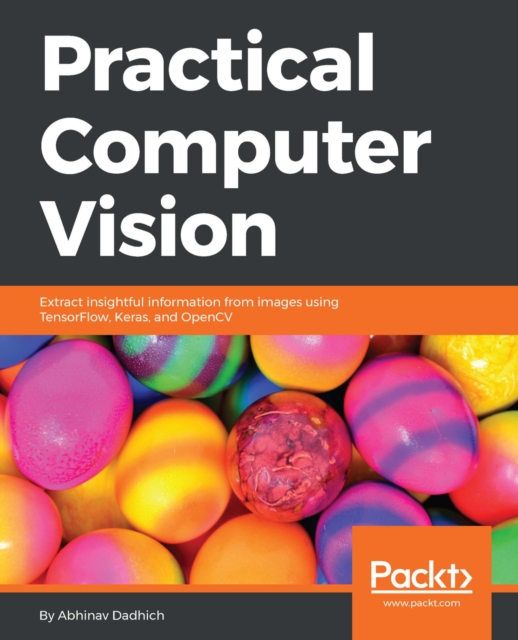
Practical computer vision
In this book, you will find several recently proposed methods in various domains of computer vision. You will start by setting up the proper Python environment to work on practical applications. This includes setting up libraries such as OpenCV, TensorFlow, and Keras using Anaconda. Using these libraries, you'll start to understand the concepts of image transformation and filtering. You will find a detailed explanation of feature detectors such as FAST and ORB; you'll use them to find similar-looking objects. With an introduction to convolutional neural nets, you will learn how to build a deep neural net using Keras and how to use it to classify the Fashion-MNIST dataset. With regard to object detection, you will learn the implementation of a simple face detector as well as the workings of complex deep-learning-based object detectors such as Faster R-CNN and SSD using TensorFlow. You'll get started with semantic segmentation using FCN models and track objects with Deep SORT. Not only this, you will also use Visual SLAM techniques such as ORB-SLAM on a standard dataset. By the end of this book, you will have a firm understanding of the different computer vision techniques and how to apply them in your applications.
eBook

OpenCV 3 Computer Vision with Python Cookbook
Delve into the world of computer vision with OpenCV 3 and Python through this recipe-driven guide. Learn to process images, analyze videos, and leverage deep learning models to solve challenging vision problems. This book equips you to apply a wide range of practical techniques for building effective computer vision applications. What this Book will help me do Effectively manipulate image data for preprocessing and analysis. Understand and implement camera models and geometry transformations. Utilize OpenCV tools for feature detection and matching. Build applications using advanced object detection and recognition models. Develop practical computer vision solutions using Python and OpenCV. Author(s) Aleksei Spizhevoi and None Rybnikov are experienced professionals in computer vision and machine learning. With deep knowledge in OpenCV and Python, they crafted this cookbook to inspire developers to create innovative computer vision applications. Their approach emphasizes practical solutions, providing clear, actionable insights. Who is it for? Ideal for Python developers with basic OpenCV knowledge aiming to expand their expertise. This book is perfect for professionals desiring to create sophisticated computer vision systems efficiently. It welcomes readers wanting practical, real-world solutions. The perfect companion for developers eager to excel in computer vision.
eBook


OpenCV computer vision examples with Python : a complete guide for dummies
Learn all the important functionalities of OpenCV Library. Implement Face Detection, Face Recognition and Optical Character Recognition. About: Computer Vision is an AI based, that is, Artificial Intelligence-based technology that allows computers to understand and label images. So, learning and mastering this fantastic world of Computer Vision-based technology is surely up-market. It will make you proficient in competing with the swiftly changing Image Processing technology arena. And this course is designed in such a way that even the very beginner to programming can master the Computer Vision-based technology. So, overall this is a complete package in which you can learn Computer Vision-based Technology, Deep Learning-based Face Detection, then Face Recognition and Optical Character Recognition. And by the end of this course, we will provide you with a course completion certificate which you can keep with you and mention it in your portfolio so that you will be having more weight when you are dealing with jobs based on Computer Vision Technology. So without wasting much time, let’s dive into this magical world. See you soon in the class room. Have a great time.
Streaming Video