
Catalogue Search | MBRL


Are you sure you want to remove the book from the shelf?

{{itemTitle}}
319
result(s) for
"Opera Production and direction."
Sort by:


Performing Operas for Mozart
The Italian opera company in Prague managed by Pasquale Bondini and Domenico Guardasoni played a central role in promoting Mozart's operas during the final years of his life. Using a wide range of primary sources which include the superb collections of eighteenth-century opera posters and concert programmes in Leipzig and the Indice de' teatrali spettacoli, an almanac of Italian singers and dancers, this study examines the annual schedules, recruitment networks, casting policies and repertoire selections of this important company. Woodfield shows how Italian-language performances of Figaro, Don Giovanni, Così fan tutte and La clemenza di Tito flourished along the well-known cultural axis linking Prague in Bohemia to Dresden and Leipzig in Saxony. The important part played by concert performances of operatic arias in the early reception of Mozart's works is also discussed and new information is presented about the reception of Josepha Duschek and Mozart in Leipzig.
eBook


Performing Opera: A Practical Guide for Singers and Directors
In Performing Opera: A Practical Guide for Singers and Directors Michael Ewans provides a detailed and practical workbook to performing many of the most commonly produced operas. Drawing on examples from twenty-four operas ranging in period from Gluck and Mozart to Britten and Tippett, it illustrates exactly how opera functions as dramatic form. Grounded in close analyses of performances of thirty scenes and five whole operas by first-rate singers and celebrated directors, Performing Opera provides readers with an appreciation of the unique challenges and skills required by performers and directors. It will assist them in their own performance and equip them with detailed knowledge of works most commonly featured in the repertoire. In the first part of the book the analysis progresses from scenes in which the singers are silent, via arias and monologues, duets and confrontations, up to ensembles. Wider issues are subsequently addressed: encounters with offstage events, encounters with the numinous, characterization, and the sense of inevitability in tragic opera.
eBook

The passions of Peter Sellars : staging the music
Recognized as one of the most innovative and influential directors of our time, Peter Sellars has produced acclaimed-and often controversial-versions of many beloved operas and oratorios. He has also collaborated with several composers, including John C. Adams and Kaija Saariaho, to create challenging new operas. The Passions of Peter Sellars follows the development of his style, beginning with his interpretations of the Mozart-Da Ponte operas, proceeding to works for which he assembled the libretti and even the music, and concluding with his celebrated stagings of Bach's passions with the Berlin Philharmonic. Many directors leave the musical aspects of opera entirely to the singers and conductor. Sellars, however, immerses himself in the score, and has created a distinctive visual vocabulary to embody musical gesture on stage, drawing on the energies of the music as he shapes characters, ensemble interaction, and large-scale dramatic trajectories. As a leading scholar of gender and music, and the history of opera, Susan McClary is ideally positioned to illuminate Sellar's goal to address both the social tensions embodied in these operas as well as the spiritual dimensions of operatic performance. McClary considers Sellars's productions of Mozart's Le nozze di Figaro, Don Giovanni, and Cosái fan tutte; Handel's Theodora; Messiaen's Saint Franðcois d'Assise; John C. Adams's Nixon in China, The death of Klinghoffer, El niäno, and Doctor Atomic; Kaija Saariaho's L'amour de loin, La passion de Simone, and Only the sound remains; Purcell's The Indian queen; and Bach's passions of Saint Matthew and Saint John. Approaching Sellars's theatrical strategies from a musicological perspective, McClary blends insights from theater, film, and literary scholarship to explore the work of one of the most brilliant living interpreters of opera.
Book

Staging scenes from the operas of Donizetti and Verdi
In Staging Scenes from the Operas of Donizetti and Verdi, veteran opera director William Ferrarapresents a detailed, practical exploration of the staging of twenty-one scenes from two of opera's most beloved composers.
eBook

Curtain, gong, steam : Wagnerian technologies of nineteenth-century opera
\"In this innovative book, Gundula Kreuzer argues for the foundational role of technologies in the conception, production, and study of nineteenth-century opera. She shows how composers increasingly incorporated novel audiovisual effects in their works and how the uses and meanings of the required machineries consistently changed, sometimes still resonating in contemporary stagings, performance art, and popular culture. Focusing on devices (which she dubs 'Wagnerian technologies') intended to amalgamate opera's various media while veiling their mechanics, Kreuzer offers a practical counternarrative to Wagner's idealist theories of total illusionism. Curtain, Gong, Steam's multifaceted exploration of the three titular technologies repositions Wagner as catalyst more than inventor in the history of operatic production. With its broad chronological and geographical scope, the book deepens our understanding of the material and mechanical conditions of historical operatic practice as well as of individual works, both well known and obscure\"--Provided by publisher.
BOOK
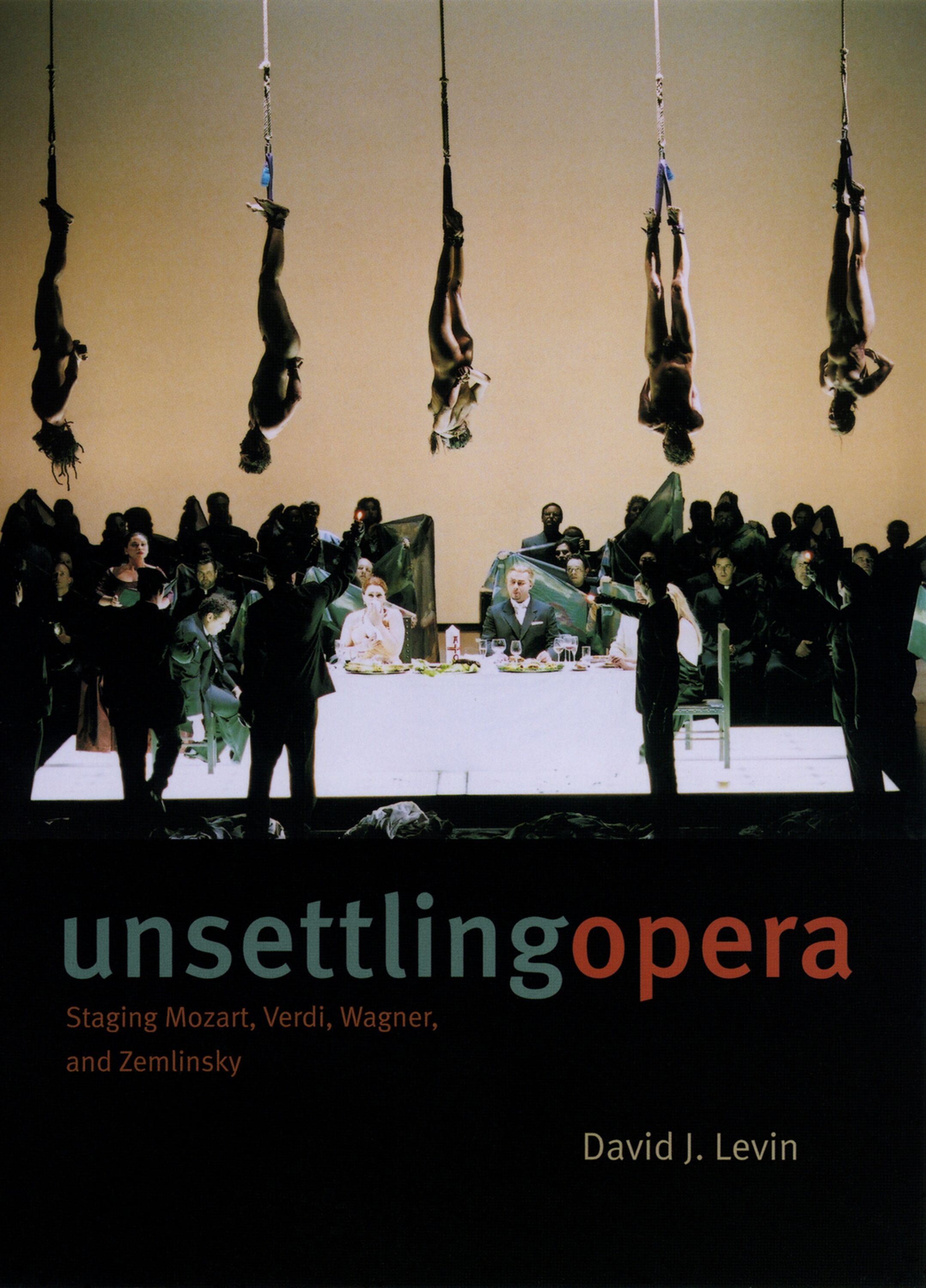
Unsettling opera
What happens when operas that are comfortably ensconced in the canon are thoroughly rethought and radically recast on stage? What does a staging do to our understanding of an opera, and of opera generally? While a stage production can disrupt a work that was thought to be established, David J. Levin here argues that the genre of opera is itself unsettled, and that the performance of operas, at its best, clarifies this condition by bringing opera’s restlessness and volatility to life. Unsettling Opera explores a variety of fields, considering questions of operatic textuality, dramaturgical practice, and performance theory. Levin opens with a brief history of opera production, opera studies, and dramatic composition, and goes on to consider in detail various productions of the works of Wagner, Mozart, Verdi, and Alexander Zemlinsky. Ultimately, the book seeks to initiate a dialogue between scholars of music, literature, and performance by addressing questions raised in each field in a manner that influences them all.
eBook


Divas and scholars
Winner of the 2007 Otto Kinkeldey Award from the American Musicological Society and the 2007 Deems Taylor Award from the American Society of Composers, Authors, and Publishers. Divas and Scholars is a dazzling and beguiling account of how opera comes to the stage, filled with Philip Gossett’s personal experiences of triumphant—and even failed—performances and suffused with his towering and tonic passion for music. Writing as a fan, a musician, and a scholar, Gossett, the world's leading authority on the performance of Italian opera, brings colorfully to life the problems, and occasionally the scandals, that attend the production of some of our most favorite operas. Gossett begins by tracing the social history of nineteenth-century Italian theaters in order to explain the nature of the musical scores from which performers have long worked. He then illuminates the often hidden but crucial negotiations opera scholars and opera conductors and performers: What does it mean to talk about performing from a critical edition? How does one determine what music to perform when multiple versions of an opera exist? What are the implications of omitting passages from an opera in a performance? In addition to vexing questions such as these, Gossett also tackles issues of ornamentation and transposition in vocal style, the matters of translation and adaptation, and even aspects of stage direction and set design. Throughout this extensive and passionate work, Gossett enlivens his history with reports from his own experiences with major opera companies at venues ranging from the Metropolitan and Santa Fe operas to the Rossini Opera Festival at Pesaro. The result is a book that will enthrall both aficionados of Italian opera and newcomers seeking a reliable introduction to it—in all its incomparable grandeur and timeless allure.
eBook