
Catalogue Search | MBRL


Are you sure you want to remove the book from the shelf?

{{itemTitle}}
675
result(s) for
"Operational readiness"
Sort by:


The School of Hard Knocks
This important new history of the development of a leadership corps of officers during World War I opens with a gripping narrative of the battlefield heroism of Cpl. Alvin York, juxtaposed with the death of Pvt. Charles Clement less than two kilometers away.
Clement had been a captain and an example of what a good officer should be in the years just before the beginning of the war. His subsequent failure as an officer and his redemption through death in combat embody the question that lies at the heart of this comprehensive and exhaustively researched book: What were the faults of US military policy regarding the training of officers during the Great War?
In The School of Hard Knocks, Richard S. Faulkner carefully considers the selection and training process for officers during the years prior to and throughout the First World War. He then moves into the replacement of those officers due to attrition, ultimately discussing the relationship between the leadership corps and the men they commanded.
Replete with primary documentary evidence including reports by the War Department during and subsequent to the war, letters from the officers detailing their concerns with the training methods, and communiqués from the leaders of the training facilities to the civilian leadership, The School of Hard Knocks makes a compelling case while presenting a clear, highly readable, no-nonsense account of the shortfalls in officer training that contributed to the high death toll suffered by the American Expeditionary Forces in World War I.
eBook

The foundations of operational resilience - assessing the ability to operate in an anti-access/area denial (A2/AD) environment : the analytical framework, lexicon, and characteristics of the Operational Resilience Analysis Model (ORAM)
\"Although much work has been done considering the issue of airbase resilience especially in the Asia-Pacific region these studies have typically focused on a single aspect of the problem (such as hardening or runway repair) but have not considered the issues in total. There is a need to view the issue more holistically, especially given the strategic implications of U.S. power projection in anti-access/area denial (A2/AD) environments. The authors of this report developed a modeling framework and lexicon for conducting a detailed analysis of future Air Force operational resilience in an A2/AD environment; the analysis itself focused on different regions (Pacific, Southwest Asia, etc.) to bound the problem and identify a robust set of strategic assumptions and planning requirements. The study was set within the context of efforts to rebalance the joint force in the Asia-Pacific region. This report describes the Operational Resilience Analysis Model (ORAM) built for this effort, which was used to evaluate the impact of different courses of action from an operational standpoint. The authors explain the ORAM model, discuss the inputs that go into modeling Blue (friendly) and Red (enemy) capabilities, and illustrate the model using a simple notional case. They conclude with some suggestions for follow-on work to improve the functionality of ORAM and to address data uncertainties in the model\"--Publisher's website.
Book
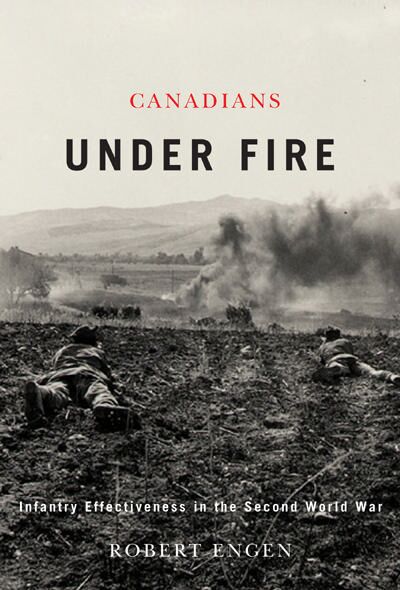
Canadians Under Fire
In Canadians Under Fire Robert Engen explores the dynamics of what combat looked like to Canada's infantrymen during the Second World War. Analyzing unexamined battle experience questionnaires from over 150 Canadian infantry officers, Engen argues for a reassessment of the tactical behaviour of Canadian soldiers in the Second World War. The evidence also shows that Marshall's theory of non-participation in combat by Allied forces is demonstrably false: Canadian soldiers took a continued and aggressive part in the fighting.
eBook


The Economics of Air Force Medical Service Readiness
The Air Force Medical Service (AFMS) currently runs three in-theater hospitals for severely injured or wounded personnel. Part of the practioners' preparation was treating DoD beneficiaries for a broad range of injuries and illnesses. Opportunities for this preparation are not as numerous \"in house\" as they once were, and AFMS does not always get proper credit for those gained elsewhere. Proper credit for that work is important for funding.
eBook


On Ops
No-one in the Australian government or Army could have predicted that in the 25 years following the end of the Cold War Army personnel would be deployed to Rwanda, Cambodia, Somalia, Bougainville, East Timor, Afghanistan, Iraq and the Solomon Islands. In a constructive critique of the modern Australian Army, 'On Ops'.
eBook


The limits of U.S. military capability : lessons from Vietnam and Iraq
Political scientist James H. Lebovic establishes that the size, strength, flexibility, and adaptability of the U.S. military cannot ensure victory in asymmetrical conflicts. In The Limits of U.S. Military Capability, Lebovic shows how political and psychological factors trumped U.S. military superiority in Vietnam and Iraq, where inappropriate strategies, low stakes, and unrealistic goals mired the United States military in protracted, no-win conflicts. Lebovic contends that the United States is at a particular disadvantage when fighting a counterinsurgency without the full support of the host government; when leveraging various third parties (the adversary's foreign allies, societal leaders, and indigenous populations); when attempting to build coalitions and nations while involved in combat; and when sustaining government and public support at home when costs rise and benefits decline. Lebovic cautions against involving the U.S. military in operations without first considering U.S. stakes and suggests that the military take a less-is-more approach when choosing to employ force. Ambitious goals bring higher costs, unexpected results, diminished options, and a greater risk of failure. Rejecting the heavy-handed approach that is typical of most comparisons between the Vietnam and Iraq wars, The Limits of U.S. Military Capability carefully assesses evidence to develop lessons applicable to other conflicts—especially the ongoing war in Afghanistan.
eBook