
Catalogue Search | MBRL


Are you sure you want to remove the book from the shelf?

{{itemTitle}}
2,724
result(s) for
"Opportunity Economic aspects."
Sort by:

Opportunity : how to win in business & create a life you love
A successful entrepreneur and internet marketer discusses opportunity, how to find and create it, and how to develop great opportunities in business, investing, health, relationships, personal development, and other areas of life.
Book
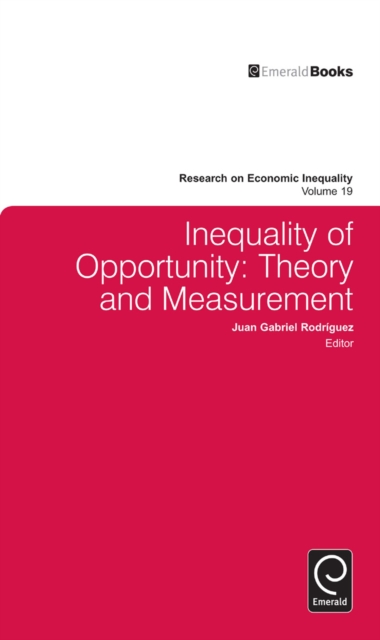
Inequality of Opportunity: Theory and Measurement
This volume contains both theoretical and applied on the concept of equality of opportunity which says that a society should guarantee its members equal access to advantage regardless of their circumstances, while holding them responsible for turning that access into actual advantage by the application of effort. Theoretical papers discuss to what extent some of the measures of inequality of opportunity meet the reward and the compensation principles, a new methodology for evaluating long-term income distributions, the implications of partial observability of individuals' circumstances on the measurement of inequality of opportunity and the advantages of applying segregation indices to study inequality in life chances. The applied work investigates how governments affect inequality of opportunity through the design of their tax and transfer schemes in 15 European countries, the changing role of circumstances for measuring inequality of opportunity in Chile, the existence of a poverty trap in Haiti and its consequences for equality of opportunity, and the correlation between circumstances and effort in the measurement of inequality of opportunity in U.S. during the period 1969-2007.
eBook

There is nothing for you here : finding opportunity in the twenty-first century
\"A celebrated foreign-policy expert and key impeachment witness reveals how declining opportunity has set America on the grim path of modern Russia - and draws on her personal journey out of poverty, and her unique perspectives as a historian and policy maker, to show how we can return hope to our forgotten places
BOOK

The Struggle for America's Promise
InThe Struggle for America's Promise,Claire Goldstene seeks to untangle one of the enduring ideals in American history, that of economic opportunity. She explores the varied discourses about its meaning during the upheavals and corporate consolidations of the Gilded Age. Some proponents of equal opportunity seek to promote upward financial mobility by permitting more people to participate in the economic sphere thereby rewarding merit over inherited wealth. Others use opportunity as a mechanism to maintain economic inequality. This tension, embedded with the idea of equal opportunity itself and continually reaffirmed by immigrant populations, animated social dissent among urban workers while simultaneously serving efforts by business elites to counter such dissent.
Goldstene uses a biographical approach to focus on key figures along a spectrum of political belief as they struggled to reconcile the inherent contradictions of equal opportunity. She considers the efforts of Booker T. Washington in a post-Civil War South to ground opportunity in landownership as an attempt to confront the intersection of race and class. She also explores the determination of the Knights of Labor to define opportunity in terms of controlling one's own labor. She looks at the attempts by Samuel Gompers through the American Federation of Labor as well as by business elites through the National Association of Manufacturers and the National Civic Federation to shift the focus of opportunity to leisure and consumption.The Struggle for America's Promisealso includes such radical figures as Edward Bellamy and Emma Goldman, who were more willing to step beyond the boundaries of the discourse about opportunity and question economic competition itself.
eBook

Unequal Chances
Is the United States \"the land of equal opportunity\" or is the playing field tilted in favor of those whose parents are wealthy, well educated, and white? If family background is important in getting ahead, why? And if the processes that transmit economic status from parent to child are unfair, could public policy address the problem? Unequal Chances provides new answers to these questions by leading economists, sociologists, biologists, behavioral geneticists, and philosophers.
New estimates show that intergenerational inequality in the United States is far greater than was previously thought. Moreover, while the inheritance of wealth and the better schooling typically enjoyed by the children of the well-to-do contribute to this process, these two standard explanations fail to explain the extent of intergenerational status transmission. The genetic inheritance of IQ is even less important. Instead, parent-offspring similarities in personality and behavior may play an important role. Race contributes to the process, and the intergenerational mobility patterns of African Americans and European Americans differ substantially.
Following the editors' introduction are chapters by Greg Duncan, Ariel Kalil, Susan E. Mayer, Robin Tepper, and Monique R. Payne; Bhashkar Mazumder; David J. Harding, Christopher Jencks, Leonard M. Lopoo, and Susan E. Mayer; Anders Björklund, Markus Jäntti, and Gary Solon; Tom Hertz; John C. Loehlin; Melissa Osborne Groves; Marcus W. Feldman, Shuzhuo Li, Nan Li, Shripad Tuljapurkar, and Xiaoyi Jin; and Adam Swift.
eBook

Islam and Mammon
The doctrine of \"Islamic economics\" entered debates over the social role of Islam in the mid-twentieth century. Since then it has pursued the goal of restructuring economies according to perceived Islamic teachings. Beyond its most visible practical achievement--the establishment of Islamic banks meant to avoid interest--it has promoted Islamic norms of economic behavior and founded redistribution systems modeled after early Islamic fiscal practices.
In this bold and timely critique, Timur Kuran argues that the doctrine of Islamic economics is simplistic, incoherent, and largely irrelevant to present economic challenges. Observing that few Muslims take it seriously, he also finds that its practical applications have had no discernible effects on efficiency, growth, or poverty reduction. Why, then, has Islamic economics enjoyed any appeal at all? Kuran's answer is that the real purpose of Islamic economics has not been economic improvement but cultivation of a distinct Islamic identity to resist cultural globalization.
The Islamic subeconomies that have sprung up across the Islamic world are commonly viewed as manifestations of Islamic economics. In reality, Kuran demonstrates, they emerged to meet the economic aspirations of socially marginalized groups. The Islamic enterprises that form these subeconomies provide advancement opportunities to the disadvantaged. By enhancing interpersonal trust, they also facilitate intragroup transactions.
These findings raise the question of whether there exist links between Islam and economic performance. Exploring these links in relation to the long-unsettled question of why the Islamic world became underdeveloped, Kuran identifies several pertinent social mechanisms, some beneficial to economic development, others harmful.
eBook

Enhancing Evolution
InEnhancing Evolution, leading bioethicist John Harris dismantles objections to genetic engineering, stem-cell research, designer babies, and cloning and makes an ethical case for biotechnology that is both forthright and rigorous. Human enhancement, Harris argues, is a good thing--good morally, good for individuals, good as social policy, and good for a genetic heritage that needs serious improvement.Enhancing Evolutiondefends biotechnological interventions that could allow us to live longer, healthier, and even happier lives by, for example, providing us with immunity from cancer and HIV/AIDS. Further, Harris champions the possibility of influencing the very course of evolution to give us increased mental and physical powers--from reasoning, concentration, and memory to strength, stamina, and reaction speed. Indeed, he says, it's not only morally defensible to enhance ourselves; in some cases, it's morally obligatory.
In a new preface, Harris offers a glimpse at the new science and technology to come, equipping readers with the knowledge to assess the ethics and policy dimensions of future forms of human enhancement.
eBook

Status Signals
Why are elite jewelers reluctant to sell turquoise, despite strong demand? Why did leading investment bankers shun junk bonds for years, despite potential profits?Status Signalsis the first major sociological examination of how concerns about status affect market competition. Starting from the basic premise that status pervades the ties producers form in the marketplace, Joel Podolny shows how anxieties about status influence whom a producer does (or does not) accept as a partner, the price a producer can charge, the ease with which a producer enters a market, how the producer's inventions are received, and, ultimately, the market segments the producer can (and should) enter. To achieve desired status, firms must offer more than strong past performance and product quality--they must also send out and manage social and cultural signals.
Through detailed analyses of market competition across a broad array of industries--including investment banking, wine, semiconductors, shipping, and venture capital--Podolny demonstrates the pervasive impact of status. Along the way, he shows how corporate strategists, tempted by the profits of a market that would negatively affect their status, consider not only whether to enter the market but also whether they can alter the public's perception of the market. Podolny also examines the different ways in which a firm can have status. Wal-Mart, for example, has low status among the rich as a place to shop, but high status among the rich as a place to invest.
Status Signalsprovides a systematic understanding of market dynamics that have--until now--not been fully appreciated.
eBook

Post-Soviet Social
The Soviet Union created a unique form of urban modernity, developing institutions of social provisioning for hundreds of millions of people in small and medium-sized industrial cities spread across a vast territory. After the collapse of socialism these institutions were profoundly shaken--casualties, in the eyes of many observers, of market-oriented reforms associated with neoliberalism and the Washington Consensus. InPost-Soviet Social, Stephen Collier examines reform in Russiabeyondthe Washington Consensus. He turns attention from the noisy battles over stabilization and privatization during the 1990s to subsequent reforms that grapple with the mundane details of pipes, wires, bureaucratic routines, and budgetary formulas that made up the Soviet social state.
Drawing on Michel Foucault's lectures from the late 1970s,Post-Soviet Socialuses the Russian case to examine neoliberalism as a central form of political rationality in contemporary societies. The book's basic finding--that neoliberal reforms provide a justification for redistribution and social welfare, and may work to preserve the norms and forms of social modernity--lays the groundwork for a critical revision of conventional understandings of these topics.
eBook
Climate change and migration
Climate change is a major source of concern in the Middle East and North Africa (MENA) region, and migration is often understood as one of several strategies used by households to respond to changes in climate and environmental conditions, including extreme weather events. This study focuses on the link between climate change and migration. Most micro-level studies measure climate change either by the incidences of extreme weather events or by variation in temperature or rainfall. A few studies have found that formal and informal institutions as well as policies also affect migration. Institutions that make government more responsive to households (for example through public spending) discourage both international and domestic migration in the aftermath of extreme weather events. Migration is often an option of last resort after vulnerable rural populations attempting to cope with new and challenging circumstances have exhausted other options such as eating less, selling assets, or removing children from school. This study is based in large part on new data collected in 2011 in Algeria, Egypt, Morocco, Syria, and the Republic of Yemen. The surveys were administered by in-country partners to a randomly selected set of 800 households per country. It is also important to emphasize that neither the household survey results nor the findings from the qualitative focus groups are meant to be representative of the five countries in which the work was carried, since only a few areas were surveyed in each country. This report is organized as follows: section one gives synthesis. Section two discusses household perceptions about climate change and extreme weather events. Section three focuses on migration as a coping mechanisms and income diversification strategy. Section four examines other coping and adaptation strategies. Section five discusses perceptions about government and community programs.
eBook