
Catalogue Search | MBRL


Are you sure you want to remove the book from the shelf?

{{itemTitle}}
70
result(s) for
"Oral communication Political aspects."
Sort by:


Cloning terror
The phrase “War on Terror” has quietly been retired from official usage, but it persists in the American psyche, and our understanding of it is hardly complete. Nor will it be, W. J. T Mitchell argues, without a grasp of the images that it spawned, and that spawned it. Exploring the role of verbal and visual images in the War on Terror, Mitchell finds a conflict whose shaky metaphoric and imaginary conception has created its own reality. At the same time, Mitchell locates in the concept of clones and cloning an anxiety about new forms of image-making that has amplified the political effects of the War on Terror. Cloning and terror, he argues, share an uncanny structural resemblance, shuttling back and forth between imaginary and real, metaphoric and literal manifestations. In Mitchell’s startling analysis, cloning terror emerges as the inevitable metaphor for the way in which the War on Terror has not only helped recruit more fighters to the jihadist cause but undermined the American constitution with “faith-based” foreign and domestic policies. Bringing together the hooded prisoners of Abu Ghraib with the cloned stormtroopers of the Star Wars saga, Mitchell draws attention to the figures of faceless anonymity that stalk the ever-shifting and unlocatable “fronts” of the War on Terror. A striking new investigation of the role of images from our foremost scholar of iconology, Cloning Terror will expand our understanding of the visual legacy of a new kind of war and reframe our understanding of contemporary biopower and biopolitics.
eBook
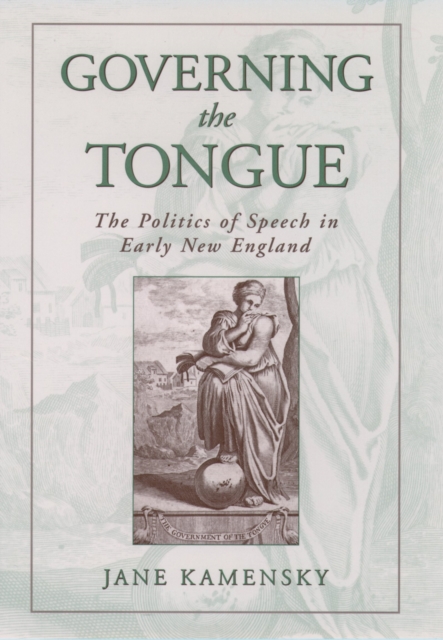
Governing the tongue : the politics of speech in early New England
Colonial New Englanders would have found our modern notions of free speech very strange indeed. Children today shrug off harsh words by chanting “sticks and stones may break my bones but names will never hurt me,\" but in the seventeenth century people felt differently. “A soft tongue breaketh the bone,” they often said. Governing the Tongue explains why the spoken word assumed such importance in the culture of early New England. Author Jane Kamensky re-examines such famous Puritan events as the Salem witch trials and the banishment of Anne Hutchinson to expose the ever-present fear of what the puritans called “sins of the tongue.” But even while dangerous or deviant speech was restricted, Kamensky points out, godly speech was continuously praised and promoted. Congregations were told that one should ones voice “like a trumpet” to God and “cry out and cease not.” By placing speech at the heart of familiar stories of Puritan New England, Kamensky develops new ideas about the relationship between speech and power both in Puritan New England and, by extension, in our world today.
eBook

Mass Oratory and Political Power in the Late Roman Republic
This book highlights the role played by public, political discourse in shaping the distribution of power between Senate and People in the Late Roman Republic. Against the background of the debate between 'oligarchical' and 'democratic' interpretations of Republican politics, Robert Morstein-Marx emphasizes the perpetual negotiation and reproduction of political power through mass communication. The book analyses the ideology of Republican mass oratory and situates its rhetoric fully within the institutional and historical context of the public meetings (contiones) in which these speeches were heard. Examples of contional orations, drawn chiefly from Cicero and Sallust, are subjected to an analysis that is influenced by contemporary political theory and empirical studies of public opinion and the media, rooted in a detailed examination of key events and institutional structures, and illuminated by a vivid sense of the urban space in which the contio was set.
eBook

Singing Ideas
The songs of the beloved Irish poet Maire Bhui Ni Laeire (Yellow Mary O'Leary) explore themes of colonial subjection, oppression and injustice, representing an integral contribution to the development of anti-colonial thought in Ireland. Singing Ideas explores the significance of her work, and the immense power of her chosen medium.
eBook

Resistant Practices in Communities of Sound
Print – and by extension, visuality – has historically dominated the literary, artistic, and academic spheres in Canada; however, scholars and artists have become increasingly attuned to the creative and scholarly opportunities offered by paying attention to sound.
Resistant Practices in Communities of Sound turns to a particular opportunity, interrogating the ways that sonic practices act as forms of aesthetic and political dissent. Chapters explore, on the one hand, critical methods of engaging with sound – particularly bodies of literary and artistic work in their specific materiality as read, recited, performed, mediated, archived, and remixed objects; on the other hand, they also engage with creative practices that mobilize sound as a political aesthetic, taking on questions of identity, racialization, ability, mobility, and surveillance. Divided into nine pairings that bring together works originating in oral/aural forms with works originating in writing, the book explores the creative and critical output of leading sonic practitioners. It showcases diverse approaches to the equally complex formations of sound, resistance, and community, bridging the too-often separate worlds of the practical and the academic in generative, resonant dialogue.
Combining the oral and the written, the creative and the critical, and the mediated and the live, Resistant Practices in Communities of Sound asks us to attune ourselves as listeners as well as readers.
eBook

Narrative Landmines
Islamic extremism is the dominant security concern of many contemporary governments, spanning the industrialized West to the developing world.Narrative Landminesexplores how rumors fit into and extend narrative systems and ideologies, particularly in the context of terrorism, counter-terrorism, and extremist insurgencies. Its concern is to foster a more sophisticated understanding of how oral and digital cultures work alongside economic, diplomatic, and cultural factors that influence the struggles between states and non-state actors in the proverbial battle of hearts and minds. Beyond face-to-face communication, the authors also address the role of new and social media in the creation and spread of rumors.
As narrative forms, rumors are suitable to a wide range of political expression, from citizens, insurgents, and governments alike, and in places as distinct as Singapore, Iraq, and Indonesia-the case studies presented for analysis. The authors make a compelling argument for understanding rumors in these contexts as \"narrative IEDs,\" low-cost, low-tech weapons that can successfully counter such elaborate and expansive government initiatives as outreach campaigns or strategic communication efforts. While not exactly the same as the advanced technological systems or Improvised Explosive Devices to which they are metaphorically related, narrative IEDs nevertheless operate as weapons that can aid the extremist cause.
eBook

Increasing young people’s use of sexual and reproductive health services in government health facilities in rural Kenya
Young people in sub-Saharan Africa, especially in rural areas, face numerous daunting geographic and psychosocial barriers to accessing sexual and reproductive health (SRH) services and information. Adolescents worry that providers will be judgmental and not accord them privacy and confidentiality. They are also concerned that community members or extended family may see them waiting for SRH services, which could lead to parental perceptions of promiscuity and punishment. Because they lack comprehensive sexuality education (CSE) in schools, youths often have serious misconceptions about contraceptives. To address these barriers and increase youths’ uptake of SRH services, the After-Hours Adolescent Project (AHAP) was created as a low-cost intervention for rural government health facilities. The main strategies involved extending clinic hours into early evening to be more convenient and confidential for youths, and training newly-graduated nurses to serve as AHAP nurses. AHAP was tested using a randomized cluster design in thirteen government health facilities in Western Kenya. The study examined two intervention types—the full intervention, which included having AHAP nurses conduct CSE classes in nearby schools and community locations; and a partial intervention, which was entirely clinic-based. After one year, AHAP increased young people’s use of SRH services by 87% (full intervention 97%; partial intervention 77%), whereas comparison facilities saw no change. The full intervention facilities also attracted significantly more female and younger SRH clients. Additionally, improved nurse SRH attitudes after AHAP training were sustained. In sum, AHAP was acceptable and effective in rural settings, but requires ongoing budget outlays for nurse salaries.
Journal Article

Asylum seekers and refugees’ access to oral health care services in Switzerland: a qualitative study
Background
Asylum seekers and refugees in Switzerland face major barriers to oral health care services, often limited to urgent treatments like tooth extractions. Access depends largely on legal status, canton of residence and duration in the country, whereby it is largely unclear for those affected as to which treatments are actually covered.
Methods
Sixteen interviews and three in-clinic observations were conducted with Arabic-speaking asylum seekers and refugees in Basel-Stadt and Basel-Landschaft, two German-speaking Swiss cantons.
Results
It was documented that financial constraints, permit restrictions, communication challenges, and limited autonomy often led participants to delay or avoid dental care, worsening their oral health. While frameworks like Levesque’s model help explain access challenges, they do not fully capture how systemic barriers shape asylum seekers and refugees’ abilities to recognize needs, seek care, and participate in their own health decisions. If these deeper structural issues are not addressed, there is a risk that efforts to improve care will fall short.
Conclusion
The current findings point to the need for systemic reforms to improve coverage, communication, and preventive care, while promoting equitable, tooth-preserving treatment options for asylum seekers and refugees.
Journal Article
Truth in the public sphere
Has truth become a casualty of America's increasingly caustic and volatile political culture?Truth in the Public Sphere seeks to understand the significance of truth for the everyday world of human communication.
eBook