
Catalogue Search | MBRL


Are you sure you want to remove the book from the shelf?

{{itemTitle}}
2,018
result(s) for
"Oral interpretation"
Sort by:

Wham! it's a poetry jam : discovering performance poetry
Follow the author as she guides young writers in performing poetry with style and pizzazz. More than 30 poems to practice with.
Book

The Ethnography of Rhythm: Orality and Its Technologies
Who speaks? The author as producer, the contingency of the text, intertextuality, the \"device\"-core ideas of modern literary theory-were all pioneered in the shadow of oral literature. Authorless, loosely dated, and variable, oral texts have always posed a challenge to critical interpretation. When it began to be thought that culturally significant texts-starting with Homer and the Bible-had emerged from an oral tradition, assumptions on how to read these texts were greatly perturbed. Through readings that range from ancient Greece, Rome, and China to the Cold War imaginary, The Ethnography of Rhythm situates the study of oral traditions in the contentious space of nineteenth- and twentieth-century thinking about language, mind, and culture. It also demonstrates the role of technologies in framing this category of poetic creation. By making possible a new understanding of Maussian \"techniques of the body\" as belonging to the domain of Derridean \"arche-writing,\" Haun Saussy shows how oral tradition is a means of inscription in its own right, rather than an antecedent made obsolete by the written word or other media and data-storage devices.
eBook


Orality in African Literary Works: An Interaction of Oromo Oral Literature with Written Poetry
This article deals with the interaction of Oromo's oral literature with written poetry. The main objective is to indicate the way different types of oral literature elements are adapted to written poetry. Data were collected through qualitative methods such as document analysis, interviews, and group discussions and were analyzed qualitatively. Types of Oromo oral literature like a proverb, oral narrative, oral poetry, and riddles are adapted into written poetry by different authors. The interaction forms a bridge between the oral literary culture and written literature enabling both to complimentarily develop Oromo literature. As Richard M. Dorson states, \"Oral literature can and frequently does enter into written literature. A new generation of African novelists … strews the proverbs of their native languages throughout their fiction\" (2). The intermixing of African orality and written literary works makes literature closer to culture and societal life. These connections sustain the life of oral literature in written literature, on the one hand, and enable written literature to aesthetically communicate the culture, history, norms, and beliefs of a group of people who share it.
Journal Article


Cognitive constraints on advance planning of sentence intonation
Pitch peaks tend to be higher at the beginning of longer than shorter sentences (e.g., ‘A farmer is pulling donkeys’ vs ‘A farmer is pulling a donkey and goat’), whereas pitch valleys at the ends of sentences are rather constant for a given speaker. These data seem to imply that speakers avoid dropping their voice pitch too low by planning the height of sentence-initial pitch peaks prior to speaking. However, the length effect on sentence-initial pitch peaks appears to vary across different types of sentences, speakers and languages. Therefore, the notion that speakers plan sentence intonation in advance due to the limitations in low voice pitch leaves part of the data unexplained. Consequently, this study suggests a complementary cognitive account of length-dependent pitch scaling. In particular, it proposes that the sentence-initial pitch raise in long sentences is related to high demands on mental resources during the early stages of sentence planning. To tap into the cognitive underpinnings of planning sentence intonation, this study adopts the methodology of recording eye movements during a picture description task, as the eye movements are the established approximation of the real-time planning processes. Measures of voice pitch (Fundamental Frequency) and incrementality (eye movements) are used to examine the relationship between (verbal) working memory (WM), incrementality of sentence planning and the height of sentence-initial pitch peaks.
Journal Article

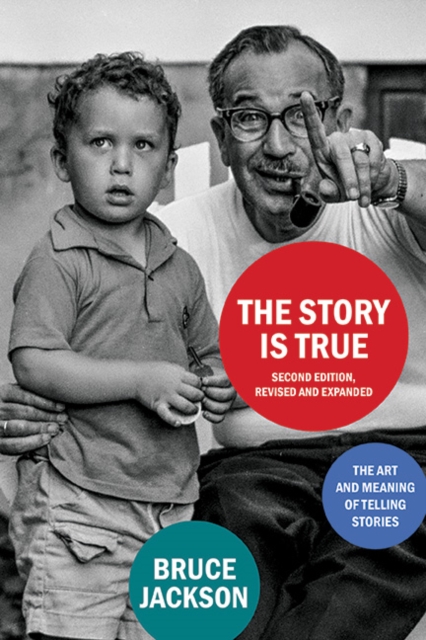
The Story Is True
In The Story Is True, folklorist, filmmaker, and professor of English Bruce Jackson explores the ways we use the stories that become a central part of our public and private lives. Describing and explaining how stories are made and used, Jackson examines how stories narrate and bring meaning to our lives. Jackson writes about his family and friends, acquaintances, and experiences, focusing on more than a dozen personal stories. From oral histories to public stories-such as what happened when Bob Dylan \"went electric\" at the 1965 Newport Folk Festival-Jackson gets at how the \"truth\" is constantly shifting depending on the perspective, memory, and social meaning that is ascribed to various events-both real and imaginary. The book is ideal for students and writers of oral history and storytelling but goes beyond those topics to encompass how we interpret and understand the real-life \"stories\" that we encounter in our daily experience.This edition includes new sections on how stories are related to historical facts and new chapters on contemporary films (expanding the discussion of visual storytelling) and on conspiracy narratives and Trump's Big Lie. Fresh examples tie together new material with the existing stories.
eBook


LXX Judith: Removing the fourth wall
Given the strong mimetic and dramatic qualities found in Judith the authors make the suggestion that perhaps, before LXX Judith became a fixed, written text, the basic fabula might well have been part of an oral tradition. The authors accept that an appropriately written dramatic work, whether transmitted through reading or an oral presentation, by means of its performative qualities, has the potential to achieve immediacy. Here, the audience may become captivated with its own familiarity and memory of popular, communally shared narratives. Accordingly, this article attempts to find evidence in the Greek text of LXX Judith for a possible oral precursor. In this context, corroboration is sought for the employment of verbal aspect and mood of the Greek language as well as instances of drama, theatrics, bodily gestures, mnemonic devices or special emphasis on the employment of the senses such as sight, taste and smell. The authors suggest that based on an analysis of the text of Chapter 13, there is much circumstantial evidence for the Judith fabula once being an oral narrative – one that embodies the dramatic and even encourages audience participation. This characteristic strongly suggests the removal of the fourth wall – the notion of an imaginary boundary between any fictional work and its audience.ContributionThis article shows that Judith 13 is indeed the climax of the narrative. However, it goes further. It is a vivid scene with various performative aspects. There are props, dialogue and audience participation. This research is cutting-edge and paves the way for new explorations.
Journal Article