
Catalogue Search | MBRL


Are you sure you want to remove the book from the shelf?

{{itemTitle}}
8
result(s) for
"Oral tradition Greece History To 1500."
Sort by:


Homer the preclassic
Homer the Preclassic considers the development of the Homeric poems-in particular the Iliad and Odyssey-during the time when they were still part of the oral tradition. Gregory Nagy traces the evolution of rival \"Homers\" and the different versions of Homeric poetry in this pretextual period, reconstructed over a time frame extending back from the sixth century BCE to the Bronze Age. Accurate in their linguistic detail and surprising in their implications, Nagy's insights conjure the Greeks' nostalgia for the imagined \"epic space\" of Troy and for the resonances and distortions this mythic past provided to the various Greek constituencies for whom the Homeric poems were so central and definitive.
eBook


Between Memory and Mythology
Inspired by the theoretical insights of Patrick Hutton, Roland Barthes and Maurice Halbwachs, this volume examines the relationship between myths and memory and the ways in which the narratives (and the mythologies) of wars play a central role in constructing modern identities. The scholarly examination of war narratives shows how the political elite became eagerly engaged in the process of mythmaking. The collection opens with a preface by Patrick Hutton, the leading historian in the field o.
eBook

Aesopic conversations
Examining the figure of Aesop and the traditions surrounding him, Aesopic Conversations offers a portrait of what Greek popular culture might have looked like in the ancient world. What has survived from the literary record of antiquity is almost entirely the product of an elite of birth, wealth, and education, limiting our access to a fuller range of voices from the ancient past. This book, however, explores the anonymous Life of Aesop and offers a different set of perspectives. Leslie Kurke argues that the traditions surrounding this strange text, when read with and against the works of Greek high culture, allow us to reconstruct an ongoing conversation of \"great\" and \"little\" traditions spanning centuries.
eBook


Listening to Homer
The Homeric poems were not intended for readers but for a listening audience. The stories, traditional in their basic elements, were learned by oral poets from earlier poets and re-created at every performance. Individual nuances, tailored to the audience and its particular preferences, could creep into the stories of the Greek heroes on each and every occasion when a bard recited the epics. For a particular audience at a particular moment, \"tradition\" is what it believes it has inherited from the past (and its traditions may not be particularly old). The boundaries between the traditional and the innovative may become blurry and indistinct. By rethinking tradition, we can see Homer's methods and concerns in a new light. The Homeric poet is not naive. He must convince his audience that the story is true—he must therefore seem disinterested, unconcerned with promoting anyone's interests. The poet speaks as if everything he says is merely the repetition of old tales; yet he carefully ensures that even someone who knows only a minimal amount about the ancient heroes can follow and enjoy the performance, while someone who knows many stories will not remember inappropriate ones. Pretending that every detail is already familiar, the poet heightens suspense and implies that ordinary people are the real judges of great heroes.
eBook
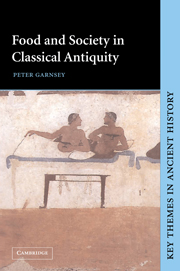
Food and Society in Classical Antiquity
This is the first study of food in classical antiquity that treats it as both a biological and a cultural phenomenon. The variables of food quantity, quality and availability, and the impact of disease, are evaluated and a judgement reached which inclines to pessimism. Food is also a symbol, evoking other basic human needs and desires, especially sex, and performing social and cultural roles which can be either integrative or divisive. The book explores food taboos in Greek, Roman, and Jewish society, and food-allocation within the family, as well as more familiar cultural and economic polarities which are highlighted by food and eating. The author draws on a wide range of evidence new and old, from written sources to human skeletal remains, and uses both comparative historical evidence from early modern and contemporary developing societies and the anthropological literature, to create a case-study of food in antiquity.
eBook