
Catalogue Search | MBRL


Are you sure you want to remove the book from the shelf?

{{itemTitle}}
27
result(s) for
"Oral-formulaic analysis."
Sort by:


Oral diagnostics tools and techniques
This edited volume highlights oral diagnostic tools and techniques from a physicist's viewpoint. Individual chapters have been prepared by academicians as well as practitioners, with the basics of oral diagnostics presented at the start of each chapter, followed by discussion of the state-of-the-art of these tools and techniques. These chapters not only form part of this comprehensive edited collection, but they also possess a standalone character, meaning this book suits the needs of a wide range of audiences. Some of the major tools discussed include molecular spectroscopy for oral diagnostics, CBCT (Cone Beam Computed Tomography), which is a highly innovative dental diagnostic procedure, the application of MRI in dental pathologies, radiography as a diagnosis tool for oral hard tissue diseases, among other important physics-based techniques. Part of IPEM-IOP Series in Physics and Engineering in Medicine and Biology.
eBook

The prosody of formulaic sequences : corpus and discourse
\"To apply the same approaches to analysing spoken and written formulaic language is problematic; to do so masks the fact that the contextual meaning of spoken formulaic language is encoded, to a large extent, in its prosody. In The Prosody of Formulaic Sequences, Phoebe Lin offers a new perspective on formulaic language, arguing that while past research often treats formulaic language as a lexical phenomenon, the phonological aspect of it is a more fundamental facet. This book draws its conclusions from three original, empirical studies of spoken formulaic language, assessing intonation unit boundaries as well as features such as tempo and stress placement. Across all studies, Lin considers questions of methodology and conceptual framework. The corpus-based descriptions of prosody outlined in this book not only deepen our understanding of the nature of formulaic language but have important implications for English Language Teaching and automatic speech synthesis\"-- Provided by publisher.
Book

Written voices, spoken signs : tradition, performance, and the epic text
Written Voices, Spoken Signs is a stimulating introduction to new perspectives on Homer and other traditional epics.Taking advantage of recent research on language and social exchange, the nine essays in this volume focus on performance and audience reception of oral poetry.
eBook

The Prosody of formulaic language
To treat spoken and written formulaic language in the same fashion is erroneous. It masks the fact the meaning of spoken formulaic language is encoded to a large extent in its prosody. This book offers a new perspective on formulaic language: it argues that while past research often treats formulaic language as a lexical phenomenon, the phonological aspect of it is a more fundamental facet. The corpus-based descriptions of prosody outlined in this book not only deepen our understanding of the nature of formulaic language but have important implications for English Language Teaching and automatic speech synthesis.
eBook

Oral Poetics and Cognitive Science
What can oral poetic traditions teach us about language and the human mind? Oral Poetics has produced insights relevant not only for the study of traditional poetry, but also for our general understanding of language and cognition: formulaic style as a product of rehearsed improvisation, the thematic structuring of traditional narratives, or the poetic use of features from everyday speech, among many others. The cognitive sciences have developed frameworks that are crucial for research on oral poetics, such as construction grammar or conversation analysis. The key for connecting the two disciplines is their common focus on usage and performance. This collection of papers explores how some of the latest research on language and cognition can contribute to advances in oral studies. At the same time, it shows how research on verbal art in its natural, oral medium can lead to new insights in semantics, pragmatics, or multimodal communication. The ultimate goal is to pave the way towards a Cognitive Oral Poetics, a new interdisciplinary field for the study or oral poetry as a window to the mind.
eBook

Homeric Responses
The HomericIliadandOdysseyare among the world's foremost epics. Yet, millennia after their composition, basic questions remain about them. Who was Homer-a real or an ideal poet? When were the poems composed-at a single point in time, or over centuries of composition and performance? And how were the poems committed to writing? These uncertainties have been known as The Homeric Question, and many scholars, including Gregory Nagy, have sought to solve it.
InHomeric Responses,Nagy presents a series of essays that further elaborate his theories regarding the oral composition and evolution of the Homeric epics. Building on his previous work inHomeric QuestionsandPoetry as Performance: Homer and Beyondand responding to some of his critics, he examines such issues as the importance of performance and the interaction between audience and poet in shaping the poetry; the role of the rhapsode (the performer of the poems) in the composition and transmission of the poetry; the \"irreversible mistakes\" and cross-references in theIliadandOdysseyas evidences of artistic creativity; and the Iliadic description of the shield of Achilles as a pointer to the world outside the poem, the polis of the audience.
eBook
Between orality and literacy : communication and adaptation in antiquity
The essays in Between Orality and Literacy address how oral and literature practices intersect as messages, texts, practices, and traditions move and change, because issues of orality and literacy are especially complex and significant when information is transmitted over wide expanses of time and space or adapted in new contexts. Their topics range from Homer and Hesiod to the New Testament and Gaius' Institutes, from epic poetry and drama to vase painting, historiography, mythography, and the philosophical letter. Repeatedly they return to certain issues. Writing and orality are not mutually exclusive, and their interaction is not always in a single direction. Authors, whether they use writing or not, try to control the responses of a listening audience. A variable tradition can be fixed, not just by writing as a technology, but by such different processes as the establishment of a Panhellenic version of an Attic myth and a Hellenistic city's creation of a single celebratory history.
eBook
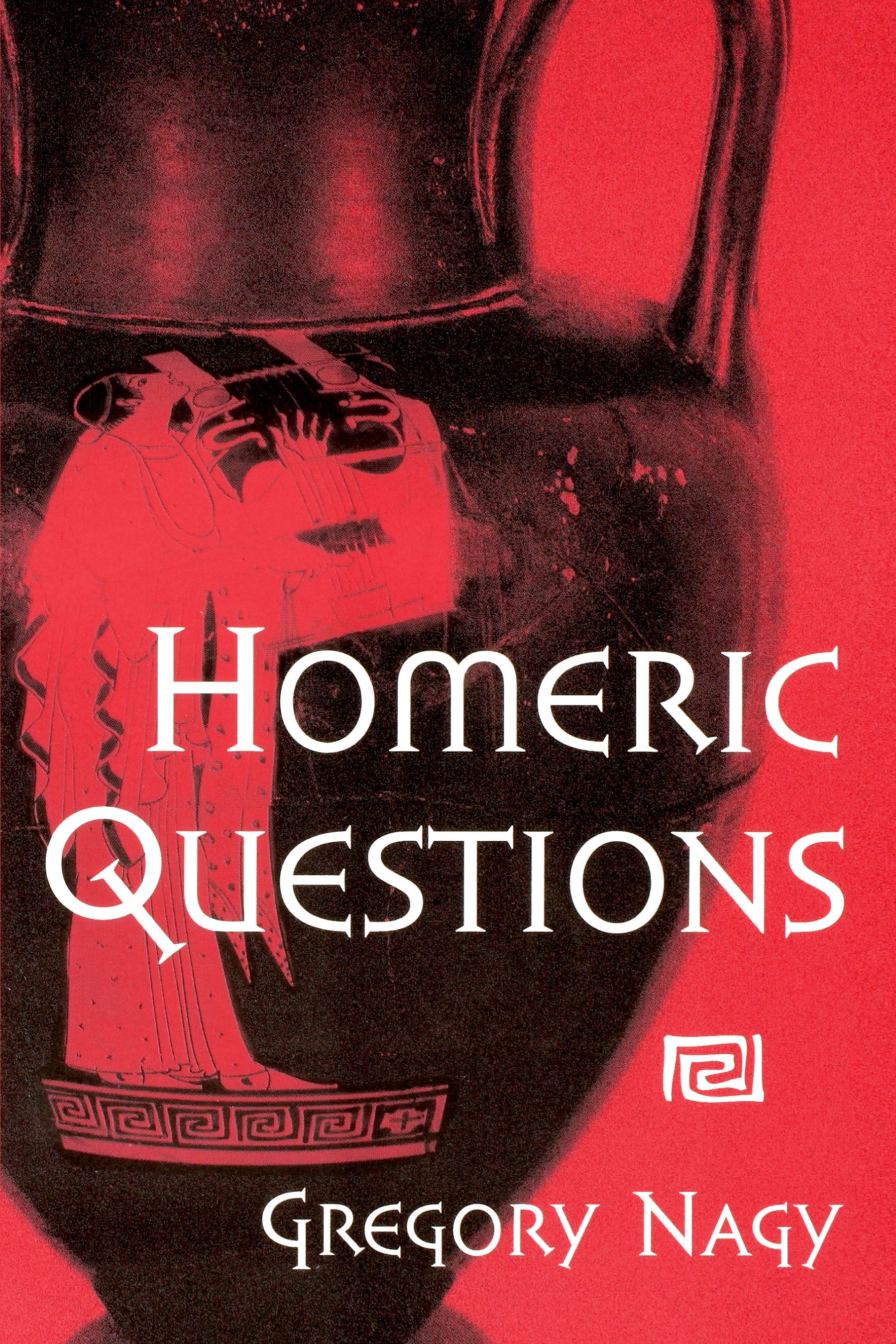
Homeric Questions
A Choice Outstanding Academic Book The \"Homeric Question\" has vexed Classicists for generations. Was the author of the Iliad and the Odyssey a single individual who created the poems at a particular moment in history? Or does the name \"Homer\" hide the shaping influence of the epic tradition during a long period of oral composition and transmission? In this innovative investigation, Gregory Nagy applies the insights of comparative linguistics and anthropology to offer a new historical model for understanding how, when, where, and why the Iliad and the Odyssey were ultimately preserved as written texts that could be handed down over two millennia. His model draws on the comparative evidence provided by living oral epic traditions, in which each performance of a song often involves a recomposition of the narrative. This evidence suggests that the written texts emerged from an evolutionary process in which composition, performance, and diffusion interacted to create the epics we know as the Iliad and the Odyssey. Sure to challenge orthodox views and provoke lively debate, Nagy's book will be essential reading for all students of oral traditions.
eBook