
Catalogue Search | MBRL


Are you sure you want to remove the book from the shelf?

{{itemTitle}}
4
result(s) for
"Orchestral music 19th century History and criticism."
Sort by:

The other worlds of Hector Berlioz : travels with the orchestra
\"Berlioz frequently explored other worlds in his writings, from the imagined exotic enchantments of New Zealand to the rings of Saturn where Beethoven's spirit was said to reside. The settings for his musical works are more conservative, and his adventurousness has instead been located in his mastery of the orchestra, as both orchestrator and conductor. Inge van Rij's book takes a new approach to Berlioz's treatment of the orchestra by exploring the relationship between these two forms of control - the orchestra as abstract sound, and the orchestra as collective labour and instrumental technology. Van Rij reveals that the negotiation between worlds characteristic of Berlioz's writings also plays out in his music: orchestral technology may be concealed or ostentatiously displayed; musical instruments might be industrialised or exoticised; and the orchestral musicians themselves move between being a society of distinctive individuals and being a machine played by Berlioz himself\"-- Provided by publisher.
BOOK
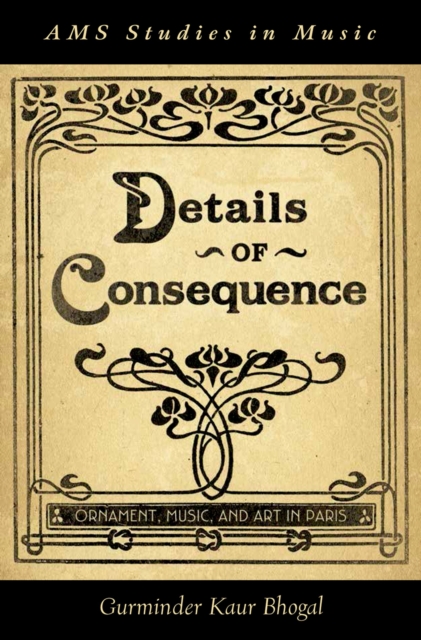
Details of Consequence
Details of Consequence examines a trait that is rarely questioned in fin-de-siècle French music: ornamental extravagance. In re-evaluating the status of ornament for French culture, this book investigates how musical and visual expressions of decorative detail shaped widespread discussions on identity, style, and aesthetics.
eBook

Music in Paris during the Franco-Prussian War and the Commune
The years 1870–71 marked the beginning of dramatic changes in French political and cultural life. A few short months witnessed defeat to Germany in the Franco-Prussian War and the fall of the Second Empire, as well as the rapid rise of the Paris Commune and its subsequent violent suppression through the establishment of republican government. The Parisian musical world, while severely affected by the events of war and deprived of performers and audiences, did not come to a standstill. Indeed, these years ushered in a remarkable increase in the number of institutions and concert societies dedicated to supporting French music and to making what would become the standard repertoire more accessible to the average citizen.
Music heightened reactions to the turmoil of war and revolution in Paris at this crucial moment in France's history. Because of their stringent governmental control and largely middle- and working-class audiences, entertainments organized initially by wartime concert societies, and then under the aegis of the Commune, provide us with the greatest opportunity for understanding the political and social contexts in which music operated. Through investigation of the contemporary French press it can be shown that: (1) the perceived function of musical performance was adjusted to suit the practical and symbolic needs of a besieged city; (2) all the factions competing for power during the war and the post-war insurrection in Paris appropriated the connotations of civilization, social stability, and good taste that surrounded “art music”; (3) the Commune's sudden rejection of the Austro-German musical tradition marked a brief but significant moment in which nationalistic preoccupations supplanted historically cosmopolitan attitudes toward foreign art. The study concludes with a meditation on Alfred Roll's painting of the execution of a Communard trumpeter, in which we find one of the strongest images relating war and rebellion to music in the France of 1871.
Journal Article

The 'Jupiter' Symphony in C, K. 551: New Perspectives on the Dramatic Finale and Its Stylistic Significance in Mozart's Orchestral Œuvre
Few works in the Western music tradition have received more lavish praise than Wolfgang Amadeus Mozart's \"Jupiter\" Symphony. Although periodically criticized at the end of the 18th century and in the 19th century for its over-abundance of \"harmonic riches,\" erudition, and \"laborious technical procedures,\" the \"Jupiter\" quickly established itself as a classic, a symphony perceived as shattering, exalted, and \"wholly above discussion,\" featuring a last movement that is \"without doubt the most successful masterpiece\" in the symphonic medium. In this article, the author attempts to systematically evaluate the drama of the final movement of the \"Jupiter,\" carried out in light of historical considerations. The investigation focuses on the concept of dialogue, since imitative and fugal counterpoint dominate Mozart's finale to a degree unprecedented in his orchestral works and both feature prominently in late 18th- and early 19th-century understandings of the concept. The author further probes the nature and structure of dramatic dialogue in the \"Jupiter\" finale. This new historical perspective will, in turn, cast fresh light on the stylistic significance of this movement in Mozart's orchestral oeuvre.
Journal Article