
Catalogue Search | MBRL


Are you sure you want to remove the book from the shelf?

{{itemTitle}}
46,973
result(s) for
"Ordinary differential equations"
Sort by:

Recent trends in formal and analytic solutions of diff. equations : Virtual Conference Formal and Analytic Solutions of Diff. Equations, June 28-July 2, 2021, University of Alcalá, Alcalá de Henares, Spain
This volume contains the proceedings of the conference on Formal and Analytic Solutions of Diff. Equations, held from June 28-July 2, 2021, and hosted by University of Alcala, Alcala de Henares, Spain. The manuscripts cover recent advances in the study of formal and analytic solutions of different kinds of equations such as ordinary differential equations, difference equations, $q$-difference equations, partial differential equations, moment differential equations, etc. Also discussed are related topics such as summability of formal solutions and the asymptotic study of their solutions. The volume is intended not only for researchers in this field of knowledge but also for students who aim to acquire new techniques and learn recent results.
eBook

Differential equation software for the computation of error-controlled continuous approximate solutions
In this paper, we survey selected software packages for the numerical solution of boundary value ODEs (BVODEs), time-dependent PDEs in one spatial dimension (1DPDEs), and initial value ODEs (IVODEs).
A unifying theme of this paper is our focus on software packages for these problem classes that compute error-controlled, continuous numerical solutions.
A continuous numerical solution can be accessed by the user at any point in the domain. We focus on error-control software; this means that the software adapts the computation until it obtains a
continuous approximate solution with a corresponding error estimate
that satisfies the user tolerance. The second section of the paper will provide an overview of recent work on the development of COLNEWSC, an updated version of the widely used collocation BVODE solver, COLNEW, that returns an error-controlled continuous approximate solution based on the use of a superconvergent interpolant to the underlying collocation solution. The third section of the paper gives a brief review of recent work on the development of a new 1DPDE solver, BACOLIKR, that provides time- and space-dependent event detection for an error-controlled continuous numerical solution. In the fourth section of the paper, we briefly review the state of the art in IVODE software for the computation of error-controlled continuous numerical solutions.
Journal Article

The dynamics of conformal Hamiltonian flows: dissipativity and conservativity
We study in detail the dynamics of conformal Hamiltonian flows that are defined on a conformal symplectic manifold (this notion was popularized by Vaisman in 1976). We show that they exhibit some conservative and dissipative behaviours. We also build many examples of various dynamics that show simultaneously their difference and resemblance with the contact and symplectic case.
Journal Article

idopNetwork: A network tool to dissect spatial community ecology
Network models have been used as a tool to characterize internal workings of complex systems. The amount of topological and functional information extracted from a network depend on the method of network inference and the type of network data. An interdisciplinary computational model has been proposed to reconstruct informative, dynamic, omnidirectional and personalized networks (idopNetwork) from any data domains including static data. We implement idopNetwork as an R‐based cartographic tool to characterize spatially varying interspecies interaction networks using the abundance data of multiple species from different geographical locations. This tool provides a unified framework for integrating power curve fitting based on allometrical scaling law, functional clustering, LASSO‐based variable selection, quasi‐dynamic ordinary differential equation solving, species abundance decomposition and network visualization. It coalesces all species from different spaces into location‐specific networks. We demonstrate the utility of this tool by analysing different organs that are spatially interconnected via microbiomes within the host using two datasets from the gut microbiota and plant microbiota. Given that biodiversity and organization vary biogeographically at different scales, idopNetwork will find its widespread application to modelling and estimating interspecific interactions with differing functions across space. 摘要 网络模型已被用作表征复杂系统内部工作的工具。而从网络中提取的拓扑和功能信息量取决于网络推理的方法和网络数据的类型。 本文提出了一种跨学科的计算模型,能从任何数据域(包括静态数据)重建信息丰富(informative),动态(dynamic),全方位(omnidirectional)以及个性化(personalized)的网络(idopNetwork。 本研究将idopNetwork实现为基于R的绘图工具,使用来自不同空间位置的多个物种的丰度数据来构建表征空间变化的种间相互作用网络。该工具提供了一个统一的框架,集成了包括基于异速生长的曲线拟合、功能聚类、基于LASSO的变量选择、拟动态常微分方程求解、物种丰度分解和网络可视化,以将不同空间的物种集合到特定位置的网络中。 本研究通过使用来自肠道微生物群和植物微生物群的两个数据集,分析宿主体内不同器官通过微生物群在空间上相互连接以证明该工具的实用性。鉴于生物多样性和组织在不同尺度的生物地理上有所不同,idopNetwork将广泛应用于建模和估算物种间的交互作用,挖掘其跨空间的不同功能。
Journal Article

Automated Linearization of a System of Nonlinear Ordinary Differential Equations
This paper investigates the possibility of automatically linearizing nonlinear models. Constructing a linearised model for a nonlinear system is quite labor-intensive and practically unrealistic when the dimension is greater than 3. Therefore, it is important to automate the process of linearisation of the original nonlinear model. Based on the application of computer algebra, a constructive algorithm for the linearisation of a system of non-linear ordinary differential equations was developed. A software was developed on MatLab. The effectiveness of the proposed algorithm has been demonstrated on applied problems: an unmanned aerial vehicle dynamics model and a twolink robot model. The obtained linearized models were then used to test the stability of the original models. In order to account for possible inaccuracies in the measurements of the technical parameters of the model, an interval linearized model is adopted. For such a model, the procedure for constructing the corresponding interval characteristic polynomial and the corresponding Hurwitz matrix is automated. On the basis of the analysis of the properties of the main minors of the Hurwitz matrix, the stability of the studied system was analyzed.
Journal Article

Boundary Coupling for Consensus of Nonlinear Leaderless Stochastic Multi-Agent Systems Based on PDE-ODEs
This paper studies the leaderless consensus of the stochastic multi-agent systems based on partial differential equations–ordinary differential equations (PDE-ODEs). Compared with the traditional state coupling, the most significant difference between this paper is that the space state coupling is designed. Two boundary couplings are investigated in this article, respectively, collocated boundary measurement and distributed boundary measurement. Using the Lyapunov directed method, sufficient conditions for the stochastic multi-agent system to achieve consensus can be obtained. Finally, two simulation examples show the feasibility of the proposed spatial boundary couplings.
Journal Article
On the Existence and Uniqueness of the ODE Solution and Its Approximation Using the Means Averaging Approach for the Class of Power Electronic Converters
Power electronic converters are mathematically represented by a system of ordinary differential equations discontinuous right-hand side that does not verify the conditions of the Cauchy-Lipschitz Theorem. More generally, for the properties that characterize their discontinuous behavior, they represent a particular class of systems on which little has been investigated over the years. The purpose of the paper is to prove the existence of at least one global solution in Filippov’s sense to the Cauchy problem related to the mathematical model of a power converter and also to calculate the error in norm between this solution and the integral of its averaged approximation. The main results are the proof of this theorem and the analytical formulation that provides to calculate the cited error. The demonstration starts by a proof of local existence provided by Filippov himself and already present in the literature for a particular class of systems and this demonstration is generalized to the class of electronic power converters, exploiting the non-chattering property of this class of systems. The obtained results are extremely useful for estimating the accuracy of the averaged model used for analysis or control of the effective system. In the paper, the goodness of the analytical proof is supported by experimental tests carried out on a converter prototype representing the class of power electronics converter.
Journal Article

Solving Directly Higher Order Ordinary Differential Equations by Using Variable Order Block Backward Differentiation Formulae
Variable order block backward differentiation formulae (VOHOBBDF) method is employed for treating numerically higher order Ordinary Differential Equations (ODEs). In this respect, the purpose of this research is to treat initial value problem (IVP) of higher order stiff ODEs directly. BBDF method is symmetrical to BDF method but it has the advantage of producing more than one solutions simultaneously. Order three, four, and five of VOHOBBDF are developed and implemented as a single code by applying adaptive order approach to enhance the computational efficiency. This approach enables the selection of the least computed LTE among the three orders of VOHOBBDF and switch the code to the method that produces the least LTE for the next step. A few numerical experiments on the focused problem were performed to investigate the numerical efficiency of implementing VOHOBBDF methods in a single code. The analysis of the experimental results reveals the numerical efficiency of this approach as it yielded better performances with less computational effort when compared with built-in stiff Matlab codes. The superior performances demonstrated by the application of adaptive orders selection in a single code thus indicate its reliability as a direct solver for higher order stiff ODEs.
Journal Article

Quantum homotopy perturbation method for nonlinear dissipative ordinary differential equations
While quantum computing provides an exponential advantage in solving linear differential equations, there are relatively few quantum algorithms for solving nonlinear differential equations. In our work, based on the homotopy perturbation method, we propose a quantum algorithm for solving n -dimensional nonlinear dissipative ordinary differential equations (ODEs). Our algorithm first converts the original nonlinear ODEs into the other nonlinear ODEs which can be embedded into finite-dimensional linear ODEs. Then we solve the embedded linear ODEs with quantum linear ODEs algorithm and obtain a state ϵ -close to the normalized exact solution of the original nonlinear ODEs with success probability Ω(1). The complexity of our algorithm is O ( gηT poly(log( nT / ϵ ))), where η , g measure the decay of the solution. Our algorithm provides exponential improvement over the best classical algorithms or previous quantum algorithms in n or ϵ .
Journal Article
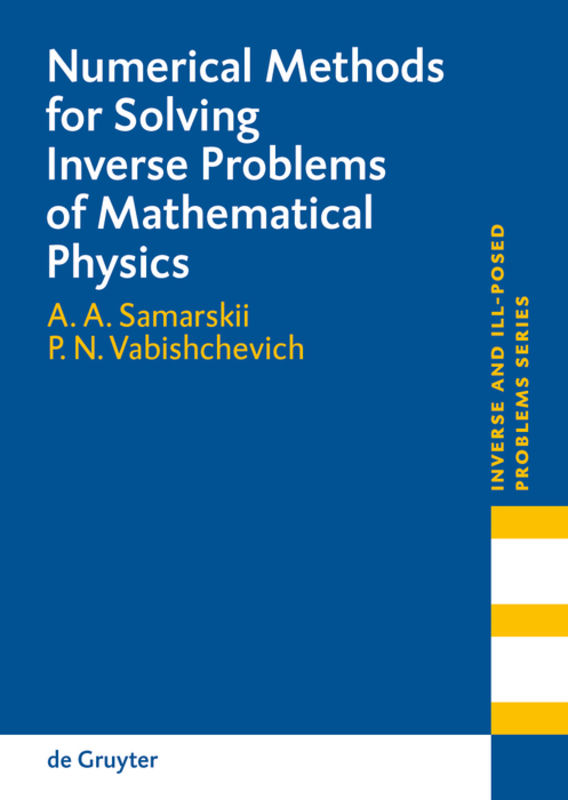
Numerical Methods for Solving Inverse Problems of Mathematical Physics
The main classes of inverse problems for equations of mathematical physics and their numerical solution methods are considered in this book which is intended for graduate students and experts in applied mathematics, computational mathematics, and mathematical modelling.
eBook