
Catalogue Search | MBRL


Are you sure you want to remove the book from the shelf?

{{itemTitle}}
1,731
result(s) for
"Ordinary-language philosophy."
Sort by:


Critical ordinary language philosophy: A new project in experimental philosophy
Several important philosophical problems (including the problems of perception, free will, and scepticism) arise from antinomies that are developed through philosophical paradoxes. The critical strand of ordinary language philosophy (OLP), as practiced by J.L. Austin, provides an approach to such ‘antinomic problems’ that proceeds from an examination of ‘ordinary language’ (how people ordinarily talk about the phenomenon of interest) and ‘common sense’ (what they commonly think about it), and deploys findings to show that the problems at issue are artefacts of fallacious reasoning. The approach is capable, and in need of, empirical development. Proceeding from a case-study on Austin’s paradigmatic treatment of the problem of perception, this paper identifies the key empirical assumptions informing the approach, assesses them in the light of empirical findings about default inferences, contextualisation failures, and belief fragmentation, and explores how these findings can be deployed to address the problem of perception. This facilitates a novel resolution of the problem of perception. Proceeding from this paradigm, the paper proposes ‘experimental critical OLP’ as a new research program in experimental philosophy that avoids apparent non-sequiturs of OLP, extends and transforms experimental philosophy’s ‘sources program’, and provides a promising new strategy for deploying empirical findings about how people ordinarily talk and think about phenomena, to address longstanding philosophical problems.
Journal Article

When Arne met J. L.: attitudes to scientific method in empirical semantics, ordinary language philosophy and linguistics
In the autumn of 1959, Arne Naess and J. L. Austin, both pioneers of empirical study in the philosophy of language, discussed their points of agreement and disagreement at a meeting in Oslo. This article considers the fragmentary record that has survived of that meeting, and investigates what light it can shed on the question of why the two philosophers apparently found so little common ground, given their shared commitment to the importance of data in the study of language. Naess and Austin held different views about two significant aspects of the relationship between scientific method and philosophical investigation. The first aspect concerns the nature of experimental data; Naess used the statistical analysis of data collected from non-philosophical informants while Austin advocated deliberation leading to agreement over usage by a few skilled experts. The second aspect relates to their respective attitudes to the role of theory in philosophical inquiry, attitudes which drew on discussions of scientific method, and its relevance to philosophy, from the early decades of the twentieth century. This article traces the evidence for these views on scientific method in Naess’s and Austin’s respective published work, and in the record of their Oslo meeting. It concludes with a brief overview of opinions about scientific method manifest in the decades since that meeting in various branches of linguistics. These opinions speak to the enduring importance of attitudes to scientific method in relation to our study and understanding of human language.
Journal Article

On philosophical idling: the ordinary language philosophy critique of the philosophical method of cases
I start with some of the early challenges to the widely-employed philosophical method of cases—the very challenges that originally prompted the new movement of experimental philosophy—and with some fundamental questions about the method that are yet to have been given satisfying answers. I then propose that what has allowed both ‘armchair’ and ‘experimental’ participants in the ongoing debates concerning the method to ignore or repress those early challenges—and in particular Robert Cummins’s ‘calibration objection’—and to discount fundamental disagreements about those questions, is in large part ‘the claim of continuity’, which is the claim, or assumption, that there is no philosophically significant difference between whatever it is that we do when we give our answer to the theorist’s question of whether some philosophically interesting word ‘applies’ (positively or negatively) to some theoretically significant case, and our use of that same word in the course of ordinary, non-philosophical discourse. I then summarize the ordinary language philosophy (OLP) argument against the claim of continuity, and explain why answers to the theorist’s questions are vulnerable to the calibration objection in a way that our non-philosophical, everyday employment of the same words is not. This then leads me to question another widespread assumption, which is the assumption that the theorist’s questions—as raised in the theorist’s context—have clear enough sense and correct answers. I end by responding to a series of objections to my argument and to OLP more generally.
Journal Article
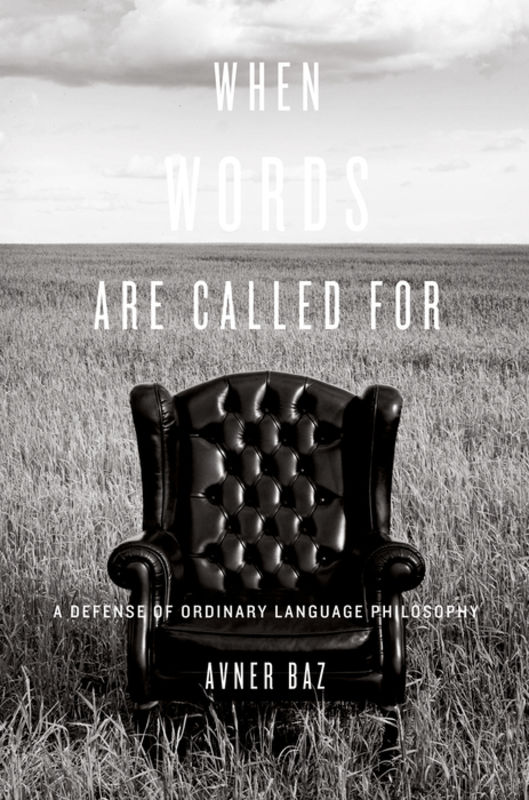
When words are called for : a defense of ordinary language philosophy
A new form of philosophizing known as ordinary language philosophy took root in England after the Second World War, promising a fresh start and a way out of long-standing dead-end philosophical debates. Pioneered by Wittgenstein, Austin, and others, OLP is now widely rumored, within mainstream analytic philosophy, to have been seriously discredited, and consequently its perspective is ignored.
Avner Baz begs to differ. In When Words Are Called For, he shows how the prevailing arguments against OLP collapse under close scrutiny. All of them, he claims, presuppose one version or another of the very conception of word-meaning that OLP calls into question and takes to be responsible for many traditional philosophical difficulties. Worse, analytic philosophy itself has suffered as a result of its failure to take OLP's perspective seriously. Baz blames a neglect of OLP's insights for seemingly irresolvable disputes over the methodological relevance of \"intuitions\" in philosophy and for misunderstandings between contextualists and anti-contextualists (or \"invariantists\") in epistemology. Baz goes on to explore the deep affinities between Kant's work and OLP and suggests ways that OLP could be applied to other philosophically troublesome concepts.
When Words Are Called For defends OLP not as a doctrine but as a form of practice that might provide a viable alternative to work currently carried out within mainstream analytic philosophy. Accordingly, Baz does not merely argue for OLP but, all the more convincingly, practices it in this eye-opening book.
eBook

Verbal Disputes
The philosophical interest of verbal disputes is twofold. First, they play a key role in philosophical method. Many philosophical disagreements are at least partly verbal, and almost every philosophical dispute has been diagnosed as verbal at some point. Here we can see the diagnosis of verbal disputes as a tool for philosophical progress. Second, they are interesting as a subject matter for first-order philosophy. Reflection on the existence and nature of verbal disputes can reveal something about the nature of concepts, language, and meaning. In this article I first characterize verbal disputes, spell out a method for isolating and resolving them, and draw out conclusions for philosophical methodology. I then use the framework to draw out consequences in first-order philosophy. In particular, I argue that the analysis of verbal disputes can be used to support the existence of a distinctive sort of primitive concept and that it can be used to reconstruct a version of an analytic/synthetic distinction, where both are characterized in dialectical terms alone.
Journal Article
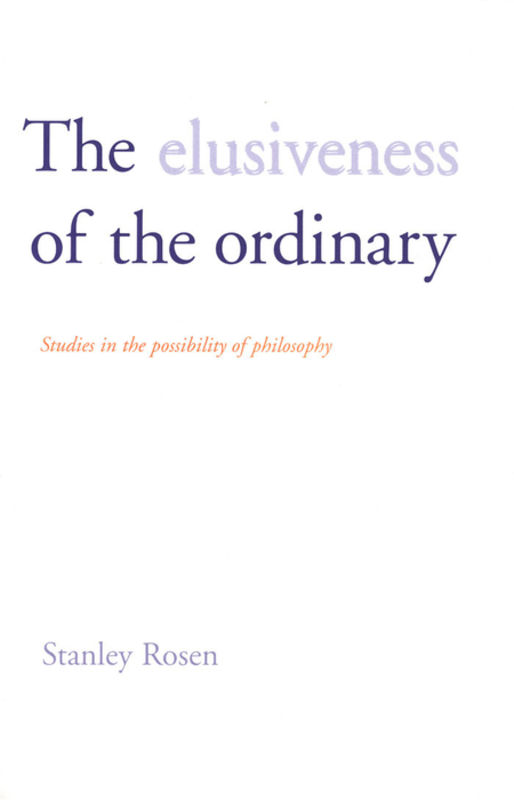
The Elusiveness of the Ordinary
The concept of the ordinary, along with such cognates as everyday life, ordinary language, and ordinary experience, has come into special prominence in late modern philosophy. Thinkers have employed two opposing yet related responses to the notion of the ordinary: scientific and phenomenological approaches on the one hand, and on the other, more informal or even anti-scientific procedures. Eminent philosopher Stanley Rosen here presents the first comprehensive study of the main approaches to theoretical mastery of ordinary experience. He evaluates the responses of a wide range of modern and contemporary thinkers and grapples with the peculiar problem of the ordinary-how to define it in its own terms without transforming it into a technical (and so, extraordinary) artifact.Rosen's approach is both historical and philosophical. He offers Montesquieu and Husserl as examples of the scientific approach to ordinary experience; contrasts Kant and Heidegger with Aristotle to illustrate the transcendental approach and its main alternatives; discusses attempts by Wittgenstein and Strauss to return to the pre-theoretical domain; and analyzes the differences among such thinkers as Moore, Austin, Grice, and Russell with respect to the analytical response to ordinary language. Rosen concludes with a theoretical exploration of the central problem of how to capture the elusive ordinary intact.
eBook
The calibration challenge to philosophical intuitions
To several critics of the philosophical method of cases—Robert Cummins, Jonathan Weinberg and his colleagues, and Avner Baz—the fact that philosophical intuitions cannot be calibrated means that we cannot rule out the skeptical hypothesis that the outcome of our theorizing based on these intuitions is deeply distorted by our cognitive artifacts. Moreover, they take this hypothesis to license the negative conclusion that we are unable to have much of the armchair knowledge we typically attribute to ourselves when philosophizing based on appeal to philosophical intuitions. This paper addresses this skeptical argument and shows how this negative conclusion can be resisted.
Journal Article