
Catalogue Search | MBRL


Are you sure you want to remove the book from the shelf?

{{itemTitle}}
764
result(s) for
"Orestes"
Sort by:


An Oresteia
In this innovative rendition of The Oresteia, the poet, translator, and essayist Anne Carson combines three different visions -- Aischylos' Agamemnon, Sophokles' Elektra, and Euripides' Orestes, giving birth to a wholly new experience of the classic Greek triumvirate of vengeance. Carson's accomplished rendering combines elements of contemporary vernacular with the traditional structures and rhetoric of Greek tragedy, opening up the plays to a modern audience.--From publisher description.
BOOK

Medical health resources allocation evaluation in public health emergencies by an improved ORESTE method with linguistic preference orderings
As an important major public health emergency, COVID-19 broke out more than two years. At present, China has entered the post-epidemic era. However, it is still necessary to study the medical health resource allocation in public health emergencies. Therefore, the evaluation of medical health resources allocation is important. Firstly, we use two kinds of linguistic preference orderings (LPOs) to represent experts’ opinions when evaluating the medical health resources allocation in public health emergencies. Then, a novel ORESTE method with LPOs is developed to solve multiple criteria decision-making (MCDM) problems. Additionally, we apply the proposed ORESTE method to solve a practical MCDM problem involving the medical health resources allocation in public health emergencies. Finally, some comparative analyses among the proposed ORESTE method and some existing methods under a double hierarchy linguistic environment are set up, and some discussions are summarized to show the validity and applicability of the proposed novel ORESTE method.
Journal Article


Que devient la malédiction des Atrides dans Iphigénie en Tauride ? Ou d’Aulis à Brauron en passant par la Tauride
Iphigénie en Tauride est un bon laboratoire pour étudier la manière originale dont Euripide s’empare du mythe des Atrides et de la malédiction qui les poursuit pour mener une réflexion philosophique et religieuse. Dans cette pièce, il réécrit en effet le sort des deux derniers rejetons de cette famille. Pourquoi le poète refuse-t-il la solution eschyléenne de l’absolution du matricide par l’Aréopage ? Quant à Iphigénie, pourquoi est-elle désormais préposée à des sacrifices humains qui lui répugnent par la déesse qui l’a sauvée ? Le raisonnement mené par l’héroïne aux v. 380-391 est central pour la compréhension de la pièce. Cette intrigue originale est bâtie autour de la malédiction : les deux jeunes gens vont-ils réussir à fuir la Tauride ? Dans ce cadre contraint, ont-ils une certaine marge de liberté ? Si la malédiction prend fin au dénouement, comme dans Les Euménides, les chemins empruntés par les deux poètes sont bien différents. C’est cette différence que nous voulons cerner. Iphigenia in Tauris enables us to examine the original way in which Euripides uses the myth of the Atreids and the history of the family curse to develop philosophical and religious ideas. In this play he rewrites the fate of the two last surviving offspring of this family, Orestes and Iphigenia. Why does the poet reject Aeschylus’ solution, which was to have the Areopagus offer Orestes amnesty for committing matricide? As for Iphigenia, why did the goddess saved her so that she could preside over human sacrifices which disgust her? The heroine’s line of argument in ll. 380-391 is central to an understanding of the play. Euripides’ original plot is built upon the curse: will the two young people succeed in escaping from the Taurian land? Within this limited framework, do they have any freedom of choice? Although the curse comes to an end at the conclusion of the play, as in Aeschylus’ Eumenides, the two poets adopt very different solutions. This is the difference that we intend to assess.
Journal Article
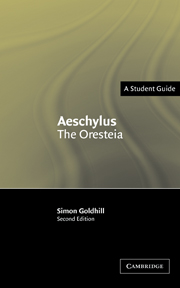
Aeschylus: The Oresteia
This is the only general introduction in English to Aeschylus' Oresteia, one of the most important and most influential of all Greek dramas. It discusses the Greek drama festival and the social and political background of Greek tragedy, and offers a reading of this central trilogy. Simon Goldhill focuses on the play's themes of justice, sexual politics, violence, and the position of man within culture, and explores how Aeschylus constructs a myth for the city in which he lived. A final chapter considers the influence of the Oresteia on later theatre. Its clear structure and guide to further reading will make this an invaluable guide for students and teachers alike.
eBook
« Faites éclater le bruit ! » (κτύπον ἐγείρετε, Euripide, Oreste, v. 1353) : l'art tragique du « fracas »
Quelle part ont pu jouer les instruments de percussion dans les compositions tragiques d’Euripide ? Sa recherche constante d’innovations l’a-t-elle conduit à expérimenter les possibilités sonores et musicales de ces instruments inhabituels sur la scène tragique ? La présence des références directes (tumpanon et aux crotales en particulier) dans plusieurs pièces révèle l’intérêt du poète pour la musique de la transe, celle des officiants de Cybèle en particulier, à laquelle ces instruments sont associés. Il semble qu’Euripide ait voulu exercer ce pouvoir musical sur son public. Une seconde approche, s’appuyant sur l’étude des termes pouvant traduire le bruit issu de la percussion, κτύπος en particulier, semble montrer que le poète tragique a voulu mettre en évidence une esthétique du « fracas ». Dans l’Oreste, le chaos sonore, produit par la chute de la maison argienne, plonge le public dans le trouble et la confusion jusqu’au retour apollinien à l’ordre et l’harmonie. What part could percussion instruments have played in Euripides’ tragic plays ? Through his continuous quest for innovations, did he come to experiment the sound and musical possibilities offered by these unusual instruments in his tragedies on stage ? Explicit references (mainly tumpanon and krotala) in several Euripidean plays reveal the poet’s interest in transe-inducing music, for example in Cybele’s worshippers It seems as if Euripides wanted to exercise this power over his audience. A second approach, based on studying terms translating the sound caused by percussion, mainly κτύπος, suggests that the tragic poet wanted to highlight his aesthetics based on crashing sound. In the Orestes, this sound chaos, caused by the fall of the house of Argos, deeply disturbs and upsets the audience, until the return to Apollonian order and harmony.
Journal Article

Projected Loss of a Salamander Diversity Hotspot as a Consequence of Projected Global Climate Change
Significant shifts in climate are considered a threat to plants and animals with significant physiological limitations and limited dispersal abilities. The southern Appalachian Mountains are a global hotspot for plethodontid salamander diversity. Plethodontids are lungless ectotherms, so their ecology is strongly governed by temperature and precipitation. Many plethodontid species in southern Appalachia exist in high elevation habitats that may be at or near their thermal maxima, and may also have limited dispersal abilities across warmer valley bottoms.
We used a maximum-entropy approach (program Maxent) to model the suitable climatic habitat of 41 plethodontid salamander species inhabiting the Appalachian Highlands region (33 individual species and eight species included within two species complexes). We evaluated the relative change in suitable climatic habitat for these species in the Appalachian Highlands from the current climate to the years 2020, 2050, and 2080, using both the HADCM3 and the CGCM3 models, each under low and high CO(2) scenarios, and using two-model thresholds levels (relative suitability thresholds for determining suitable/unsuitable range), for a total of 8 scenarios per species.
While models differed slightly, every scenario projected significant declines in suitable habitat within the Appalachian Highlands as early as 2020. Species with more southern ranges and with smaller ranges had larger projected habitat loss. Despite significant differences in projected precipitation changes to the region, projections did not differ significantly between global circulation models. CO(2) emissions scenario and model threshold had small effects on projected habitat loss by 2020, but did not affect longer-term projections. Results of this study indicate that choice of model threshold and CO(2) emissions scenario affect short-term projected shifts in climatic distributions of species; however, these factors and choice of global circulation model have relatively small affects on what is significant projected loss of habitat for many salamander species that currently occupy the Appalachian Highlands.
Journal Article

An intelligent single valued neutrosophic MCDM framework for Business English language analysis curriculum planning and pedagogical support under uncertainty
Business English communication is a fundamental issue in the success of organizations in the modern globalized business world. Nevertheless, the analysis and selection of the most suitable Business English training strategies involve various qualitative and unclear aspects, which are not always well-managed through traditional decision-making (DM) methods. In an effort to fill this gap, the present research paper proposes a Single-Valued Neutrosophic fuzzy set (SVNFS) Rangement Et Synthèse De Données Relationnelles (ORESTE) Qualitative Flexible Multiple Criteria Method (QUALIFLEX) framework to support the analysis and DM process of Business English as a language in its entirety. The framework combines the ranking-based ORESTE technique with the outranking-based QUALIFLEX technique within a SVN environment, allowing for more accurate modeling of indeterminacy and expert hesitation in the evaluation process. The suggested methodology is capable of systematizing expert opinions into a format, standardizing linguistic measurements into SVN values, and calculating the degrees of importance to generate objective values of alternatives.The practical usefulness of the framework is explained by a structured case-study of the design of best Business English training strategies, which is based on the carefully designed hypothetical data, which is rather similar to the evaluation circumstances that may take place in the real world.Its capacity to deal with expression, facilitate group decision making, and provide consistent and reasonable results are pointed out by the results. The new model in decision support offers educators, policymakers and business organizations with an effective tool to improve language training strategies in complex and uncertain situations.
Journal Article