
Catalogue Search | MBRL


Are you sure you want to remove the book from the shelf?

{{itemTitle}}
2,897
result(s) for
"Organic architecture."
Sort by:

MAD rhapsody
A sensuous and seductive vision of the future from the most promising firm in China led by Ma Yansong, an important voice in the new generation of architects.
Book

Defining the Principles of Organic Shaping while Classifying Organic Architecture
The creation of organic forms brings architectural objects closer to the organization and needs of a human being. With all the variety of design approaches, it is possible to identify the basic principles of organic shaping, helping to avoid superficial \"mimetic\" solutions. Classification of approaches of organic shaping in the architecture of the 19thȁ21st centuries provides a complete analysis of the material necessary to derive such principles, as well as the conceptual one-sidedness, in which one possible solution is prioritized. Developed by the author tables help to master a wide range of areas and approaches of organic architecture.
Journal Article

Hans Scharoun : buildings and projects
Hans Scharoun is one of the most important architects of the 20th century; as a proponent of organic architecture, he created unconventional and imaginative buildings which adapt to users' needs in a dynamic way. His oeuvre includes family residences and housing estates but also encompasses the German embassy in Brazil, and urban icons such as the Berlin Philharmonie. The book, a cooperation with Baukunstarchiv (the architecture archive) of the Akademie der Kèunste, Berlin, documents the entire range of known completed buildings by Scharoun, including, for the first time, early works in East Prussia. The specially taken photographs by Carsten Krohn, together with the historic photographs and plans from the Hans-Scharoun-Archive offer a new overview of this expressive organic architecture.
Book
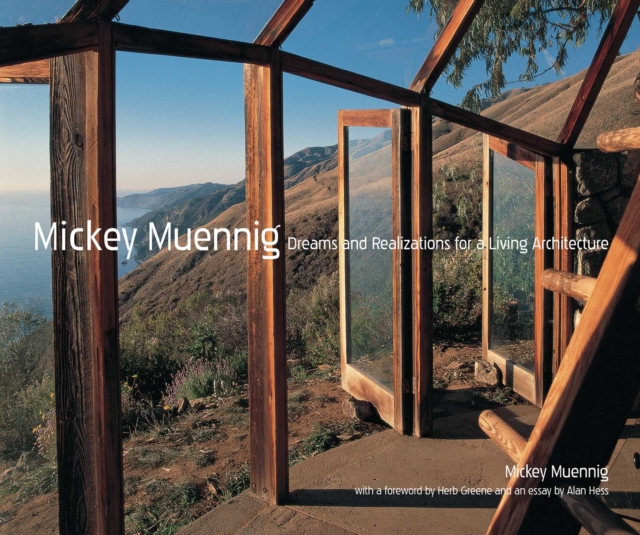
Mickey Muenning
This is the first monograph featuring the work of architect Mickey Muennig.Muennig is an important proponent of organic architecture, creating highly individualized structures and spaces that express the dreams and needs of his clients, while complementing the natural environment.
eBook

Frank Lloyd Wright : unpacking the archive
Published for a major exhibition at The Museum of Modern Art, this catalog reveals new perspectives on the work of Frank Lloyd Wright. Structured as a series of inquiries into the Frank Lloyd Wright Foundation Archives at Taliesin West, Arizona, the book is a collection of scholarly explorations rather than an attempt to construct a master narrative. Each chapter centers on a key object from the archive that aninvited author has \"unpacked\" -- tracing its meanings and connections, and juxtaposing it with other works from the archive, from MoMA, or from outside collections. The publication aims to open up Wright's work to questions, interrogations and debates, and to highlight interpretations by contemporary scholars, both established Wright experts and others considering this iconic figure from new and illuminating perspectives.
Book

Nature by design : the practice of biophilic design
Biophilia is the theory that people possess an inherent affinity for nature, which developed during the long course of human evolution. In recent years, studies have revealed that this inclination continues to be a vital component to human health and wellbeing. Given the pace and scale of construction today with its adversarial, dominative relationship with nature, the integration of nature with the built environment is one of the greatest challenges of our time. In this sweeping examination, Stephen Kellert describes the basic principles, practices, and options for successfully implementing biophilic design. He shows us what is-and isn't-good biophilic design using examples of workplaces, healthcare facilities, schools, commercial centers, religious structures, and hospitality settings. This book will to appeal to architects, designers, engineers, scholars of human evolutionary biology, and-with more than one hundred striking images of designs-anyone interested in nature-inspired spaces.
eBook


Evolution of public library architecture as based on the work of Alvar Aalto and the extension of the Seinäjoki library
The end of the 20
century was a period of dynamic change for libraries. The growing popularity of new media, the development of television and especially the Internet, changes in the way societies, economies and industries functioned have all had a significant impact on the way libraries are run. Just as libraries used to be important places for acquiring knowledge, for accessing information, today the flow of information is different, and the book as a product is no longer as attractive, but also, even in the context of libraries, has ceased to be the main element of their operation. Institutions have found a solution to this problem by attracting audiences with both a more interesting and varied cultural offer.
The paper discusses how library architecture has evolved over the centuries on the case study of the extension of the public library in Seinäjoki. Finnish city is also known for the work of Alvar Aalto, who created a civic centre that also became the site of one of the most interesting libraries. Aalto was passionate about this form of use, which accompanied him through various stages of his career. Given that the old building and the new one were built less than half a century apart, it is interesting from a research point of view to compare their architecture, aesthetics and approach to spatial organisation.
Journal Article


Measuring the geometry of nature and architecture: comparing the visual properties of Frank Lloyd Wright's Fallingwater and its natural setting
Purpose>Frank Lloyd Wright's famous house Fallingwater has been the subject of enduring scholarly debate centred on the allegedly clear parallels between its form and that of its surrounding natural setting. Despite these claims being repeated many times, no quantitative approach has ever been used to test this argument. In response, this paper uses a quantitative method, fractal analysis, to measure the relationship between the architecture of Fallingwater and of its natural surroundings.Design/methodology/approach>Using fractal dimension analysis, a computational method that mathematically measures the characteristic visual complexity of an object, this paper mathematically measures and tests the similarity between the visual properties of Fallingwater and its natural setting. Twenty analogues of the natural surroundings of Fallingwater are measured and the results compared to those developed for the properties of eight views of the house.Findings>Although individual results suggest various levels of visual similarity or difference, the complete set of results do not support the claim that the form of Frank Lloyd Wright's Fallingwater exhibits clear visual similarities to the surrounding landscape.Originality/value>In addition to testing a prominent theory about Wright's building for the first time, the paper demonstrates a rare application of fractal analysis to interpreting relations between architecture and nature.
Journal Article