
Catalogue Search | MBRL


Are you sure you want to remove the book from the shelf?

{{itemTitle}}
4,539
result(s) for
"Organizational effectiveness Decision making."
Sort by:

The 5% rule of leadership : using lean decision-making to drive superior outcomes
\"In The 5% Rule of Leadership: Using Lean Decision-Making to Drive Superior Outcomes, Anil Singhal, co-founder of NetScout Systems, reveals his contrarian approach to creating a powerhouse organization that will thrive in any climate and stand the test of time. He asserts that, for a business to be able to withstand major environmental shifts and disruptions and last for decades, the leader only needs to be involved in the first 5% of any given project--whether building a new product, creating a major go-to-market initiative, acquiring a company or starting a new company. Adapting the Pareto Principle, which states that roughly 80% of consequences come from 20% of causes, Anil asserts that decisions during the first 5% of any project or initiative results in 95% of the consequences. He suggests this principle involves creating a value system of authenticity, inclusivity, ownership, equity, and trust among all stakeholders to create a workforce of good corporate citizens in which everyone shares in the risks and rewards\"-- Provided by publisher.
BOOK
The data driven leader : a powerful approach to delivering measurable business impact through people analytics
Data is your most valuable leadership asset—here's how to use it
The Data Driven Leader presents a clear, accessible guide to solving important leadership challenges through human resources-focused and other data analytics. This engaging book shows you how to transform the HR function and overall organizational effectiveness by using data to make decisions grounded in facts vs. opinions, identify root causes behind your company's thorniest problems and move toward a winning, future-focused business strategy. Realistic and actionable, this book tells the story of a successful sales executive who, after leading an analytics-driven turnaround (in Data Driven, this book's predecessor), faces a new turnaround challenge as chief human resources officer. Each chapter features insightful commentary and practical notes on the points the story raises, guiding you to put HR analytics into action in your organization.
HR and other leaders cannot afford to overlook the power and competitive advantages of data-driven decision-making and strategies. This book reflects the growing trend of CEOs choosing analytics-minded business leaders to head HR, at a time when workplaces everywhere face game-changing forces including automation, robotics and artificial intelligence. It is urgent that human resources leaders embrace analytics, not only to remain professionally relevant but also to help their organizations successfully navigate this digital transformation. HR professionals can and must:
* Understand essential data science principles and corporate analytics models
* Identify and execute effective data analytics initiatives
* Boost HR and company productivity and performance with metrics that matter
* Shape an analytics-centric culture that generates data driven leaders
Most organizations capture and report data, but data is useless without analysis that leads to action. The Data Driven Leader shows you how to use this tremendous asset to lead your organization higher.
eBook
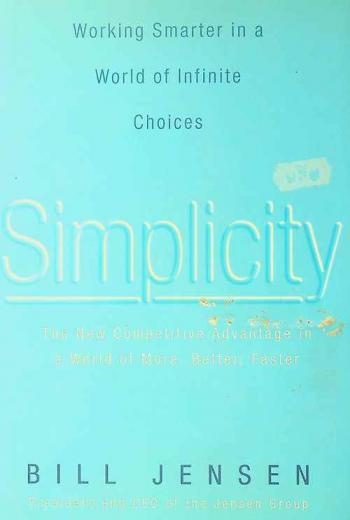
Simplicity : the new competitive advantage in a world of more, better, faster
The greatest challenge that people and companies face isn't from the competition, the marketplace or anything else out there. It is from confusion within organizations. Simplicity, outlined here, is the disciplined use of one skill and one tool.
Book


The data driven leader : a powerful approach to delivering measurable business impact through people analytics
\"This book presents a clear, accessible guide to solving important leadership challenges through human resources-focused and other data analytics. This engaging book shows you how to transform the HR function and overall organizational effectiveness by using data to make decisions grounded in facts vs. opinions, identify root causes behind your company's thorniest problems and move toward a winning, future-focused business strategy. Realistic and actionable, this book tells the story of a successful sales executive who, after leading an analytics-driven turnaround (in Data Driven, this book's predecessor), faces a new turnaround challenge as chief human resources officer. Each chapter features insightful commentary and practical notes on the points the story raises, guiding you to put HR analytics into action in your organization\"-- Provided by publisher.
Book

Estimating a cost-effectiveness threshold for health care decision-making in South Africa
Abstract
Cost-effectiveness thresholds are important decision rules that determine whether health interventions represent good value for money. In low- and middle-income countries, the World Health Organization (WHO) one to three times per capita gross domestic product (GDP) per disability-adjusted life years (DALYs) averted has been the most widely used threshold for informing resource allocation decisions. However, in 2016, the WHO withdrew recommendations for using this threshold, creating a significant vacuum in South Africa and many countries that rely on results of cost-effectiveness analyses for making resource allocation decisions. This study estimates a cost-effectiveness threshold that reflects the health opportunity cost of health spending in South Africa using a three-step approach. First, marginal returns to health spending was estimated as health spending elasticity for crude death rates using a fixed effect estimation approach. Second, the opportunity cost of health spending was estimated as DALYs averted. Finally, a cost per DALY averted threshold was estimated as the inverse of the marginal product of health spending. We show that 1% of total health spending in 2015 (equivalent to approximately ZAR 1.54 billion/USD 120.7 million) averted 1050 deaths, 34 180 years of life lost, 5880 years lived with disability and 40 055 DALYs. The cost-effectiveness threshold was estimated at approximately ZAR 38 500 (USD 3015) per DALY averted, ∼53% of South Africa’s per capita GDP in 2015 (ZAR 72 700/USD 5700) and lower than the previously recommended one to three times per capita GDP. As South Africa moves towards implementing universal health coverage reforms through National Health Insurance by 2025, the adoption of a threshold that reflects health opportunity costs will be crucial for ensuring efficiency in the allocation of scarce resources. This study provides useful insight into the magnitude of the health opportunity cost of health spending in South Africa and highlights the need for further research.
Journal Article

Visual Six Sigma : making data analysis lean
'Visual Six Sigma' provides the statistical techniques that help you get more information from your data. A unique emphasis on the visual allows you to take a more active role in data-driven decision making, so you can leverage your contextual knowledge to pose relevant questions and make more sound decisions. You'll learn dynamic visualization and exploratory data analysis techniques that help you identify occurrences and sources of variation, and the strategies and processes that make Six Sigma work for your organisation. This updated third edition includes new information on data quality, presentation, and analysis, with new, streamlined case studies featuring the latest functionalities in JMP 11 and JMP 11 Pro.
Book

The Impact of Corporate Sustainability on Organizational Processes and Performance
We investigate the effect of corporate sustainability on organizational processes and performance. Using a matched sample of 180 U.S. companies, we find that corporations that voluntarily adopted sustainability policies by 1993—termed as
high sustainability
companies—exhibit by 2009 distinct organizational processes compared to a matched sample of companies that adopted almost none of these policies—termed as
low sustainability
companies. The boards of directors of high sustainability companies are more likely to be formally responsible for sustainability, and top executive compensation incentives are more likely to be a function of sustainability metrics. High sustainability companies are more likely to have established processes for stakeholder engagement, to be more long-term oriented, and to exhibit higher measurement and disclosure of nonfinancial information. Finally, high sustainability companies significantly outperform their counterparts over the long term, both in terms of stock market and accounting performance.
This paper was accepted by Bruno Cassiman, business strategy.
Journal Article


Big data management and environmental performance: role of big data decision-making capabilities and decision-making quality
PurposeThis study is undertaken to examine the antecedents and role of big data decision-making capabilities toward decision-making quality and environmental performance among the Chinese public and private hospitals. It also examined the moderating effect of big data governance that was almost ignored in previous studies.Design/methodology/approachThe target population consisted of managerial employees (IT experts and executives) in hospitals. Data collected using a survey questionnaire from 752 respondents (374 respondents from public hospitals and 378 respondents from private hospitals) was subjected to PLS-SEM for analysis.FindingsFindings revealed that data management challenges (leadership focus, talent management, technology and organizational culture for big data) are significant antecedents for big data decision-making capabilities in both public and private hospitals. Moreover, it was also found that big data decision-making capabilities played a key role to improve the decision-making quality (effectiveness and efficiency), which positively contribute toward environmental performance in public and private hospitals of China. Public hospitals are playing greater attention to big data management for the sake of quality decision-making and environmental performance than private hospitals.Practical implicationsThis study provides guidelines required by hospitals to strengthen their big data capabilities to improve decision-making quality and environmental performance.Originality/valueThe proposed model provides an insight look at the dynamic capabilities theory in the domain of big data management to tackle the environmental issues in hospitals. The current study is the novel addition in the literature, and it identifies that big data capabilities are envisioned to be a game-changer player in effective decision-making and to improve the environmental performance in health sector.
Journal Article