
Catalogue Search | MBRL


Are you sure you want to remove the book from the shelf?

{{itemTitle}}
38
result(s) for
"Orthodox Eastern Church-Doctrines"
Sort by:


Orthodox Constructions of the West
The category of the \"West\" has played a particularly significant role in the modern Eastern Orthodox imagination. It has functioned as an absolute marker of difference from what is considered to be the essence of Orthodoxy, and, thus, ironically, has become a constitutive aspect of the modern Orthodox self. The essays collected in this volume examines the many factors that contributed to the \"Eastern\" construction of the \"West\" in order to understand why the \"West\" is so important to the Eastern Christian's sense of self.
eBook

The Eastern Orthodox Church
An insider's account of the Eastern Orthodox Church, from its beginning in the era of Jesus and the Apostles to the modern age In this short, accessible account of the Eastern Orthodox Church, John McGuckin begins by tackling the question \"What is the Church?\" His answer is a clear, historically and theologically rooted portrait of what the Church is for Orthodox Christianity and how it differs from Western Christians' expectations. McGuckin explores the lived faith of generations, including sketches of some of the most important theological themes and individual personalities of the ancient and modern Church. He interweaves a personal approach throughout, offering to readers the experience of what it is like to enter an Orthodox church and witness its liturgy. In this astute and insightful book, he grapples with the reasons why many Western historians and societies have overlooked Orthodox Christianity and provides an important introduction to the Orthodox Church and the Eastern Christian World.
eBook
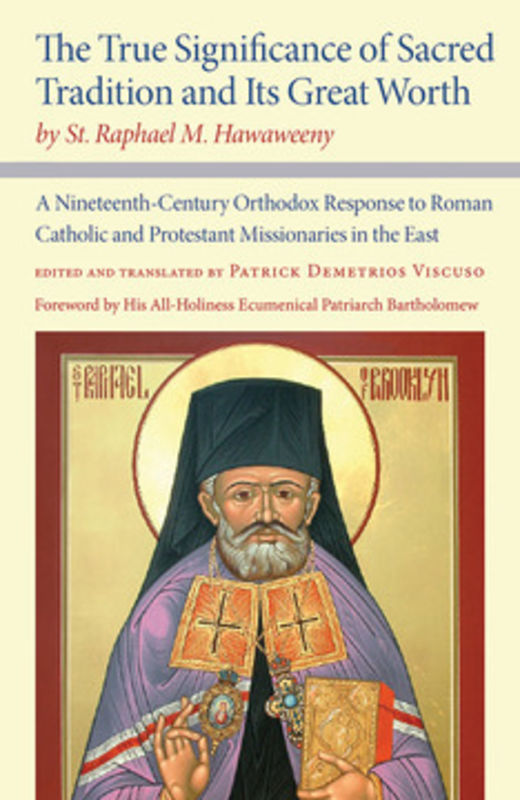
The True Significance of Sacred Tradition and Its Great Worth, by St. Raphael M. Hawaweeny
Never before published, the theological thesis of St. Raphael Hawaweeny (1860–1915) is a fascinating work that shows the intersection of Roman Catholicism, Protestantism, and Eastern Orthodoxy in the late nineteenth century. Canonized by the Orthodox Church in 2000, St. Raphael was the first Orthodox bishop consecrated in the western hemisphere. His thesis reflects the life of the Orthodox community under Ottoman rule and is an apologia for Orthodox tradition, acting as a response to arguments advanced by Roman Catholic and Protestant missionaries in the Middle East. Patrick Viscuso's introduction explains the complex historical and theological forces at work in St. Raphael's world.Since the sixteenth century, the Roman Catholic Church had launched major proselytization efforts toward Orthodox Christians in the Ottoman Empire, with the support of the great Western powers. In the late nineteenth century, the United States dominated Protestant efforts in the region. The powerful language in St. Raphael's thesis and his refutation of Roman Catholic and Protestant positions reflect an active dialogue with Western Christianity. The thesis, dated May 1, 1886 was written as part of the requirements for graduation from the Theological School of the Great Church of Christ, an institution of the Ecumenical Patriarchate located on the island of Halki in the Sea of Marmara, near present-day Istanbul. Patrick Viscuso's translation is based on his transcription of the handwritten Greek text. Viscuso provides this transcription, along with translations of the 1874 Regulations of the Theological School and a contemporary account of life at the school. This important volume will appeal to historians of the Ottoman Empire and Christianity, specialists interested in religious pluralism in America, and general readers interested in religion and Christian dialogue.
eBook
Georgian Christian Thought and Its Cultural Context
The volume contains contributions dedicated to the personality and the work of Shalva Nutsubidze, Christian Orient from the fifth to the seventh century, Georgian eleventh century, the Neoplatonic philosopher Ioane Petritsi and his epoch and Shota Rustaveli and mediaeval Georgian culture.
eBook

Liturgical Subjects
Liturgical Subjects examines the history of the self in the Byzantine Empire, challenging narratives of Christian subjectivity that focus only on classical antiquity and the Western Middle Ages. As Derek Krueger demonstrates, Orthodox Christian interior life was profoundly shaped by patterns of worship introduced and disseminated by Byzantine clergy. Hymns, prayers, and sermons transmitted complex emotional responses to biblical stories, particularly during Lent. Religious services and religious art taught congregants who they were in relation to God and each other.Focusing on Christian practice in Constantinople from the sixth to eleventh centuries, Krueger charts the impact of the liturgical calendar, the eucharistic rite, hymns for vigils and festivals, and scenes from the life of Christ on the making of Christian selves. Exploring the verse of great Byzantine liturgical poets, including Romanos the Melodist, Andrew of Crete, Theodore the Stoudite, and Symeon the New Theologian, he demonstrates how their compositions offered templates for Christian self-regard and self-criticism, defining the Christian \"I.\" Cantors, choirs, and congregations sang in the first person singular expressing guilt and repentence, while prayers and sermons defined the collective identity of the Christian community as sinners in need of salvation. By examining the way models of selfhood were formed, performed, and transmitted in the Byzantine Empire, Liturgical Subjects adds a vital dimension to the history of the self in Western culture.
eBook

Science and Eastern Orthodoxy : from the Greek fathers to the age of globalization
People have pondered conflicts between science and religion since at least the time of Christ. The millennia-long debate is well documented in the literature in the history and philosophy of science and religion in Western civilization. Science and Eastern Orthodoxy is a departure from that vast body of work, providing the first general overview of the relationship between science and Christian Orthodoxy, the official church of the Oriental Roman Empire.
This pioneering study traces a rich history over an impressive span of time, from Saint Basil's Hexameron of the fourth century to the globalization of scientific debates in the twentieth century. Efthymios Nicolaidis argues that conflicts between science and Greek Orthodoxy—when they existed—were not science versus Christianity but rather ecclesiastical debates that traversed the whole of society.
Nicolaidis explains that during the Byzantine period, the Greek fathers of the church and their Byzantine followers wrestled passionately with how to reconcile their religious beliefs with the pagan science of their ancient ancestors. What, they repeatedly asked, should be the church's official attitude toward secular knowledge? From the rise of the Ottoman Empire in the fifteenth century to its dismantling in the nineteenth century, the patriarchate of Constantinople attempted to control the scientific education of its Christian subjects, an effort complicated by the introduction of European science in the seventeenth and eighteenth centuries.
Science and Eastern Orthodoxy provides a wealth of new information concerning Orthodoxy and secular knowledge—and the reactions of the Orthodox Church to modern sciences.
eBook

The mystical as political : democracy and non-radical Orthodoxy
Theosis, or the principle of divine-human communion, sparks the theological imagination of Orthodox Christians and has been historically important to questions of political theology. In The Mystical as Political: Democracy and Non-Radical Orthodoxy, Aristotle Papanikolaou argues that a political theology grounded in the principle of divine-human communion must be one that unequivocally endorses a political community that is democratic in a way that structures itself around the modern liberal principles of freedom of religion, the protection of human rights, and church-state separation. Papanikolaou hopes to forge a non-radical Orthodox political theology that extends beyond a reflexive opposition to the West and a nostalgic return to a Byzantine-like unified political-religious culture. His exploration is prompted by two trends: the fall of communism in traditionally Orthodox countries has revealed an unpreparedness on the part of Orthodox Christianity to address the question of political theology in a way that is consistent with its core axiom of theosis; and recent Christian political theology, some of it evoking the notion of “deification,” has been critical of liberal democracy, implying a mutual incompatibility between a Christian worldview and that of modern liberal democracy. The first comprehensive treatment from an Orthodox theological perspective of the issue of the compatibility between Orthodoxy and liberal democracy, Papanikolaou’s is an affirmation that Orthodox support for liberal forms of democracy is justified within the framework of Orthodox understandings of God and the human person. His overtly theological approach shows that the basic principles of liberal democracy are not tied exclusively to the language and categories of Enlightenment philosophy and, so, are not inherently secular.
eBook

Liturgical Theology after Schmemann
While only rarely reflecting explicitly on liturgy, French philosopher Paul Ricoeur (1913-2005) gave sustained attention to several themes pertinent to the interpretation of worship, including metaphor, narrative, subjectivity, and memory. Inspired by his well-known aphorism, \"The symbol gives rise to thought,\" Liturgical Theology after Schmemann offers an original exploration of the symbolic world of the Byzantine Rite , culminating in a Ricoeurian analysis of its Theophany \"Great Blessing of Water.\" .
The book examines two fundamental questions: 1) what are the implications of the philosopher's oeuvre for liturgical theology at large? And 2)how does the adoption of a Ricoeurian hermeneutic shape the study of a particular rite? Taking the seminal legacy of Orthodox theologian Alexander Schmemann (1921-1983) as its point of departure, Butcher contributes to the renewal of contemporary Eastern Christian thought and ritual practice by engaging a spectrum of current theological and philosophical conversations.
eBook

Dynamis of Healing
This book explores how traces of the energies and dynamics of Orthodox Christian theology and anthropology may be observed in the clinical work of depth psychology. Looking to theology to express its own religious truths and to psychology to see whether these truth claims show up in healing modalities, the author creatively engages both disciplines in order to highlight the possibilities for healing contained therein. Dynamis of Healing elucidates how theology and psychology are by no means fundamentally at odds with each other but rather can work together in a beautiful and powerful synergia to address both the deepest needs and deepest desires of the human person for healing and flourishing.
eBook