
Catalogue Search | MBRL


Are you sure you want to remove the book from the shelf?

{{itemTitle}}
22
result(s) for
"Osgerby, Jay."
Sort by:
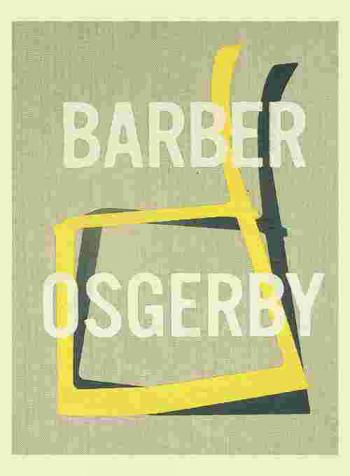

Edward Barber and Jay Osgerby, Seeking the Void and Then Filling It
Edward Barber and Jay Osgerby met when they were architecture students at the Royal College of Art in London, and founded their firm, Barber Osgerby, shortly after graduation, in 1996. [...] they have quietly taken the design world by storm, winning numerous awards and creating products for the likes of Cappellini, Flos, Vitra, Established & Sons, Sony and even Coca-Cola, which commissioned them to design a new bottle.
Newspaper Article


Design history in making
IRISH Design 2015 is a year-long programme dedicated to exploring, promoting and celebrating Irish design and designers, both nationally and internationally. The first exhibition of the programme -- called In The Making -- is currently running at the Coach House, Dublin Castle.
Newspaper Article

Barber Osgerby : projects
This definitive monograph of the acclaimed designers includes stunning images - many unpublished - with six essays from influential figures in design. Collaborators for over 20 years, Edward Barber and Jay Osgerby have applied their talents to everything from industrial design and furniture to lighting and installations. The most comprehensive survey of their work to date, this book offers a unique, 360-degree view of their approach and working methods. Stunning images explore their work thematically, while six essays provide an exclusive look into career-defining projects.
BOOK

The New Review: Critics: Design: Can you tell what it is yet?: Curated by design duo Barber Osgerby, In the Making freeze-frames the production process of everyday objects: In the Making Design Museum, London SE1; Wed to 4 May
The chamfers and tapers of the Tip Ton chair by Edward Barber and Jay Osgerby are doing all these things, but it is not obvious which is doing what. Instead these variations are unified into an elegant, robust object of a single substance and colour. They serve the chair's most important idea, which is that it can half-rock, which enables a sitting position, a sort of forward-leaning perch, which is both good for the back and (again) the circulation of blood. If children like to tilt their chairs, it is not just to annoy, but also because it is good for them - it makes them more alert - and the Tip Ton chair makes a virtue of this fact. Although it sells healthily to individual buyers in shops such as John Lewis, the chair is mainly intended for schools. They started in [Barber Osgerby]'s flat in the Trellick Tower, the concrete monolith designed by Erno Goldfinger, which is famous for its changes from being progressive council housing, to tabloid-derided \"vertical slum\", to gentrified and sought-after design classic. Now they run an office of 60 people behind an anonymous door in Shoreditch, their premises expanding like a subterranean watercourse into the basements and spare spaces of adjoining buildings. Captions: Unfinished items from the In the Making exhibition at the Design Museum (clockwise from top left): a French horn; an optical lens, using Swarovski glass; a Coke can; and part of a football boot. Below: Barber Osgerby's Tip Ton chair, designed with schoolchildren in mind. Photographs by Gyorgy Korossy
Newspaper Article

What's in a table? Class and a dab of humor
\"There's so much energy in their designs, but it's compressed: there are no sudden explosions, but a consistent elegance,\" said Piero Gandini, chairman of the Italian lighting company Flos. Gareth Williams, a curator at the Victoria & Albert Museum in London, describes BarberOsgerby's work as \"well-resolved and thoughtful, often quite sober, but not without lightness.\" He sees parallels with \"the rather unsung generation of British furniture designers, like Ernest Race, emerging after World War II, and mixing Modernism with arts and crafts ideals.\" Each of their projects is developed collaboratively. \"One or other of us will come up with the initial idea, and we then spend a good deal of time refining it,\" said [Jay Osgerby]. \"Hopefully that dialogue gives the work depth and detail. As there are two of us we tend to push it.\" They enjoy experimenting with new materials and technologies, and working on different scales, from mass production for Flos and Panasonic, to limited editions like the Iris tables and the handcrafted pieces launched in Milan last month for Meta. All of their clients comment on their commitment to detail. \"It's in those details that their talent shines,\" said Alasdhair Willis, chief executive of Established & Sons. Louise-Anne Comeau, Meta's co-creative director, recalls their producing \"over a hundred drawings and mock-ups\" for one candelabrum. Restrained though BarberOsgerby's designs may be, their concepts are so clearly defined and detailing so precise, that their work has a distinctive signature, something that few designers achieve, especially without resorting to sensationalism. \"There's something that makes our work easily readable,\" said Osgerby. \"It's not overly complex, so you don't get lost in the geometry. We produce things logically, not whimsically, because we want them to have longevity.\"
Newspaper Article

G2: Arts: Before they were famous: This green strip is destined to become a football boot - and that brass torture device is actually a pair of taps ... Oliver Wainwright on the secret lives of design classics
\"We spend a lot of time in factories,\" says Barber. \"It's the first place we go when we get a new commission, and we often see things that are more beautiful in their unfinished state than in the completed product.\" \"We've been fascinated by how things are made since playschool,\" says Osgerby, who grew up opposite a hat factory, where he would spend happy hours rifling through the bins to find scraps of leather and felt. Barber's dad was a DIY enthusiast, so there was rarely a weekend when he wasn't helping out, hammer or saw in hand. \"We're trying to get people excited about the making process again,\" adds Osgerby. \"Some of these things have a real abstract beauty, and some of the techniques are not at all what you'd imagine.\"
Newspaper Article
Engineers' work on sculpture is no fluke
RE [Harvey Cooke], based in Stretton Business Park, was commissioned by designers Edward Barber and Jay Osgerby to turn their ideas into reality and manufactured The Fluke - a 1.3-tonne sculpture inspired by the lobe of a whale's tail and the palm of an anchor. \"We are delighted with RE Cooke's expertise in manufacturing this impressive three-metre high by four-metre wide sculpture from 8mm Cor-Ten steel plate.\"
Newspaper Article