
Catalogue Search | MBRL


Are you sure you want to remove the book from the shelf?

{{itemTitle}}
36,791
result(s) for
"Otto"
Sort by:

Non-Markovian quantum Otto refrigerator
Based on a recently developed non-perturbative platform designed to simulate the full quantum dynamics of quantum thermal machines, the situation of a quantum refrigerator operating according to an Otto cycle is studied. The periodic steady-state dynamics is discussed in detail as well as the key thermodynamic quantities work, heat, and entropy. A particular benefit of the formulation is that it allows to access explicitly the work required for switching on and off the interaction with the respective thermal reservoirs in a consistent way. The domains in which the device operates in refrigerator mode are characterized.
Journal Article


Polyborato Complexes of Tungsten: Mapping Steric vs. Electronic Features of IFacially/I Coordinating Ligands
A convenient synthesis of [HB(HImMe)[sub.3]](PF[sub.6])[sub.2] (ImMe = N-methylimidazolyl) is decribed. This salt serves in situ as a precursor to the tris(imidazolylidenyl)borate Li[HB(ImMe)[sub.3]] pro-ligand upon deprotonation with nBuLi. Reaction with [W(≡CC[sub.6]H[sub.4]Me-4)(CO)[sub.2](pic)[sub.2](Br)] (pic = 4-picoline) affords the carbyne complex [W(≡CC[sub.6]H[sub.4]Me-4)(CO)[sub.2]HB(ImMe)[sub.3]]. Interrogation of experimental and computational data for this compound allow a ranking of familiar tripodal and facially coordinating ligands according to steric (percentage buried volume) and electronic (ν[sub.CO]) properties. The reaction of [W(≡CC[sub.6]H[sub.4]Me-4)(CO)[sub.2]HB(ImMe)[sub.3]] with [AuCl(SMe[sub.2])] affords the heterobimetallic semi-bridging carbyne complex [WAu(μ-CC[sub.6]H[sub.4]Me-4)(CO)[sub.2](Cl)HB(ImMe)[sub.3]].
Journal Article

Quantum supremacy of many-particle thermal machines
While the emergent field of quantum thermodynamics has the potential to impact energy science, the performance of thermal machines is often classical. We ask whether quantum effects can boost the performance of a thermal machine to reach quantum supremacy, i.e., surpassing both the efficiency and power achieved in classical thermodynamics. To this end, we introduce a nonadiabatic quantum heat engine operating an Otto cycle with a many-particle working medium, consisting of an interacting Bose gas confined in a time-dependent harmonic trap. It is shown that thanks to the interplay of nonadiabatic and many-particle quantum effects, this thermal machine can outperform an ensemble of single-particle heat engines with same resources, demonstrating the quantum supremacy of many-particle thermal machines.
Journal Article

POST OTTO WAGNER : Von der Postsparkasse zur Postmoderne = From the Postal Savings Bank to Post-Modernism
Otto Wagner is considered as the \"father of the Viennese modernism\" and one of the most important international architects. The publication on the MAK exhibition illustrates the resonance of Wagner?s oeuvre by protagonists of early modernism as well as his influence on his contemporaries, students and subsequent generations of architects and designers such as Josef Hoffmann, Jo?e Plecnik, Leopold Bauer, Rudolph M. Schindler, Frank Lloyd Wright, Auguste Perret, Frei Otto, Aldo Rossi and Robert Venturi/Denise Scott Brown.0With generous and often unknown image material the book illustrates Wagner?s influence on international architecture from the turn of the century to the present, and thus a link between the intricate relationship of modernism and postmodernism.
BOOK

Otto Warburg's contributions to current concepts of cancer metabolism
Key Points
Otto Warburg was a pioneering biochemistry researcher who made substantial contributions to our early understanding of cancer metabolism. Warburg was awarded the Nobel Prize in Physiology or Medicine in 1931 for his discovery of cytochrome
c
oxidase, not for his work on cancer and the formulation of the Warburg hypothesis.
The Warburg effect is the reverse of the Pasteur effect (the inhibition of fermentation by O
2
) exhibited by cancer cells; alteration of the Pasteur effect in cancer is linked to prolyl hydroxylases and hypoxia-inducible factor (HIF).
Tumour suppressors and oncogenes converge on HIF to reverse the Pasteur effect and thereby induce the Warburg effect.
Cancer cells carry out aerobic glycolysis and respiration concurrently.
Tumour suppressors and oncogenes exert direct effects on metabolism: p53 promotes the pentose phosphate pathway and oxidative phosphorylation; MYC induces glycolysis and glutamine metabolism.
Mutations in metabolic enzymes, specifically isocitrate dehydrogenase 1 (IDH1) and IDH2 and other citric acid cycle enzymes, are causally linked to familial and spontaneous cancers.
Otto Warburg has contributed important data and hypotheses to the fields of cancer research and metabolism, but what did he actually find and what conclusions did he draw? This Review looks at the life and research of Otto Warburg and places his work in the context of our current understanding of metabolism and hypoxia in cancer.
Otto Warburg pioneered quantitative investigations of cancer cell metabolism, as well as photosynthesis and respiration. Warburg and co-workers showed in the 1920s that, under aerobic conditions, tumour tissues metabolize approximately tenfold more glucose to lactate in a given time than normal tissues, a phenomenon known as the Warburg effect. However, this increase in aerobic glycolysis in cancer cells is often erroneously thought to occur instead of mitochondrial respiration and has been misinterpreted as evidence for damage to respiration instead of damage to the regulation of glycolysis. In fact, many cancers exhibit the Warburg effect while retaining mitochondrial respiration. We re-examine Warburg's observations in relation to the current concepts of cancer metabolism as being intimately linked to alterations of mitochondrial DNA, oncogenes and tumour suppressors, and thus readily exploitable for cancer therapy.
Journal Article
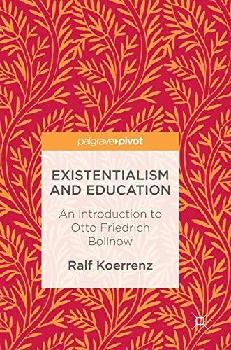
Existentialism and education : an introduction to Otto Friedrich Bollnow
This volume examines Otto Friedrich Bollnow's philosophical approach to education, which brought Heidegger's existentialism together with other theories of what it is to be \"human.\" This introduction to Bollnow's work begins with a summary of the theoretical influences that Bollnow synthesized, and goes on to outline his highly original account of experiential \"educational reality\"--namely, as a reality alternately \"harmonious\" or \"broken,\" but fundamentally \"guided.\" This book will be of value to scholars and students of education and philosophy, especially those interested in bringing larger existential questions into connection with everyday educational engagement.
Book
A quantum Otto engine with finite heat baths: energy, correlations, and degradation
We study a driven harmonic oscillator operating an Otto cycle by strongly interacting with two thermal baths of finite size. Using the tools of Gaussian quantum mechanics, we directly simulate the dynamics of the engine as a whole, without the need to make any approximations. This allows us to understand the non-equilibrium thermodynamics of the engine not only from the perspective of the working medium, but also as it is seen from the thermal baths' standpoint. For sufficiently large baths, our engine is capable of running a number of perfect cycles, delivering finite power while operating very close to maximal efficiency. Thereafter, having traversed the baths, the perturbations created by the interaction abruptly deteriorate the engine's performance. We additionally study the correlations generated in the system, and, in particular, we find a direct connection between the build up of bath-bath correlations and the degradation of the engine's performance over the course of many cycles.
Journal Article