
Catalogue Search | MBRL


Are you sure you want to remove the book from the shelf?

{{itemTitle}}
15,476
result(s) for
"Outer space Exploration."
Sort by:


Solar and Space Physics
From the interior of the Sun, to the upper atmosphere and near-space environment of Earth, and outward to a region far beyond Pluto where the Sun's influence wanes, advances during the past decade in space physics and solar physics-the disciplines NASA refers to as heliophysics-have yielded spectacular insights into the phenomena that affect our home in space.
Solar and Space Physics , from the National Research Council's (NRC's) Committee for a Decadal Strategy in Solar and Space Physics, is the second NRC decadal survey in heliophysics. Building on the research accomplishments realized during the past decade, the report presents a program of basic and applied research for the period 2013-2022 that will improve scientific understanding of the mechanisms that drive the Sun's activity and the fundamental physical processes underlying near-Earth plasma dynamics, determine the physical interactions of Earth's atmospheric layers in the context of the connected Sun-Earth system, and enhance greatly the capability to provide realistic and specific forecasts of Earth's space environment that will better serve the needs of society.
Although the recommended program is directed primarily at NASA and the National Science Foundation for action, the report also recommends actions by other federal agencies, especially the parts of the National Oceanic and Atmospheric Administration charged with the day-to-day (operational) forecast of space weather. In addition to the recommendations included in this summary, related recommendations are presented in this report.
eBook

Space discoveries
\"Imagine discovering new planets light years away or galaxies you never knew existed. Readers learn all about new and amazing space discoveries in these carefully-leveled and engaging books reviewed by Smithsonian experts\"-- Provided by publisher.
Book
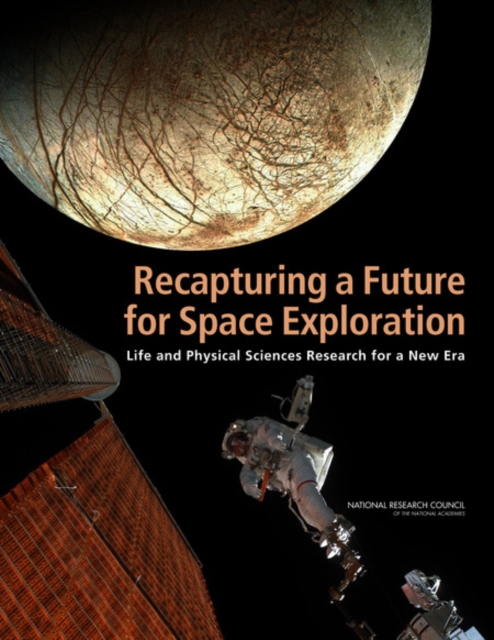
Recapturing a Future for Space Exploration
More than four decades have passed since a human first set foot on the Moon. Great strides have been made in our understanding of what is required to support an enduring human presence in space, as evidenced by progressively more advanced orbiting human outposts, culminating in the current International Space Station (ISS). However, of the more than 500 humans who have so far ventured into space, most have gone only as far as near-Earth orbit, and none have traveled beyond the orbit of the Moon. Achieving humans' further progress into the solar system had proved far more difficult than imagined in the heady days of the Apollo missions, but the potential rewards remain substantial.
During its more than 50-year history, NASA's success in human space exploration has depended on the agency's ability to effectively address a wide range of biomedical, engineering, physical science, and related obstacles-an achievement made possible by NASA's strong and productive commitments to life and physical sciences research for human space exploration, and by its use of human space exploration infrastructures for scientific discovery. The Committee for the Decadal Survey of Biological and Physical Sciences acknowledges the many achievements of NASA, which are all the more remarkable given budgetary challenges and changing directions within the agency. In the past decade, however, a consequence of those challenges has been a life and physical sciences research program that was dramatically reduced in both scale and scope, with the result that the agency is poorly positioned to take full advantage of the scientific opportunities offered by the now fully equipped and staffed ISS laboratory, or to effectively pursue the scientific research needed to support the development of advanced human exploration capabilities.
Although its review has left it deeply concerned about the current state of NASA's life and physical sciences research, the Committee for the Decadal Survey on Biological and Physical Sciences in Space is nevertheless convinced that a focused science and engineering program can achieve successes that will bring the space community, the U.S. public, and policymakers to an understanding that we are ready for the next significant phase of human space exploration. The goal of this report is to lay out steps and develop a forward-looking portfolio of research that will provide the basis for recapturing the excitement and value of human spaceflight-thereby enabling the U.S. space program to deliver on new exploration initiatives that serve the nation, excite the public, and place the United States again at the forefront of space exploration for the global good.
eBook

Exploring space
\"Simple text and full-color photos present information about the past and future of space exploration\"--Provided by publisher.
Book
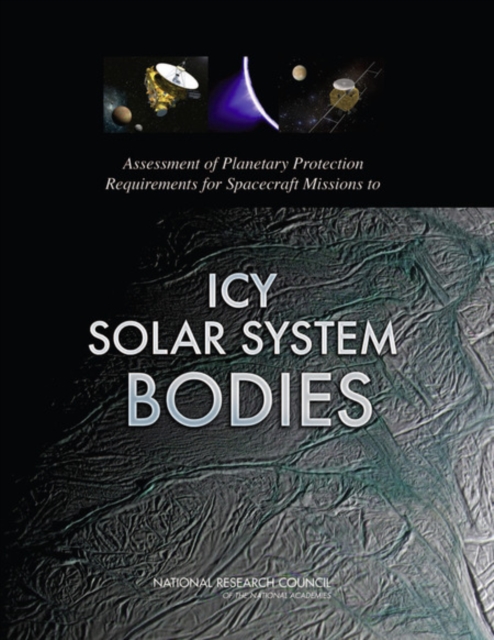
Assessment of Planetary Protection Requirements for Spacecraft Missions to Icy Solar System Bodies
NASA's exploration of planets and satellites during the past 50 years has led to the discovery of traces of water ice throughout the solar system and prospects for large liquid water reservoirs beneath the frozen ICE shells of multiple satellites of the giant planets of the outer solar system. During the coming decades, NASA and other space agencies will send flybys, orbiters, subsurface probes, and, possibly, landers to these distant worlds in order to explore their geologic and chemical context. Because of their potential to harbor alien life, NASA will select missions that target the most habitable outer solar system objects. This strategy poses formidable challenges for mission planners who must balance the opportunity for exploration with the risk of contamination by Earth's microbes, which could confuse the interpretation of data obtained from these objects.
The 2000 NRC report Preventing the Forward Contamination of Europa provided a criterion that was adopted with prior recommendations from the Committee on Space Research of the International Council for Science. This current NRC report revisits and extends the findings and recommendations of the 2000 Europa report in light of recent advances in planetary and life sciences and, among other tasks, assesses the risk of contamination of icy bodies in the solar system.
eBook

Reclaiming space : progressive and multicultural visions of space exploration
\"Space, to use a worn metaphor, is in the mind of the beholder. When we contemplate the seemingly limitless universe, we tend to project onto space our own hopes and dreams (as well as our fears and anxieties). But like responses to Rorschach inkblots, there are many different hopes, dreams, fears, and anxieties that one can project onto the night's sky. To those who approach it with a thirst for profits, space appears as a resource-rich goldmine, beckoning to anyone with enough wealth and privilege to take advantage of untapped markets. To those who approach it with a yearning for human expansion, space appears as a frontier that is humanity's birthright to conquer, its new manifest destiny. To those who approach it with a passion for knowledge and understanding, space appears as a tantalizing and pristine laboratory for scientific exploration. In these ways, our visions for humanity's future in space--what planets and moons we hope to visit, what we hope to accomplish when we get there--are more products of our perspectives about space (and our underlying worldviews and value systems) than anything else\"-- Provided by publisher.
BOOK

Shattered Dreams
Shattered Dreamsdelves into the personal stories and recollections of several men and women who were in line to fly a specific or future space mission but lost that opportunity due to personal reasons, mission cancellations, or even tragedies. While some of the subjects are familiar names in spaceflight history, the accounts of others are told here for the first time. Colin Burgess features spaceflight candidates from the United States, Russia, Indonesia, Australia, and Great Britain.Shattered Dreamsbrings to new life such episodes and upheavals in spaceflight history as the saga of the three Apollo missions that were cancelled due to budgetary constraints and never flew; NASA astronaut Patricia Hilliard Robertson, who died of burn injuries after her airplane crashed before she had a chance to fly into space; and a female cosmonaut who might have become the first journalist to fly in space. Another NASA astronaut was preparing to fly an Apollo mission before he was diagnosed with a disqualifying illness. There is also the amazing story of the pilot who could have bailed out of his damaged aircraft but held off while heroically avoiding a populated area and later applied to NASA to fulfill his cherished dream of becoming an astronaut despite having lost both legs in the accident. These are the incredibly human stories of competitive realists fired with an unquenchable passion. Their accounts reveal in their own words-and those of others close to them-how their shared ambition would go awry through personal accidents, illness, theChallengerdisaster, death, or other circumstances.
eBook


Human Spaceflight
Mars, the red planet named for the god of war, a mysterious dust-ridden place, is most like Earth in its climate and seasons. Of all the possible destinations in space to travel, Mars is the most likely for humans to reach. According to esteemed scientist Louis Friedman, it may be the only destination outside the moon to ever see human footprints.Far from diminishing our future in space,Human Spaceflightlays out a provocative future for human space travel. The noted aerospace engineer and scientist says that human space exploration will continue well into the future, but space travel by humans will stop at Mars. Instead, nanotechnology, space sails, robotics, biomolecular engineering, and artificial intelligence will provide the vehicles of the future for an exciting evolution not just of space travel but of humankind.Friedman has worked with agencies around the globe on space exploration projects to extend human presence beyond Mars and beyond the solar system. He writes that once we accept Mars as the only viable destination for humans, our space program on planet Earth can become more exciting and more relevant. Mars, he writes, will take hundreds, even thousands, of years to settle. During that time, humans and all our supporting technologies will evolve, allowing our minds to be present throughout the universe while our bodies stay home on Earth and Mars.
eBook