
Catalogue Search | MBRL


Are you sure you want to remove the book from the shelf?

{{itemTitle}}
596
result(s) for
"PÉREZ GALDÓS, BENITO (1843-1920)"
Sort by:
Wisdom of Eccentric Old Men
Bly's principal revelation is that Galdós deliberately and consistently used this secondary type to emphasize the significance of the major plot developments and to underline the strengths or weaknesses of principal characters. In filling these roles the eccentric old men develop from comic shallow types into more complex secondary characters, men of insight and wisdom, who occupy a pivotal position in the novels.
eBook

Benito Perez Galdos and the Creative Process
Most critics would rank Benito Perez Galdos second only to Cervantes among the great novelists of Spain. However, in spite of the esteem in which he is generally held, Galdos has been the subject of relatively few scholarly studies. Professor Pattison, by an analysis of two of Galdos’ novels, attempts to reconstruct the creative processes that were involved in the writing of these novels. This is the first time that such a critical approach has been used in the field of Spanish fiction and the resulting study is significant not only to Spanish scholars but to all students of literature seeking further insights into the fascinating and still elusive creative process. Professor Pattison analyzes the novels Gloria, published in 1877, and Marianela, which was published the following year. Both are stories of contemporary life, the former having as its theme the conflict between noble religion and the fanaticism of individual religious sects, and the latter presenting a story of tragic love interwoven with the social problem of the responsibilities of the rich toward the poor. In tracking down the sources of ideas, characters, plots, and viewpoints that emerge in these novels, Professor Pattison worked first-hand in Galdos’ personal library in Madrid. From the notes and markings in the books and from other intimate observations, the scholar-detective put his finger on many of the original sources that contributed to Galdos’ artistic creations and identified the prototypes for fictional characters among persons Galdos knew.
eBook

Striking Their Modern Pose
The importance of fashion in the construction and representation of gender and the formation of modern society in nineteenth-century Spanish narrative is the focus of Dorota Heneghan's Striking Their Modern Pose. The study moves beyond traditional interpretations that equate female passion for finery with symptoms of social ambition and the decline of the Spanish nation, and brings to light the manners in which nineteenth-century Spanish novelists drew attention to the connection between the complexities of fashionable female protagonists and the shifting limits of conventional womanhood to address the need to reformulate customary ideals of gender as a necessary condition for Spain to advance in the process of modernization. The project also sheds light on an area largely unexplored by previous studies: men's pursuit of fashion. Through the analysis of the richness of sartorial subtleties in Benito Pérez Galdós's and Emilia Pardo Bazán's portraits of their male characters, this book brings forward these writers' exposure of the much-denied bourgeois men's love for self-adornment and the incoherencies and contradictions in the allegedly monolithic, stable concept of nineteenth-century Spanish masculinity. While highlighting the ways in which the art of dressing smartly provided nineteenth-century Spanish novelists with effective means to voice their critique of conventional gender order, the book also lends insight into these authors' methods of manipulating sartorial signs to explore and to envision (as in the case of Pardo Bazán and Jacinto Octavio Picón) alternative models of masculinity and femininity. Threading through all chapters of the study is the idea propagated by all three of these writers that Spain's full integration into modernity required not only the redefinition of the feminine role, but the reconfiguration of the masculine one as well.
eBook


Galdós and Darwin
Despite the fact that Darwinian theory was perhaps the big idea of the nineteenth century, most critics in the past have assumed that Benito Pérez Galdós would have remained unaffected by this scientific and philosophical revolution. This work contends otherwise, charting the influence of evolutionary theories on Galdós throughout his literary career. From his adaptation of the early nineteenth-century costumbristas' depiction of social species into a more sophisticated portrayal of Madrid society to his treatment of shifting social forces at a time of major socio-economic change, Galdós's outlook is shown to be deeply enmeshed in the Darwinian debate. Attention is paid not only to the hypotheses of Darwin himself, but also for instance to Ernst Haeckel's evolutionary thought, to Herbert Spencer's social Darwinism, and to the radical histology of Santiago Ramón y Cajal. Galdós and Darwin discusses how Spain's greatest novelist since Cervantes imaginatively reworked these epoch-making theories and investigates the impact of science on culture as the Spanish nation approached the twentieth century. T. E. BELL completed his Ph.D. under the supervision of Professor Nicholas Round at Sheffield University.
eBook
Modelos dialógicos en la narrativa de Benito Pérez Galdós
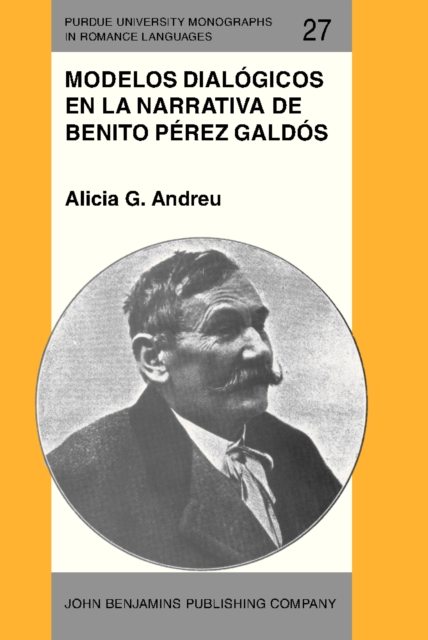
Benito Perez Galdos sought a new narrative structure which would revitalize the literary models prevalent in 19th-century Spain. He found such a structure in the creation of a dialogue between normally incompatible texts - between old and new, national and foreign, high culture and low. From the confrontation of these incongruous texts a narrative is born which, through the destruction of textual hierarchies, creates an ambiguous and often duplicitous texture of storytelling. Five paradigms, based upon five Novelas Contemporaneas, are used to exemplify the dialogical structure of the new Galdosian novel.
eBook


Making Modern Spain
In this elegantly written study, Alfante explores the work of select nineteenth-century writers, intellectuals, journalists, politicians, and clergy who responded to cultural and spiritual shifts caused by the movement toward secularization in Spain. Focusing on the social experience, this book probes the tensions between traditionalism and liberalism that influenced public opinion of the clergy, sacred buildings, and religious orders. The writings of Cecilia Böhl de Faber (Fernán Caballero), Gustavo Adolfo Bécquer, Benito Pérez Galdós, and José María de Pereda addressed conflicts between modernizing forces and the Catholic Church about the place of religion and its signifiers in Spanish society. Foregrounding expropriation (government confiscation of civil and ecclesiastical property) and exclaustration (the expulsion of religious communities), and drawing on archival research, the history of disentailment, cultural theory, memory studies, and sociology, Alfante demonstrates how Spain’s liberalizing movement profoundly influenced class mobility and faith among the populace.
eBook