
Catalogue Search | MBRL


Are you sure you want to remove the book from the shelf?

{{itemTitle}}
6,451
result(s) for
"PALESTINIAN HISTORY"
Sort by:


Transnational Palestine : migration and the right of return before 1948
Tens of thousands of Palestinians migrated to the Americas in the final decades of the nineteenth century and early decades of the twentieth. By 1936, an estimated 40,000 Palestinians lived outside geographic Palestine. Transnational Palestine is the first book to explore the history of Palestinian immigration to Latin America, the struggles Palestinian migrants faced to secure Palestinian citizenship in the interwar period, and the ways in which these challenges contributed to the formation of a Palestinian diaspora and to the emergence of Palestinian national consciousness. Nadim Bawalsa considers the migrants' strategies for economic success in the diaspora, for preserving their heritage, and for resisting British mandate legislation, including citizenship rejections meted out to thousands of Palestinian migrants. They did this in newspapers, social and cultural clubs and associations, political organizations and committees, and in hundreds of petitions and pleas delivered to local and international governing bodies demanding justice for Palestinian migrants barred from Palestinian citizenship. As this book shows, Palestinian political consciousness developed as a thoroughly transnational process in the first half of the twentieth century—and the first articulation of a Palestinian right of return emerged well before 1948.
eBook

The Forgotten Palestinians
For more than 60 years, hundreds of thousands of Palestinians have lived as Israeli citizens within the borders of the nation formed at the end of the 1948 conflict. Occupying a precarious middle ground between the Jewish citizens of Israel and the dispossessed Palestinians of the West Bank and the Gaza Strip, the Israeli Palestinians have developed an exceedingly complex relationship with the land they call home; however, in the innumerable discussions of the Israel-Palestine problem, their experiences are often overlooked and forgotten.
In this book, historian Ilan Pappé examines how Israeli Palestinians have fared under Jewish rule and what their lives tell us about both Israel's attitude toward minorities and Palestinians' attitudes toward the Jewish state. Drawing upon significant archival and interview material, Pappé analyzes the Israeli state's policy towards its Palestinian citizens, finding discrimination in matters of housing, education, and civil rights. Rigorously researched yet highly readable,The Forgotten Palestiniansbrings a new and much-needed perspective to the Israel-Palestine debate.
eBook
The Arab-Israeli conflict : a history
In this timely volume, noted military historian Ian J. Bickerton examines this struggle in detail, describing its beginnings with the dissolution of the Ottoman Empire following the end of World War I.
Book

Thinking palestine
This book brings together an inter-disciplinary group of Palestinian, Israeli, American, British and Irish scholars who theorise 'the question of Palestine'.Critically committed to supporting the Palestinian quest for self determination, they present new theoretical ways of thinking about Palestine.
eBook

Struggle and survival in Palestine/Israel
Too often, the study of Israel/Palestine has focused on elite actors and major events. Struggle and Survival in Palestine/Israel takes advantage of new sources about everyday life and the texture of changes on the ground to put more than two dozen human faces on the past and present of the region. With contributions from a leading cast of scholars across disciplines, the stories here are drawn from a variety of sources, from stories passed down through generations to family archives, interviews, and published memoirs. As these personal narratives are transformed into social biographies, they explore how the protagonists were embedded in but also empowered by their social and historical contexts. This wide-ranging and accessible volume brings a human dimension to a conflict-ridden history, emphasizing human agency, introducing marginal voices alongside more well-known ones, defying \"typical\" definitions of Israelis and Palestinians, and, ultimately, redefining how we understand both \"struggle\" and \"survival\" in a troubled region.
eBook

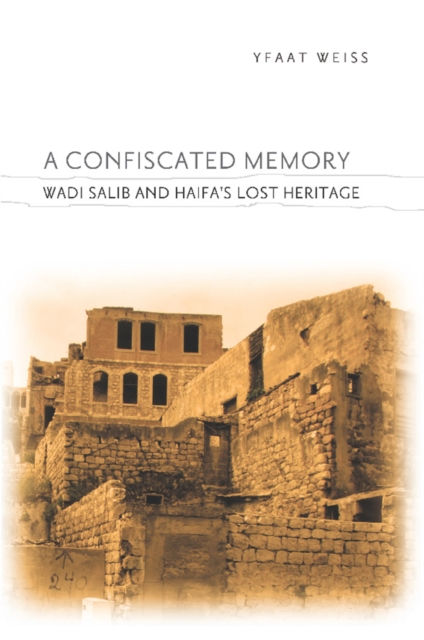
A confiscated memory
Yfaat Weiss tells the story of an Arab neighborhood in Haifa that later acquired iconic status in Israeli memory. In the summer of 1959, Jewish immigrants from Morocco rioted against local and national Israeli authorities of European origin. The protests of Wadi Salib generated for the first time a kind of political awareness of an existing ethnic discrimination among Israeli Jews. However, before that, Wadi Salib existed as an impoverished Arab neighborhood. The war of 1948 displaced its residents, even though the presence of the absentees and the Arab name still linger.
Weiss investigates the erasure of Wadi Salib's Arab heritage and its emergence as an Israeli site of memory. At the core of her quest lies the concept of property, as she merges the constraints of former Arab ownership with requirements and restrictions pertaining to urban development and the emergence of its entangled memory. Establishing an association between Wadi Salib's Arab refugees and subsequent Moroccan evacuees, Weiss allegorizes the Israeli amnesia about both eventual stories-that of the former Arab inhabitants and that of the riots of 1959, occurring at different times but in one place. Describing each in detail, Weiss uncovers a complex, multilayered, and hidden history. Through her sensitive reading of events, she offers uncommon perspective on the personal and political making of Israeli belonging.
eBook