
Catalogue Search | MBRL


Are you sure you want to remove the book from the shelf?

{{itemTitle}}
6,534
result(s) for
"PARLIAMENTARY PRACTICE"
Sort by:

The politics of parliamentary debate : parties, rebels and representation
This book explains how parties and their members of parliament (MPs) structure parliamentary debate. Parties may actively seek to prevent some members from taking the floor while promoting opportunities for others. In doing so, they attempt to control the message that their partisans convey in parliament. The authors provide a theoretical model to explain the design of procedural rules in parliament, how the party leadership interacts with rebel backbenchers, and how MPs represent voters. The book explores political institutions, intra-party politics, electoral politics and legislative behavior. It develops and tests a new theory of parliamentary debate, using data from the UK, Germany, New Zealand and the European Parliament.
Book
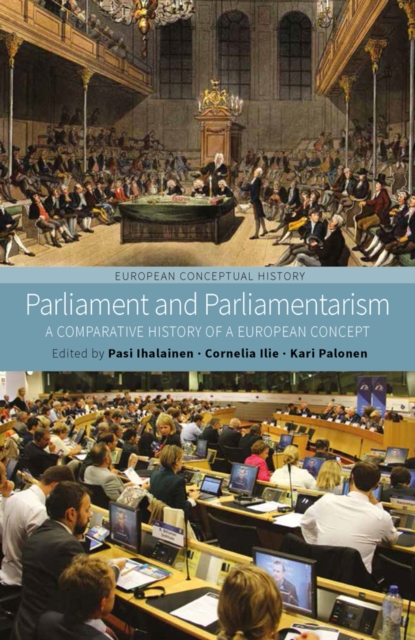
Parliament and parliamentarism
Parliamentary theory, practices, discourses, and institutions constitute a distinctively European contribution to modern politics. Taking a broad historical perspective, this cross-disciplinary, innovative, and rigorous collection locates the essence of parliamentarism in four key aspects-deliberation, representation, responsibility, and sovereignty-and explores the different ways in which they have been contested, reshaped, and implemented in a series of representative national and regional case studies. As one of the first comparative studies in conceptual history, this volume focuses on debates about the nature of parliament and parliamentarism within and across different European countries, representative institutions, and genres of political discourse.
eBook

Robert's Rules for dummies
A guide to mastering \"Roberts Rules of Order\" breaks down the various rules and procedures of the popular and long-lived manual for running meetings, electing officers, and setting up committees.
Book


Filibuster
Parliamentary obstruction, popularly known as the \"filibuster,\" has been a defining feature of the U.S. Senate throughout its history. In this book, Gregory J. Wawro and Eric Schickler explain how the Senate managed to satisfy its lawmaking role during the nineteenth and early twentieth century, when it lacked seemingly essential formal rules for governing debate.
What prevented the Senate from self-destructing during this time? The authors argue that in a system where filibusters played out as wars of attrition, the threat of rule changes prevented the institution from devolving into parliamentary chaos. They show that institutional patterns of behavior induced by inherited rules did not render Senate rules immune from fundamental changes.
The authors' theoretical arguments are supported through a combination of extensive quantitative and case-study analysis, which spans a broad swath of history. They consider how changes in the larger institutional and political context--such as the expansion of the country and the move to direct election of senators--led to changes in the Senate regarding debate rules. They further investigate the impact these changes had on the functioning of the Senate. The book concludes with a discussion relating battles over obstruction in the Senate's past to recent conflicts over judicial nominations.
eBook

The young adult's guide to Robert's rules of order : how to run meetings for your club or organization
Approximately 95 percent of all clubs, organizations, and governments in the United States practice Robert's Rules of Order. However, these rules were written almost 150 years ago. This book brings a seemingly outdated guide into the 21st century by focusing on the role of technology and the Internet in your club or organization. This book will teach you everything you need to know about how to use technology to conduct meetings online as well as how to communicate online through teleconferences, Web conferences, and Web seminars. You will also learn about the traditional book, Robert's Rules of Order, which is explained in an easy-to-read way; no age restrictions here. This book will serve as your guide to conducting orderly and fair meetings in the 21st century.
Book

Holding the Executive to Account in South Africa: Analysis of Weaknesses and Strengths
The powers of the executive arm of the state are limited in so many respects. The Constitution of the Republic of South Africa of 1996 limits the powers of each arm of the state including the executive, which comprises the president, ministers, premiers, members of the executive councils and the entire administration. The executive's constitutional responsibility is that of implementing policies of the state, that is, spending the approved budget, and putting life into all the legislations, state of the nation address or any other intentions of government. The executive is allocated and is responsible for spending most part of the budget of the state. However, the executive should account regularly to requisite state institutions including the legislature to avoid abuse of state power and resources. To this end, this conceptual paper uses existing literature to examine and analyse possible weaknesses that are encountered in holding the executive arm of the state to account. Possible solutions are recommended to enhance the accountability of the executive arm including amending the legislative framework, which allows the head of the executive (The President) to appoint heads of the institutions mandated to hold the executive to account. Key words: Account, Executive, Power, Authority, Policy, Resources.
Journal Article

European parliaments under scrutiny : discourse strategies and interaction practices
In the European tradition, parliaments are central political institutions that play a crucial role in the development of democratic societies. No other institution regularly offers a public arena for open deliberation and dissent, for discussing opposite points of view and for reaching compromise solutions between political adversaries. However, in spite of the growing visibility of modern parliaments, the study of parliamentary language use, interaction practices and discourse strategies has long been under-researched. Based on extensive parliamentary data, this book integrates a rich variety of innovative analytical approaches that explore the far-reaching impacts of parliamentary practices and linguistic strategies on current political action and interaction. Individual chapters problematise and re-evaluate the discourse-shaped identities and roles of Members of Parliament, the structure and functions of parliamentary discourse genres, interpersonal behaviour and intertextual meaning co-construction in post-Communist parliaments. They offer broad cross-cultural perspectives on parliamentary discursive psychology and argumentation. The book provides essential reading for scholars and students of language and linguistics, rhetoric, political and social sciences, as well as for anyone interested in language and politics.
eBook