
Catalogue Search | MBRL


Are you sure you want to remove the book from the shelf?

{{itemTitle}}
5,244
result(s) for
"PERFORMING ARTS / Comedy."
Sort by:

Rolling
Since slavery, African and African American humor has baffled,
intrigued, angered, and entertained the masses.
Rolling centers Blackness in comedy, especially on
television, and observing that it is often relegated to biopics,
slave narratives, and the comedic. But like W. E. B. DuBois's ideas
about double consciousness and Racquel Gates's extension of his
theories, we know that Blackness resonates for Black viewers in
ways often entirely different than for white viewers. Contributors
to this volume cover a range of cases representing African American
humor across film, television, digital media, and stand-up as Black
comic personas try to work within, outside, and around culture,
tilling for content. Essays engage with the complex industrial
interplay of Blackness, white audiences, and comedy; satire and
humor on media platforms; and the production of Blackness within
comedy through personal stories and interviews of Black production
crew and writers for television comedy.
Rolling illuminates the inner workings of Blackness and
comedy in media discourse.
eBook

Dead Funny
Horror films strive to make audiences scream, but they also garner
plenty of laughs. In fact, there is a long tradition of horror
directors who are fluent in humor, from James Whale to John Landis
to Jordan Peele. So how might horror and humor overlap more than we
would expect? Dead Funny locates humor as a key element in
the American horror film, one that is not merely used for
extraneous \"comic relief\" moments but often serves to underscore
major themes, intensify suspense, and disorient viewers. Each
chapter focuses on a different comic style or device, from the use
of funny monsters and scary clowns in movies like A Nightmare
on Elm Street to the physical humor and slapstick in movies
ranging from The Evil Dead to Final Destination .
Along the way, humor scholar David Gillota explores how horror
films employ parody, satire, and camp to comment on gender,
sexuality, and racial politics. Covering everything from the
grotesque body in Freaks to the comedy of awkwardness in
Midsommar , this book shows how integral humor has been to
the development of the American horror film over the past century.
eBook


The anatomy of Harpo Marx
The Anatomy of Harpo Marx is a luxuriant, detailed play-by-play account of Harpo Marx's physical movements as captured on screen. Wayne Koestenbaum guides us through the thirteen Marx Brothers films, from The Cocoanuts in 1929 to Love Happy in 1950, to focus on Harpo's chief and yet heretofore unexplored attribute—his profound and contradictory corporeality. Koestenbaum celebrates the astonishing range of Harpo's body—its kinks, sexual multiplicities, somnolence, Jewishness, \"cute\" pathos, and more. In a virtuosic performance, Koestenbaum's text moves gracefully from insightful analysis to cultural critique to autobiographical musing, and provides Harpo with a host of odd bedfellows, including Walter Benjamin and Barbra Streisand.
eBook

Pretty/Funny
Focusing on star writer/performer comedians—Kathy Griffin, Tina Fey, Sarah Silverman, Margaret Cho, Wanda Sykes, and Ellen DeGeneres—Pretty/Funny demonstrates that women’s comedy has become a prime site of feminism in the twenty-first century.
eBook

All joking aside : American humor and its discontents
A professor of American Studies—and stand-up comic—examines sharply focused comedy and its cultural utility in contemporary society.
Outstanding Academic Title, Choice
In this examination of stand-up comedy, Rebecca Krefting establishes a new genre of comedic production, \"charged humor, \" and charts its pathways from production to consumption. Some jokes are tears in the fabric of our beliefs—they challenge myths about how fair and democratic our society is and the behaviors and practices we enact to maintain those fictions. Jokes loaded with vitriol and delivered with verve, charged humor compels audiences to action, artfully summoning political critique.
Since the institutionalization of stand-up comedy as a distinct cultural form, stand-up comics have leveraged charged humor to reveal social, political, and economic stratifications. All Joking Aside offers a history of charged comedy from the mid-twentieth century to the early aughts, highlighting dozens of talented comics from Dick Gregory and Robin Tyler to Micia Mosely and Hari Kondabolu.
The popularity of charged humor has waxed and waned over the past sixty years. Indeed, the history of charged humor is a tale of intrigue and subversion featuring dive bars, public remonstrations, fickle audiences, movie stars turned politicians, commercial airlines, emergent technologies, neoliberal mind-sets, and a cavalcade of comic misfits with an ax to grind. Along the way, Krefting explores the fault lines in the modern economy of humor, why men are perceived to be funnier than women, the perplexing popularity of modern-day minstrelsy, and the way identities are packaged and sold in the marketplace.
Appealing to anyone interested in the politics of humor and generating implications for the study of any form of popular entertainment, this history reflects on why we make the choices we do and the collective power of our consumptive practices. Readers will be delighted by the broad array of comic talent spotlighted in this book, and for those interested in comedy with substance, it will offer an alternative punchline.
eBook

Andy Kaufman
Taking as his starting point the 1999 biopic Man on the Moon, Florian Keller explores Andy Kaufman's career within a broader discussion of the ideology of the American Dream, grasping Kaufman's radical agenda beyond avant-garde theories of transgression. Presenting readings of Kaufman's most significant performances, Keller shows how he mounted a critique of America's obsession with celebrity and individualism.
eBook
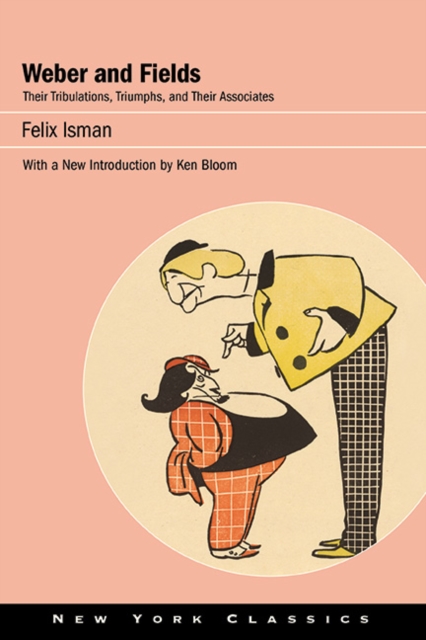
Weber and Fields
Joe Weber and Lew Fields were the dominant musical comedy team at
the turn of the last century. They created classic comedic
characters and routines and formed their own theatrical troupe,
running a theater in New York for many years where they produced
successful revues that combined music, dance, and song. So famous
were they in their time that they inspired a full-length biography
by a major publisher. Weber and Fields follows the duo
from their childhood on New York's rough-and-tumble Lower East Side
to the creation of their best-known characters, the Dutch
knockabout comedians Mike and Myer, and continues with the opening
of their own theater in 1896 (with landmark productions through
1904) to their reunion in 1912. This new edition brings an
out-of-print classic to a new generation of theater loves. A new
introduction by Ken Bloom carries the story through the rest of
their careers, showing how Weber and Fields set the stage for comic
duos that followed, including Mutt and Jeff of comic book fame,
Laurel and Hardy, Abbott and Costello, Rowan and Martin, and
countless others.
eBook

Butterfly's Sisters
In this fascinating and wide-ranging book, Yoko Kawaguchi explores the Western portrayal of Japanese women-and geishas in particular-from the mid-nineteenth century to the present day. She argues that in the West, Japanese women have come to embody certain ideas about feminine sexuality, and she analyzes how these ideas have been expressed in diverse art forms, ranging from fiction and opera to the visual arts and music videos. Among the many works Kawaguchi discusses are the art criticism of Baudelaire and Huysmans, the operaMadama Butterfly
,the sculptures of Rodin, the Broadway playTeahouse of the August Moon
,and the international best sellerMemoirs of a Geisha
.
Butterfly's Sistersalso examines the impact on early twentieth-century theatre, drama, and dance theory of the performance styles of the actresses Madame Hanako and Sadayakko, both formerly geishas.
eBook

Strip Show
This book offers an account of an unprecedented North American study of contemporary female and male strip shows. It particularly focuses on the contradictory sex roles, cultural positions, and performance practices of 'straight' strip shows during their second heyday in the early 1990s. Katherine Liepe-Levinson's research took her to over seventy different strip bars, clubs, theatres and sex emporiums ranging from elaborate lap-dancing and couch-dancing 'gentlemen's' clubs in New York, Houston, and San Francisco; to Peoria's onetime duplex cabaret where women strip for men downstairs, and men for women upstairs; to the nightclubs of Montreal where female and male performers displayed the 'Full Monty'. Liepe-Levinson's intriguing, comprehensive study concentrates on the cultural and theatrical elements of the strip shows themselves including the geographic locations and interior designs of the clubs, the choreography and costumes of the dancers and the all-important participation of the audience. She draws upon a variety of methodologies as well as interviews with performers to explore how the strip show's cultural and theatrical aspects simultaneously uphold and break traditional sex roles. Her findings readily complicate several of the most prominent and prevalent theories about sexual representation, gender and desire.
eBook