
Catalogue Search | MBRL


Are you sure you want to remove the book from the shelf?

{{itemTitle}}
49,259
result(s) for
"PHILOSOPHY / Criticism"
Sort by:

A Sceptical Guide to Meaning and Rules
No other recent book in Anglophone philosophy has attracted as much criticism and has found so few friends as Saul Kripke's \"Wittgenstein on Rules and Private Language\". Amongst its critics, one finds the very top of the philosophical profession. Yet, it is rightly counted amongst the books that students of philosophy, at least in the Anglo-American world, have to read at some point in their education. Enormously influential, it has given rise to debates that strike at the very heart of contemporary philosophy of mind and language. In this major new interpretation, Martin Kusch defends Kripke's account against the numerous weighty objections that have been put forward over the past twenty years and argues that none of them is decisive. He shows that many critiques are based on misunderstandings of Kripke's reasoning; that many attacks can be blocked by refining and developing Kripke's position; and that many alternative proposals turn out either to be unworkable or to be disguised variants of the view they are meant to replace. Kusch argues that the apparent simplicity of Kripke's text is deceptive and that a fresh reading gives Kripke's overall argument a new strength.
eBook

The Not-Two
InThe Not-Two, Lorenzo Chiesa examines the treatment of logic and God in Lacan's later work. Chiesa draws for the most part from Lacan's Seminars of the early 1970s, as they revolve around the axiom \"There is no sexual relationship.\" Chiesa provides both a close reading of Lacan's effort to formalize sexual difference as incompleteness and an assessment of its broader implications for philosophical realism and materialism.
Chiesa argues that \"There is no sexual relationship\" is for Lacan empirically and historically circumscribed by psychoanalysis, yet self-evident in our everyday lives. Lacan believed that we have sex because we love, and that love is a desire to be One in face of the absence of the sexual relationship. Love presupposes a real \"not-two.\" The not-two condenses the idea that our love and sex lives are dictated by the impossibility of fusing man's contradictory being with theheterosof woman as a fundamentally uncountable Other. Sexual liaisons are sustained by a transcendental logic, the so-called phallic function that attempts to overcome this impossibility.
Chiesa also focuses on Lacan's critical dialogue with modern science and formal logic, as well as his dismantling of sexuality as considered by mainstream biological discourse. Developing a new logic of sexuation based on incompleteness requires the relinquishing of any alleged logos of life and any teleological evolution.
For Lacan, the truth of incompleteness as approached psychoanalytically through sexuality would allow us to go further in debunking traditional onto-theology and replace it with a \"para-ontology\" yet to be developed. Given the truth of incompleteness, Chiesa asks, can we think such a truth in itself without turning incompleteness into another truth about truth, that is, into yet another figure of God as absolute being?
eBook
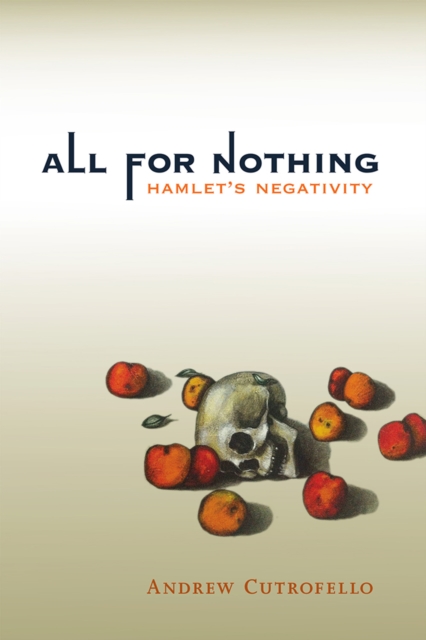
All for Nothing
A specter is haunting philosophy -- the specter of Hamlet. Why is this? Wherefore? What should we do?Entering from stage left: the philosopher's Hamlet. The philosopher's Hamlet is a conceptual character, played by philosophers rather than actors. He performs not in the theater but within the space of philosophical positions. In All for Nothing, Andrew Cutrofello critically examines the performance history of this unique role. The philosopher's Hamlet personifies negativity. In Shakespeare's play, Hamlet's speech and action are characteristically negative; he is the melancholy Dane. Most would agree that he has nothing to be cheerful about. Philosophers have taken Hamlet to embody specific forms of negativity that first came into view in modernity. What the figure of the Sophist represented for Plato, Hamlet has represented for modern philosophers. Cutrofello analyzes five aspects of Hamlet's negativity: his melancholy, negative faith, nihilism, tarrying (which Cutrofello distinguishes from \"delaying\"), and nonexistence. Along the way, we meet Hamlet in the texts of Kant, Coleridge, Hegel, Marx, Schopenhauer, Kierkegaard, Nietzsche, Freud, Russell, Wittgenstein, Heidegger, Benjamin, Arendt, Schmitt, Lacan, Deleuze, Foucault, Derrida, Badiou, Žižek, and other philosophers. Whirling across a kingdom of infinite space, the philosopher's Hamlet is nothing if not thought-provoking.
eBook
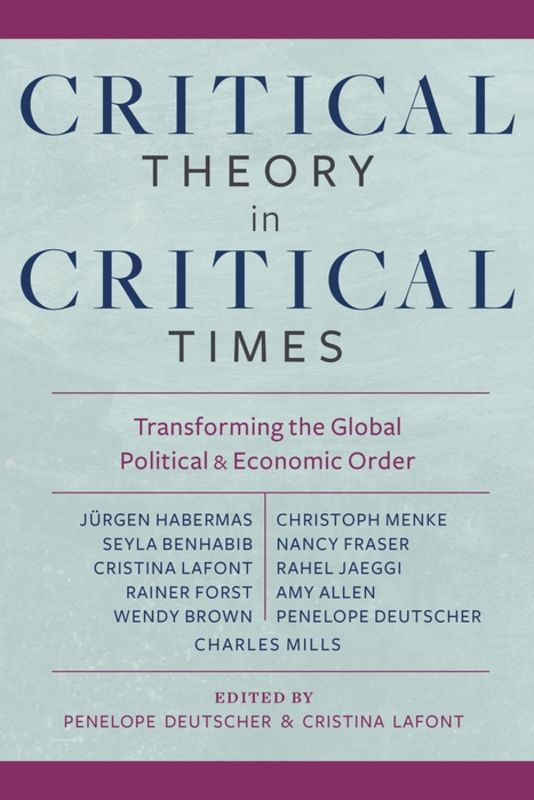
Critical Theory in Critical Times
We live in critical times. We face a global crisis in economics and finance, a global ecological crisis, and a constant barrage of international disputes. Perhaps most dishearteningly, there seems to be little faith in our ability to address such difficult problems. However, there is also a more positive sense in which these are critical times. The world's current state of flux gives us a unique window of opportunity for shaping a new international order that will allow us to cope with current and future global crises.InCritical Theory in Critical Times, eleven of the most distinguished critical theorists offer new perspectives on recent crises and transformations of the global political and economic order. Essays from Jürgen Habermas, Seyla Benhabib, Cristina Lafont, Rainer Forst, Wendy Brown, Christoph Menke, Nancy Fraser, Rahel Jaeggi, Amy Allen, Penelope Deutscher, and Charles Mills address pressing issues including international human rights and democratic sovereignty, global neoliberalism, novel approaches to the critique of capitalism, critical theory's Eurocentric heritage, and new directions offered by critical race theory and postcolonial studies. Sharpening the conceptual tools of critical theory, the contributors toCritical Theory in Critical Timesreveal new ways of expanding the diverse traditions of the Frankfurt School in response to some of the most urgent and important challenges of our times.
eBook

Mind and language - on the philosophy of Anton Marty
The series is devoted to monographs and anthologies on Austrian philosophy (Bolzano, Brentano, Meinong and others) as well as on phenomenology and its history in general. Moreover, the series is open to a wide variety of different approaches in the philosophy of mind.
eBook

The External World and Our Knowledge of It
David Hume is often considered to have been a sceptic, particularly in his conception of the individual's knowledge of the external world. However, a closer examination of his works gives a much different impression of this aspect of Hume's philosophy, one that is due for a thorough scholarly analysis. This study argues that Hume was, in fact, a critical realist in the early twentieth-century sense, a period in which the term was used to describe the epistemological and ontological theories of such philosophers as Roy Wood Sellars and Bertrand Russell.
Carefully situating Hume in his historical context, that is, relative to Aristotelian and rationalist traditions, Fred Wilson makes important and unique insights into Humean philosophy. Analyzing key sections of theTreatise, theEnquiry, and theDialogues concerning Natural Religion, Wilson offers a deeper understanding of Hume by taking into account the philosopher's theories of the external world. Such a reading, the author explains, is not only more faithful to the texts, but also reinforces the view of Hume as a critical realist in light of twentieth-century discussions between externalism and internalism, and between coherentists and foundationalists.
Complete with original observations and ideas, this study is sure to generate debates about Humean philosophy, critical realism, and the limits of perceptual knowledge.
eBook

Apocalypse-cinema
Apocalypse-cinema is not only the end of time that has so often been staged as spectacle in films like 2012, The Day After Tomorrow, and The Terminator. By looking at blockbusters that play with general annihilation while also paying close attention to films like Melancholia, Cloverfield, Blade Runner, and Twelve Monkeys, this book suggests that in the apocalyptic genre, film gnaws at its own limit. Apocalypse-cinema is, at the same time and with the same double blow, the end of the world and the end of the film. It is the consummation and the (self-)consumption of cinema, in the form of an acinema that Lyotard evoked as the nihilistic horizon of filmic economy. The innumerable countdowns, dazzling radiations, freeze-overs, and seismic cracks and crevices are but other names and pretexts for staging film itself, with its economy of time and its rewinds, its overexposed images and fades to white, its freeze-frames and digital touch-ups. The apocalyptic genre is not just one genre among others: It plays with the very conditions of possibility of cinema. And it bears witness to the fact that, every time, in each and every film, what Jean-Luc Nancy called the cine-world is exposed on the verge of disappearing. In a Postface specially written for the English edition, Szendy extends his argument into a debate with speculative materialism. Apocalypse-cinema, he argues, announces itself as cinders that question the \"ultratestimonial\" structure of the filmic gaze. The cine-eye, he argues, eludes the correlationism and anthropomorphic structure that speculative materialists have placed under critique, allowing only the ashes it bears to be heard.
eBook
Divine flesh, embodied word
What has Luce Irigaray's statement that women need a God to do with her thoughts on the relation between body and mind, or the sensible and the intelligible?
Using the theological notion 'incarnation' as a hermeneutical key, Anne-Claire Mulder brings together and illuminates the interrelations between these different themes in Luce Irigaray's work. Seesawing between Luce Irigaray's critique of philosophical discourse and her constructive philosophy, Mulder elucidates Irigaray's thoughts on the relations between 'becoming woman' and 'becoming divine'. She shows that Luce Irigaray's restaging of the relation between the sensible and the intelligible, between flesh and Word, is key to her reinterpretation of the relation between wo/man and God. In and through her interpretation of Luce Irigaray's thoughts on the flesh she argues that the relation between flesh and Word must be seen as a dialectical one, instead of as a dualistic relation. This means that 'incarnation' is no longer seen as a one-way process of Word becoming flesh, but as a continuing process of flesh becoming word and word becoming flesh. For all images and thoughts - including those of 'God' - are produced by the flesh, divine in its creativity inexhaustibility, in response to the touch of the other. And these images, thoughts, words in turn become embodied, by touching and moving the flesh of the subject.
eBook

Nietzsche's Philosophical Context
Friedrich Nietzsche was immensely influential and, counter to most expectations, also very well read. As scholars consider his place in European philosophy and assess how his ideas developed, much speculation surrounds how and what Nietzsche read. An essential new reference tool for those interested in his thinking, Nietzsche's Philosophical Context identifies the chronology and huge range of philosophical books that engaged him. Rigorously examining the scope of this reading, Thomas H. Brobjer consulted over two thousand volumes in Nietzsche's personal library, as well as his book bills, library records, journals, letters, and publications. This meticulous investigation also considers many of the annotations in his books. In arguing that Nietzsche's reading often constituted the starting point for, or counterpoint to, much of his own thinking and writing, Brobjer's study provides scholars with fresh insight into how Nietzsche worked and thought; to which questions and thinkers he responded; and by which of them he was influenced. The result is a new and much more contextual understanding of Nietzsche's life and thinking._x000B__x000B_
eBook

Locating the Moving Image
Leading scholars in the interdisciplinary field of geo-spatial visual studies examine the social experience of cinema and the different ways in which film production developed as a commercial enterprise, as a leisure activity, and as modes of expression and communication. Their research charts new pathways in mapping the relationship between film production and local film practices, theatrical exhibition circuits and cinema going, creating new forms of spatial anthropology. Topics include cinematic practices in rural and urban communities, development of cinema by amateur filmmakers, and use of GIS in mapping the spatial development of film production and cinema going as social practices.
eBook