
Catalogue Search | MBRL


Are you sure you want to remove the book from the shelf?

{{itemTitle}}
3,095
result(s) for
"PHILOSOPHY / Free Will "
Sort by:

Social conventions
Social conventions are those arbitrary rules and norms governing the countless behaviors all of us engage in every day without necessarily thinking about them, from shaking hands when greeting someone to driving on the right side of the road. In this book, Andrei Marmor offers a pathbreaking and comprehensive philosophical analysis of conventions and the roles they play in social life and practical reason, and in doing so challenges the dominant view of social conventions first laid out by David Lewis.
Marmor begins by giving a general account of the nature of conventions, explaining the differences between coordinative and constitutive conventions and between deep and surface conventions. He then applies this analysis to explain how conventions work in language, morality, and law. Marmor clearly demonstrates that many important semantic and pragmatic aspects of language assumed by many theorists to be conventional are in fact not, and that the role of conventions in the moral domain is surprisingly complex, playing mostly an auxiliary and supportive role. Importantly, he casts new light on the conventional foundations of law, arguing that the distinction between deep and surface conventions can be used to answer the prevalent objections to legal conventionalism.
Social Conventionsis a much-needed reappraisal of the nature of the rules that regulate virtually every aspect of human conduct.
eBook

Rousseau on Education, Freedom, and Judgment
In Rousseau on Education, Freedom, and Judgment, Denise Schaeffer challenges the common view of Rousseau as primarily concerned with conditioning citizens’ passions in order to promote republican virtue and unreflective patriotic attachment to the fatherland. Schaeffer argues that, to the contrary, Rousseau’s central concern is the problem of judgment and how to foster it on both the individual and political level in order to create the conditions for genuine self-rule. Offering both a detailed commentary on Rousseau’s major work on education, Emile, and wide-ranging analysis of the relationship between Emile and several of Rousseau’s other works, Schaeffer explores Rousseau’s understanding of what good judgment is, how it is learned, and why it is central to the achievement and preservation of human freedom. The model of Rousseauian citizenship that emerges from Schaeffer’s analysis is more dynamic and self-critical than is often acknowledged. This book demonstrates the importance of Rousseau’s contribution to our understanding of faculty of judgment, and, more broadly, invites a critical reevaluation of Rousseau’s understanding of education, citizenship, and both individual and collective freedom.
eBook
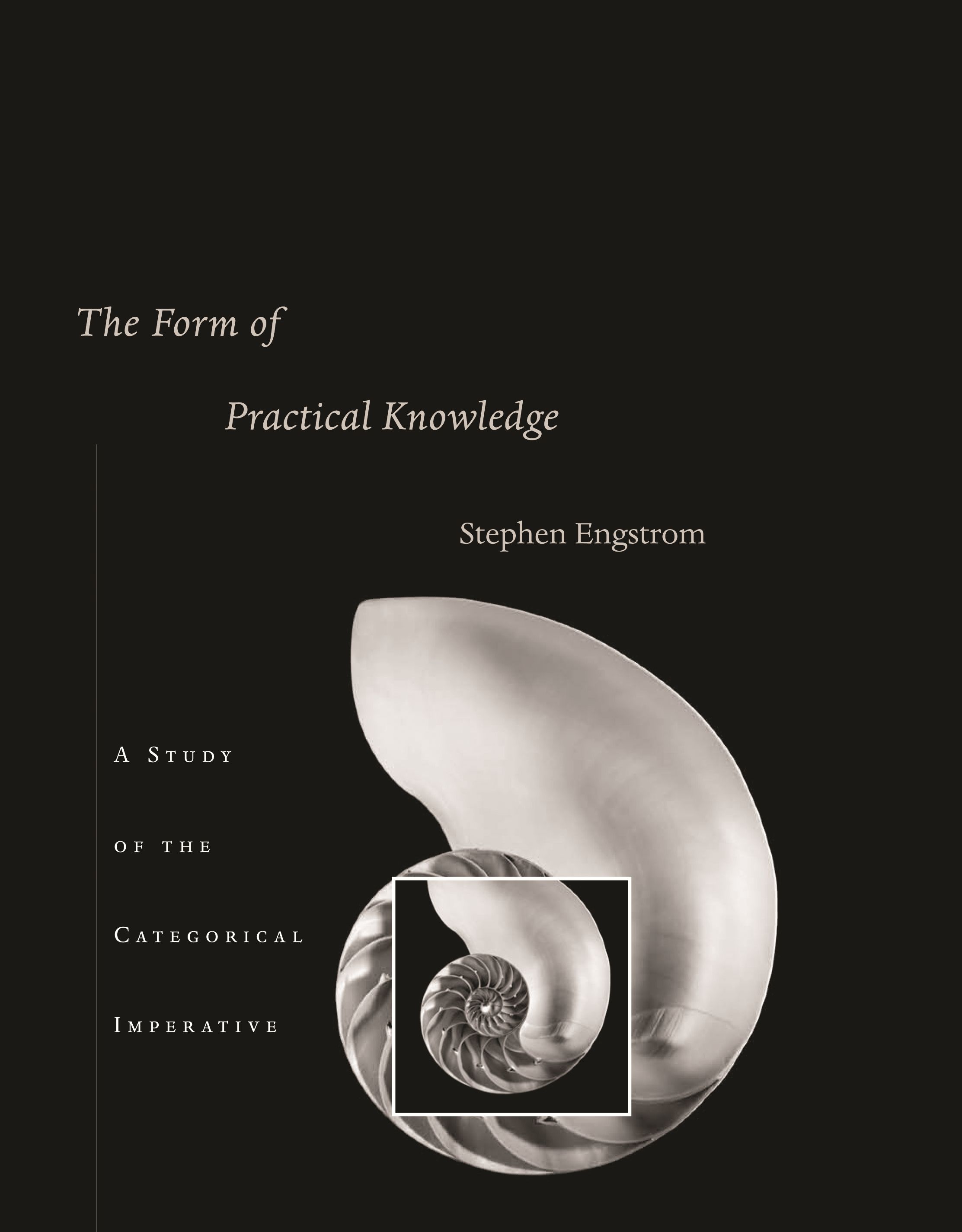
The form of practical knowledge : a study of the categorical imperative
Immanuel Kant's claim that the categorical imperative of morality is based in practical reason has long been a source of puzzlement and doubt, even for sympathetic interpreters. Kant's own explanations, which mainly concern his often-criticized formula of universal law, are laconic and obscure, leading interpreters to dismiss them in favor of less ambitious claims involving his other famous formulas.
In The Form of Practical Knowledge, Stephen Engstrom provides an illuminating new interpretation of the categorical imperative, arguing that we have exaggerated and misconceived Kant's break with tradition: Kant never departs from the classical conception of practical reason as a capacity for knowledge of the good. His distinctive contribution is the idea that morality's imperatives express the form of such knowledge.
By developing an account of practical knowledge that situates Kant's ethics within his broader epistemology and rethinks numerous topics in his moral psychology and in his account of practical reason (including desire, intention, choice, will, as well as pleasure, happiness, and the good), Engstrom's work promises to deepen and to reshape our understanding of Kantian ethics.
eBook

Free Will
In our daily life, it reallyseemsas though we have free will, that what we do from moment to moment is determined by conscious decisions that we freely make. You get up from the couch, you go for a walk, you eat chocolate ice cream. It seems that we're in control of actions like these; if we are, then we have free will. But in recent years, some have argued that free will is an illusion. The neuroscientist (and best-selling author) Sam Harris and the late Harvard psychologist Daniel Wegner, for example, claim that certain scientific findings disprove free will. In this engaging and accessible volume in the Essential Knowledge series, the philosopher Mark Balaguer examines the various arguments and experiments that have been cited to support the claim that human beings don't have free will. He finds them to be overstated and misguided.Balaguer discusses determinism, the view that every physical event is predetermined, or completely caused by prior events. He describes several philosophical and scientific arguments against free will, including one based on Benjamin Libet's famous neuroscientific experiments, which allegedly show that our conscious decisions are caused by neural events that occur before we choose. He considers various religious and philosophical views, including the philosophical pro-free-will view known as compatibilism. Balaguer concludes that the anti-free-will arguments put forward by philosophers, psychologists, and neuroscientists simply don't work. They don't provide any good reason to doubt the existence of free will. But, he cautions, this doesn't necessarily mean that we have free will. The question of whether we have free will remains an open one; we simply don't know enough about the brain to answer it definitively.
eBook

Philosophical Investigations into the Essence of Human Freedom
Jeff Love and Johannes Schmidt offer a fresh translation of Schelling's enigmatic and influential masterpiece, widely recognized as an indispensable work of German Idealism. The text is an embarrassment of riches—both wildly adventurous and somberly prescient. Martin Heidegger claimed that it was \"one of the deepest works of German and thus also of Western philosophy\" and that it utterly undermined Hegel's monumental Science of Logic before the latter had even appeared in print. Schelling carefully investigates the problem of evil by building on Kant's notion of radical evil, while also developing an astonishingly original conception of freedom and personality that exerted an enormous (if subterranean) influence on the later course of European philosophy from Schopenhauer and Kierkegaard through Heidegger to important contemporary theorists like Slavoj Zðizûek.
This translation of Schelling's notoriously difficult and densely allusive work provides extensive annotations and translations of a series of texts (by Boehme, Baader, Lessing, Jacobi, and Herder), hard to find or previously unavailable in English, whose presence in the Philosophical Investigations is unmistakable and highly significant. This handy study edition of Schelling's masterpiece will prove useful for scholars and students alike.
eBook

Freedom from Reality
It is commonly observed that behind many of the political and cultural issues that we face today there are impoverished conceptions of freedom, which, according to D. C. Schindler, we have inherited from the classical liberal tradition without a sufficient awareness of its implications. Freedom from Reality presents a critique of the deceptive and ultimately self-subverting character of the modern notion of freedom, retrieving an alternative view through a new interpretation of the ancient tradition. While many have critiqued the inadequacy of identifying freedom with arbitrary choice, this book seeks to penetrate to the metaphysical roots of the modern conception by going back, through an etymological study, to the original sense of freedom.
Schindler begins by uncovering a contradiction in John Locke's seminal account of human freedom. Rather than dismissing it as a mere \"academic\" problem, Schindler takes this contradiction as a key to understanding the strange paradoxes that abound in the contemporary values and institutions founded on the modern notion of liberty: the very mechanisms that intend to protect modern freedom render it empty and ineffectual. In this respect, modern liberty is \"diabolical\"—a word that means, at its roots, that which \"drives apart\" and so subverts. This is contrasted with the \"symbolical\" (a \"joining-together\"), which, he suggests, most basically characterizes the premodern sense of reality. This book will appeal to students and scholars of political philosophy (especially political theorists), philosophers in the continental or historical traditions, and cultural critics with a philosophical bent.
eBook

Hobbes and Bramhall on Liberty and Necessity
Do human beings ever act freely, and if so what does freedom mean? Is everything that happens antecedently caused, and if so how is freedom possible? Is it right, even for God, to punish people for things that they cannot help doing? This volume presents the famous seventeenth-century controversy in which Thomas Hobbes and John Bramhall debate these questions and others. The complete texts of their initial contributions to the debate are included, together with selections from their subsequent replies to one another and from other works of Hobbes, in a collection that offers an illuminating commentary on issues still of concern to philosophers today. The volume is completed by a historical and philosophical introduction that explains the context in which the debate took place.
eBook

Philosophy and Freedom
James Doull's remarkable legacy as a teacher, scholar, and thinker has left behind a profound and challenging examination of the philosophical and historical roots of contemporary thought and politics. His life's work was devoted to a reflection on freedom in its philosophical and historical context and, more specifically, to looking beneath the commonly accepted forms of North American and Continental thought and discovering a deeper theoretical and practical development. David Peddle and Neil Robertson have collected Doull's essays on the history of western thought and freedom, from the Ancient period to the Post-Modern era, and have provided an introduction that places them in the context of Doull's overall project.
Commentaries on his intricate works by twelve former colleagues and students explore various aspects of Doull's history and place it within the context of contemporary scholarship, allowing the reader to judge the depth and rigour of Doull's writing. Together, the texts and commentaries provide a long-overdue introduction to and analysis of Doull's thought, offering further insight into a longstanding and significant dialogue in Canadian philosophy and classical studies, and bringing out a penetrating analysis of the philosophical underpinnings of the contemporary world.
eBook
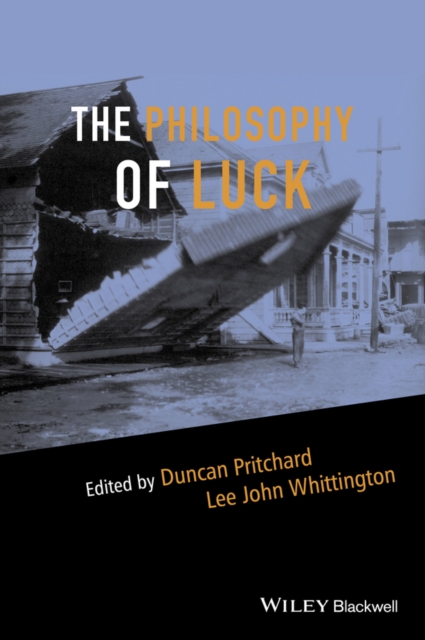
The philosophy of luck
This is the first volume of its kind to provide a curated collection of cutting-edge scholarship on the philosophy of luck
* Offers an in-depth examination of the concept of luck, which has often been overlooked in philosophical study
* Includes discussions of luck from a range of philosophical perspectives, including ethics, epistemology, metaphysics, and cognitive science
* Examines the role of luck in core philosophical problems, such as free will
* Features work from the main philosophers writing on luck today
eBook
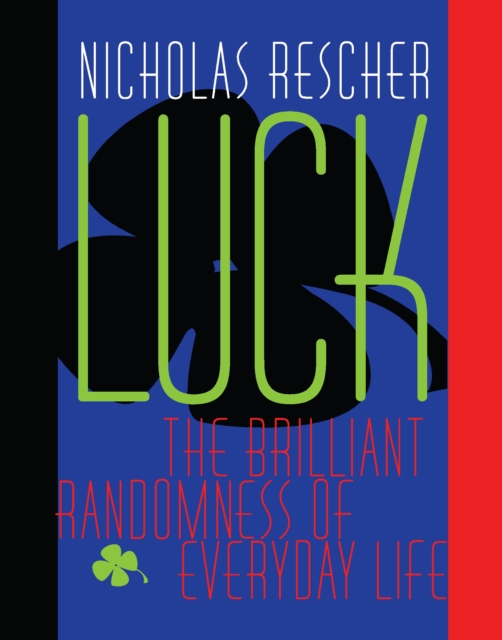
Luck
Luck touches us all. \"Why me?\" we complain when things go wrong-though seldom when things go right. But although luck has a firm hold on all our lives, we seldom reflect on it in a cogent, concerted way.
InLuck, one of our most eminent philosophers offers a realistic view of the nature and operation of luck to help us come to sensible terms with life in a chaotic world. Differentiating luck from fate (inexorable destiny) and fortune (mere chance), Nicholas Rescher weaves a colorful tapestry of historical examples, from the use of lots in the Old and New Testaments to Thomas Gataker's treatise of 1619 on the great English lottery of 1612, from casino gambling to playing the stock market. Because we are creatures of limited knowledge who do and must make decisions in the light of incomplete information, Rescher argues, we are inevitably at the mercy of luck. It behooves us to learn more about it.
eBook