
Catalogue Search | MBRL


Are you sure you want to remove the book from the shelf?

{{itemTitle}}
1,052
result(s) for
"PHILOSOPHY / Movements / Critical Theory"
Sort by:

Blackness Visible
Charles Mills makes visible in the world of mainstream philosophy some of the crucial issues of the black experience. Ralph Ellison's metaphor of black invisibility has special relevance to philosophy, whose demographic and conceptual \"whiteness\" has long been a source of wonder and complaint to racial minorities. Mills points out the absence of any philosophical narrative theorizing and detailing race's centrality to the recent history of the West, such as feminists have articulated for gender domination.
European expansionism in its various forms, Mills contends, generates a social ontology of race that warrants philosophical attention.Through expropriation, settlement, slavery, and colonialism, race comes into existence as simultaneously real and unreal: ontological without being biological, metaphysical without being physical, existential without being essential, shaping one's being without being in one's shape.
His essays explore the contrasting sums of a white and black modernity, examine standpoint epistemology and the metaphysics of racial identity, look at black-Jewish relations and racial conspiracy theories, map the workings of a white-supremacist polity and the contours of a racist moral consciousness, and analyze the presuppositions of Frederick Douglass's famous July 4 prognosis for black political inclusion. Collectively they demonstrate what exciting new philosophical terrain can be opened up once the color line in western philosophy is made visible and addressed.
eBook
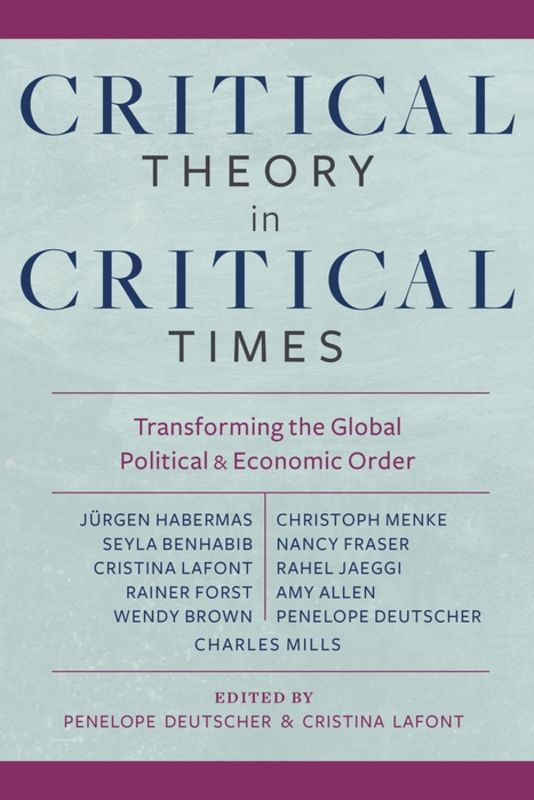
Critical Theory in Critical Times
We live in critical times. We face a global crisis in economics and finance, a global ecological crisis, and a constant barrage of international disputes. Perhaps most dishearteningly, there seems to be little faith in our ability to address such difficult problems. However, there is also a more positive sense in which these are critical times. The world's current state of flux gives us a unique window of opportunity for shaping a new international order that will allow us to cope with current and future global crises.InCritical Theory in Critical Times, eleven of the most distinguished critical theorists offer new perspectives on recent crises and transformations of the global political and economic order. Essays from Jürgen Habermas, Seyla Benhabib, Cristina Lafont, Rainer Forst, Wendy Brown, Christoph Menke, Nancy Fraser, Rahel Jaeggi, Amy Allen, Penelope Deutscher, and Charles Mills address pressing issues including international human rights and democratic sovereignty, global neoliberalism, novel approaches to the critique of capitalism, critical theory's Eurocentric heritage, and new directions offered by critical race theory and postcolonial studies. Sharpening the conceptual tools of critical theory, the contributors toCritical Theory in Critical Timesreveal new ways of expanding the diverse traditions of the Frankfurt School in response to some of the most urgent and important challenges of our times.
eBook

The Archaeology of War
The book analyses the history of violence in the twentieth and twenty-first centuries and traces the many situations, images, motifs and sources for this experience of unbounded violence that characterizes our times.
eBook

Bourdieu and Literature
Bourdieu and Literature is a wide-ranging, rigorous and accessible introduction to the relationship between Pierre Bourdieu's work and literary studies. It provides a comprehensive overview and critical assessment of his contributions to literary theory and his thinking about authors and literary works. One of the foremost French intellectuals of the post-war era, Bourdieu has become a standard point of reference in the fields of anthropology, linguistics, art history, cultural studies, politics, and sociology, but his longstanding interest in literature has often been overlooked. This study explores the impact of literature on Bourdieu's intellectual itinerary, and how his literary understanding intersected with his sociological theory and thinking about cultural policy. This is the first full-length study of Bourdieu's work on literature in English, and it provides an invaluable resource for students and scholars of literary studies, cultural theory and sociology.
eBook
Once upon a Time in the West
Western civilization is over. So begins Jan Zwicky's trenchant exploration of the roots of global cultural and ecological collapse. Once Upon a Time in the West documents how a narrow epistemological style has left us blind to critical features of reality, and how the terrifying consequences of that shuttered vision are now unfolding.
eBook

Imagination and Invention
A radical rethinking of the theory and the experience of mental images Here, in English translation for the first time, is Gilbert Simondon’s fundamental reconception of the mental image and the theory of imagination and invention. Drawing on a vast range of mid-twentieth-century theoretical resources—from experimental psychology, cybernetics, and ethology to the phenomenological reflections of Sartre and Merleau-Ponty— Imagination and Invention provides a comprehensive account of the mental image and adds a vital new dimension to the theory of psychical individuation in Simondon’s earlier, highly influential work. Simondon traces the development of the mental image through four phases: first a bundle of motor anticipations, the image becomes a cognitive system that mediates the organism’s relation to its milieu, then a symbolic and abstract integration of motor and affective experience to, finally, invention, a solution to a problem of life that requires the externalization of the mental image and the creation of a technical object. An image cannot be understood from the perspective of one phase alone, he argues, but only within the trajectory of its progressive metamorphosis.
eBook

The Counterhuman Imaginary
The Counterhuman Imaginary
proposes that alongside the historical, social, and
institutional structures of human reality that seem to be the sole
subject of the literary text, an other-than-human world is
everywhere in evidence. Laura Brown finds that within
eighteenth-century British literature, the human cultural imaginary
can be seen, equally, as a counterhuman imaginary-an alternative
realm whose scope and terms exceed human understanding or
order.
Through close readings of works by Daniel Defoe, Jonathan Swift,
and Alexander Pope, along with lapdog lyrics, circulation
narratives that give agency to inanimate objects like coins and
carriages, and poetry about the Lisbon earthquake of 1755, Brown
traces the ways presence and power of the nonhuman-weather, natural
disasters, animals, even the concept of love-not only influence
human creativity, subjectivity, and history but are inseparable
from them. Traversing literary theory, animal studies, new
materialism, ecocriticism, and affect theory, The Counterhuman
Imaginary offers an original repudiation of the centrality of
the human to advance an integrative new methodology for reading
chaos, fluidity, force, and impossibility in literary culture.
eBook
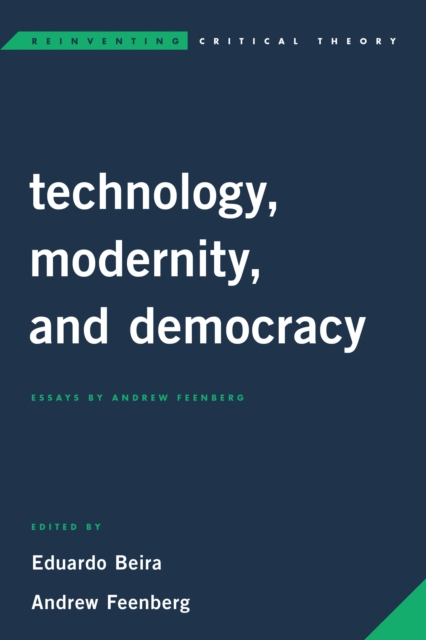
Technology, modernity, and democracy
This important collection of essays by Andrew Feenberg presents his critical theory of technology, an innovative approach to philosophy and sociology of technology based on a synthesis of ideas drawn from STS and Frankfurt School Critical Theory. According to critical theory of technology, technologies are neither neutral nor deterministic, but are encoded with specific socio-economic values and interests. Feenberg explores how they can be developed and adapted to more or less democratic values and institutions, and how their future is subject to social action, negotiation and reinterpretation. Technologies bring with them a particular \"rationality,\" sets of rules and implied ways of behaving and thinking which, despite their profound influence on institutions, ideas and actions, can be transformed in a process of democratic rationalization. Feenberg argues that the emergence of human communication on the Internet and the environmental movement offer abundant examples of public interventions that have reshaped technologies originally designed for different purposes. This volume includes chapters on citizenship and critical theory of technology, philosophy of technology and modernity, and Heidegger and Marcuse, two of the most prominent philosophers of technology.
eBook
Finding McLuhan
In 1965, Tom Wolfe famously asked of Marshall McLuhan: \"Suppose he is the oracle of the modern times--what if he is right?\" Fifty years later, McLuhan's biographer Douglas Coupland, McLuhan's sons, and sixteen scholars explore the many ways in which McLuhan's predictions have come true.
eBook