
Catalogue Search | MBRL


Are you sure you want to remove the book from the shelf?

{{itemTitle}}
278
result(s) for
"PHILOSOPHY / Movements / Existentialism."
Sort by:

Philosophy of Kierkegaard
Although the ideas of Søren Kierkegaard played a pivotal role in shaping mainstream German philosophy and French existentialism, the question of how philosophers should read Kierkegaard is difficult. His intransigent religiosity has led some philosophers to view him essentially as a religious thinker with an anti-philosophical attitude. In a major new survey of Kierkegaard's thought, George Pattison addresses this question and shows that although it would be difficult to claim a \"philosophy of Kierkegaard\" as one can a philosophy of Kant or Hegel, there are significant common interests in Kierkegaard's central thinking and the questions that concern philosophers today. The Philosophy of Kierkegaard examines existence, anxiety, the good, and the infinite qualitative difference and the absolute paradox, arguing that the challenge of self-knowledge in an age of moral and intellectual uncertainty which lies at the heart of Kierkegaard's writings is as important today as it was in the culture of post-Enlightenment modernity.
eBook

Jean-Luc Nancy and the Future of Philosophy
Jean-Luc Nancy's The Experience of Freedom is a landmark work of contemporary continental philosophy and his writings on psychoanalysis, literature, theology, art, and culture have been widely influential. Jean-Luc Nancy and the Future of Philosophy is a sustained and critical examination of Nancy's ideas and their place within the general project of deconstructing Western philosophy. B.C. Hutchens offers a clear and succinct appraisal of Nancy's work. He explains the primary areas of the philosopher's thought and explores their relevance for contemporary issues such as nationalism, racism, media rights, and political practice. Nancy's work on freedom and morality, community and politics, and arts and the media is examined in greater detail. Hutchens also examines Nancy's indebtedness to Nietzsche, Heidegger, and Bataille and compares his ideas with those of his contemporaries, such as Levinas and Negri. Jean-Luc Nancy and the Future of Philosophy concludes with the author's recent and previously unpublished interview with Nancy about the future of philosophy. This book is an important addition to the literature on contemporary continental thought and political philosophy.
eBook

Philosophy of Schopenhauer
Arthur Schopenhauer (1788-1860) crafted one of the most unified philosophical systems by synthesizing Plato, Kant, and Asian religious traditions such as Buddhism and Hinduism into an encyclopedic worldview that combines the empirical science of his day with Eastern mysticism in a radically idealist metaphysics and epistemology. In The Philosophy of Schopenhauer, Dale Jacquette assesses Schopenhauer's philosophical enterprise and the astonishing implications it has for metaphysics, epistemology, ethics, political philosophy, aesthetics, logic, science, and religion. Jacquette analyses the central topics in Schopenhauer's philosophy, including his so-called pessimistic appraisal of the human condition, his examination of the concept of death, his dualistic analysis of free will, and his simplified non-Kantian theory of morality. His metaphysics of the world as representation and Will - his most important and controversial contribution - is discussed in depth. The legacy of Schopenhauer's ideas, in particular his influence on Nietzsche, who was first a follower and then an arch opponent, and the early Wittgenstein, is explored in the final chapter. This introduction makes even the most difficult of Schopenhauer's ideas accessible without sacrificing any of their complexity.
eBook

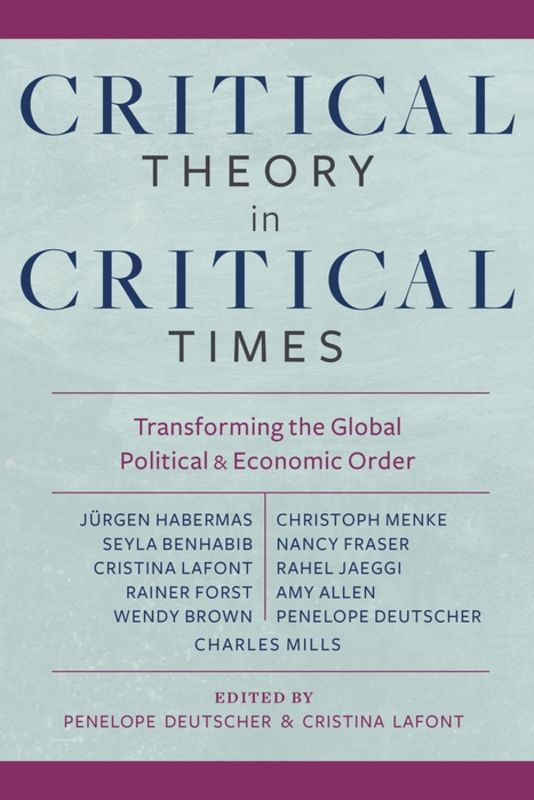
Critical Theory in Critical Times
We live in critical times. We face a global crisis in economics and finance, a global ecological crisis, and a constant barrage of international disputes. Perhaps most dishearteningly, there seems to be little faith in our ability to address such difficult problems. However, there is also a more positive sense in which these are critical times. The world's current state of flux gives us a unique window of opportunity for shaping a new international order that will allow us to cope with current and future global crises.InCritical Theory in Critical Times, eleven of the most distinguished critical theorists offer new perspectives on recent crises and transformations of the global political and economic order. Essays from Jürgen Habermas, Seyla Benhabib, Cristina Lafont, Rainer Forst, Wendy Brown, Christoph Menke, Nancy Fraser, Rahel Jaeggi, Amy Allen, Penelope Deutscher, and Charles Mills address pressing issues including international human rights and democratic sovereignty, global neoliberalism, novel approaches to the critique of capitalism, critical theory's Eurocentric heritage, and new directions offered by critical race theory and postcolonial studies. Sharpening the conceptual tools of critical theory, the contributors toCritical Theory in Critical Timesreveal new ways of expanding the diverse traditions of the Frankfurt School in response to some of the most urgent and important challenges of our times.
eBook

The Archaeology of War
The book analyses the history of violence in the twentieth and twenty-first centuries and traces the many situations, images, motifs and sources for this experience of unbounded violence that characterizes our times.
eBook

A short life of Kierkegaard (new in paperback)
A small, insignificant-looking intellectual with absurdly long legs, Søren Kierkegaard (1813-1855) was a veritable Hans Christian Andersen caricature of a man. A strange combination of witty cosmopolite and melancholy introvert, he spent years writing under a series of fantastical pseudonyms, lavishing all the splendor of his magnificent mind on a seldom-appreciative world. He had a tragic love affair with a young girl, was dominated by an unforgettable Old Testament father, fought a sensational literary duel with a popular satiric magazine, and died in the midst of a violent quarrel with the state church for which he had once studied theology. Yet this iconoclast produced a number of brilliant books that have profoundly influenced modern thought.
In this classic biography, the celebrated Kierkegaard translator Walter Lowrie presents a charming and warmly appreciative introduction to the life and work of the great Danish writer. Lowrie tells the story of Kierkegaard's emotionally turbulent life with a keen sense of drama and an acute understanding of how his life shaped his thought. The result is a wonderfully informative and entertaining portrait of one of the most important thinkers of the past two centuries. This edition also includes Lowrie's wry essay \"How Kierkegaard Got into English,\" which tells the improbable story of how Lowrie became one of Kierkegaard's principal English translators despite not learning Danish until he was in his 60s, as well as a new introduction by Kierkegaard scholar Alastair Hannay.
eBook

Existential drinker
Looks at the nineteenth-century convergence of a new kind of excessive, habitual drinking, and a new way of thinking about the self, which we came to label 'existential'.Drinking to excess has been a striking problem for industrial and post-industrial societies - who is responsible when an individual opts for a slow suicide? The causes of such drinking have often been blamed on genes, moral weakness, 'disease' (addiction), hedonism, and Romantic illusion. Yet there is another reason: the drinker may act with sincere philosophical intent, exploring the edges of self, consciousness, will, ethics, authenticity and finitude. Beginning with Jack London'sJohn Barleycorn: alcoholic memoirs the book goes on to cover novels such as Jean Rhys'sGood morning, midnight, Malcolm Lowry's Under the volcano, Charles Jackson'sThe lost weekend and John O'Brien's Leaving Las Vegas, and less familiar works such as Frederick Exley's A fan's notes, Venedikt Yerofeev's Moscow-Petushki, and A. L. Kennedy's Paradise.
eBook

Time and world politics
This book offers the first authoritative guide to assumptions about time in theories of contemporary world politics. It demonstrates how predominant theories of the international or global ‘present’ are affected by temporal assumptions, grounded in western political thought, that fundamentally shape what we can and cannot know about world politics today.The first part of the book traces the philosophical roots of assumptions about time in contemporary political theory. The second part examines contemporary theories of world politics, including liberal and realist International Relations theories and the work of Habermas, Hardt and Negri, Virilio and Agamben. In each case, it is argued, assumptions about political time ensure the identification of the particular temporality of western experience with the political temporality of the world as such and put the theorist in the unsustainable position of holding the key to the direction of world history. In the final chapter, the book draws on postcolonial and feminist thinking, and the philosophical accounts of political time in the work of Derrida and Deleuze, to develop a new ‘untimely’ way of thinking about time in world politics.
eBook