
Catalogue Search | MBRL


Are you sure you want to remove the book from the shelf?

{{itemTitle}}
650
result(s) for
"PHILOSOPHY - Hindu."
Sort by:
Indian Philosophy and the Consequences of Knowledge
This book presents a collection of essays, setting out both the special concern of classical Indian thought and some of its potential contributions to global philosophy. It presents a number of key arguments made by different schools about this special concern: the way in which attainment of knowledge of reality transforms human nature in a fundamentally liberating way. It also looks in detail at two areas in contemporary global philosophy - the ethics of difference, and the metaphysics of consciousness - where this classical Indian commitment to the spiritually transformative power of knowledge can lead to critical insights, even for those who do not share its presuppositions. Close reading of technical Indian texts is combined with wide-ranging and often comparative analysis of philosophical issues to derive original arguments from the Indian material through an analytic method that is seldom mastered by philosophers of non-western traditions.
eBook

Thinking with the Yoga Sهutra of Pataنnjali : translation and interpretation
Explores Pataنnjali's Yoga Sutra from a contemporary scholarly perspective. Chapters in this book explore questions regarding its metaphysics, epistemology, and praxis. Contributors to this volume guide us in a philosophical journey that will be of interest to scholars and yoga practitioners alike.
Book

Visions and Revisions in Sanskrit Narrative
Sanskrit narrative is the lifeblood of Indian culture, encapsulating and perpetuating insights and values central to Indian thought and practice. This volume brings together eighteen of the foremost scholars across the globe, who, in an unprecedented collaboration, accord these texts the integrity and dignity they deserve. The last time this was attempted, on a much smaller scale, was a generation ago, with Purāṇa Perennis (1993). The pre-eminent contributors to this landmark collection use novel methods and theory to meaningfully engage Sanskrit narrative texts, showcasing the state of contemporary scholarship on the Sanskrit epics and purāṇas.
eBook


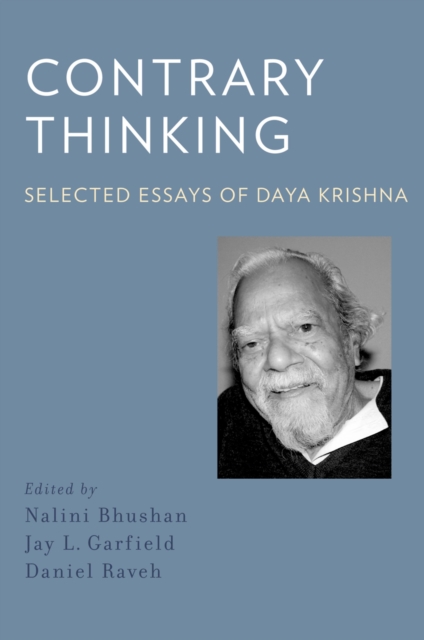
Contrary Thinking
Daya Krishna was easily the most creative and original Indian philosopher of the second half of the twentieth century. His thought and philosophical energy dominated academic Indian philosophy and determined the nature of the engagement of Indian philosophy with Western philosophy during that period. He passed away recently, leaving behind an enormous corpus of published work on a wide range of philosophical topics, as well as a great deal of incomplete, nearly-complete and complete-but-as-yet-unpublished work. Krishna's thought and publications address a broad range of philosophical issues, including issues of global philosophical importance that transcend considerations of particular traditions; issues particular to Indian philosophy; and issues at the intersection of Indian and Western philosophy, especially questions about the philosophy of language and ontology that emerge in the context of his Samvada project that brought together Western philosophers and Nyaya pandits to discuss questions in the philosophy of language and metaphysics. The volume is organized as a set of ten couplets and triplets. Each draws together papers from different periods in Krishna's life: some take different approaches to the same problem or text; in some cases, the second paper references and takes issue with arguments developed in the first; in still others, Krishna addresses very different topics, but using the same distinctive philosophical methodology. These couplets are framed by two of Krishna's finest metaphilosophical essays, one that introduces his approach, and one that draws some of his grand morals about the discipline.
eBook

Exploring agency in the Mahهabhهarata : ethical and political dimensions of Dharma
\"The Mahهabhهarata, one of the major epics of India, is a sourcebook complete by itself as well as an open text constantly under construction. This volume looks at transactions between its modern discourses and ancient vocabulary. Located amid conversations between these two conceptual worlds, the volume grapples with the epic's problematisation of dharma or righteousness, and consequently, of the ideal person and the good life through a cluster of issues surrounding the concept of agency and action. Drawing on several interdisciplinary approaches, the essays reflect on a range of issues in the Mahهabhهarata, including those of duty, motivation, freedom, selfhood, choice, autonomy, and justice, both in the context of philosophical debates and their ethical and political ramifications for contemporary times. This book will be of interest to scholars and researchers engaged with philosophy, literature, religion, history, politics, culture, gender, South Asian studies, and Indology. It will also appeal to the general reader interested in South Asian epics and the Mahهabhهarata.\"--Page i.
Book

The Advaita Worldview
2007 CHOICE Outstanding Academic Title In
this book, Anantanand Rambachan offers a fresh and detailed
perspective on Advaita Vedanta, Hinduism's most influential and
revered religious tradition. Rambachan, who is both a scholar and
an Advaitin, attends closely to the Upanisads and authentic
commentaries of Sankara to challenge the tradition and to
reconsider central aspects of its current teachings. His
reconstruction and reinterpretation of Advaita focuses in
particular on the nature of brahman, the status of the world in
relation to brahman, and the meaning and relevance of liberation.
Rambachan queries contemporary representations of an impersonal
brahman and the need for popular, hierarchical distinctions such as
those between a higher (para) and lower (apara) brahman. Such
distinctions, Rambachan argues, are inconsistent with the non-dual
nature of brahman and are unnecessary when brahman's relationship
with the world is correctly understood. Questioning Advaita's
traditional emphasis on renunciation and world-denial, Rambachan
expands the understanding of suffering (duhkha) and liberation
(moksa) and addresses socioeconomic as well as gender and caste
inequalities. Positing that the world is a celebrative expression
of God's fullness, this book advances Advaita as a universal and
uninhibited path to a liberated life committed to compassion,
equality, and justice.
eBook