
Catalogue Search | MBRL


Are you sure you want to remove the book from the shelf?

{{itemTitle}}
123,326
result(s) for
"PHILOSOPHY OF EDUCATION"
Sort by:

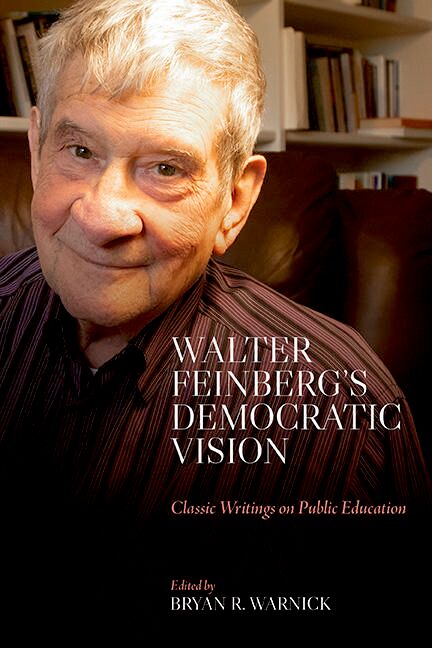
Walter Feinberg's Democratic Vision
Collects Walter Feinberg's classic writings on the
meaning of democracy for public education.
For over fifty years, Walter Feinberg has been a leader in
interpreting democracy in and its meaning for public education.
In this collection, Feinberg explores the question of how to
study education, the necessary role of history and philosophy
in this endeavor, and the need for educational theorists to
engage with the lived realities of students, parents, and
teachers through philosophical anthropology. He demonstrates a
particular way of paying attention to public education that
brings an interpretive sensitivity for others to the big
philosophical questions of what public schooling should be in
democratic societies. Feinberg explores many of the central
questions that vex educational policy and practice: What should
be the purpose of public schools? What should we think of
school choice proposals? What are the relationships between
religion and public schools? Should schools promote an American
identity? How should we think about affirmative action? In this
tour of educational ideas, democracy is the central concern, as
it both presents questions that demand answers and becomes an
approach to studying education with rigor and sensitivity.
eBook

The importance of philosophy in teacher education : mapping the decline and its consequences
\"The Importance of Philosophy in Teacher Education maps the gradual decline of philosophy as a central, integrated part of educational studies. Chapters consider how this decline has impacted teacher education and practice, offering new directions for the reintegration of philosophical thinking in teacher preparation and development. Touching on key points in history, this valuable collection of chapters accurately appraises the global decline of philosophy of education in teacher education programs and seeks to understand the external and endemic causes of changed attitudes towards a discipline which was once assigned such a central place in teacher education. Chapters illustrate how a grounding in the theoretical and ethical dimensions of teaching, learning, and education systems contribute in meaningful ways to being a good teacher, and trace the consequences of a decline in philosophy on individuals' professional development and on the evolution of the teaching profession more broadly. With this in mind, the text focusses on the future of teacher education and considers how we can ensure that philosophy of education feeds into the excellence of teaching today. This book will be of great interest to graduate, postgraduate students as well as research scholars in the field of educational philosophy and history of education. In addition, it will be useful for those involved in teacher education, and in particular, course, module and program development\"-- Provided by publisher.
Book

Actionable postcolonial theory in education
Andreotti illustrates how postcolonial theory is applied in the contexts of educational research/critique and in pioneering pedagogical projects. She offers an accessible and useful overview and comparison of theoretical debates related to critiques of Western/Northern hegemony.
eBook

Cherishing and the good life of learning : ethics, education, upbringing
\"What is a good human life? A life of duty? Virtue? Happiness? This book weaves a path through traditional answers. We live well, suggests the author, not primarily by pursuing goods for ourselves, but by cherishing other people and guiding them towards lives of cherishing. We cherish objects too - the planet, my grandfather's watch - and practices like music-making to which we are personally drawn. In this work of 'populated philosophy' (copiously illustrated by literary and 'real life' examples), a cherishing life is presented as hard and irreducibly individual. The idea of cherishing, says the author, points towards intimate, unreasonable layers of the ethical life, as well as the deepening of wisdom and connection. It also points towards incomparable satisfactions, reminding us who we are and who we want to be.\"-- Provided by publisher.
Book

John Dewey
Designed specifically for teachers and education students, with carefully selected articles, lectures, and book chapters covering Dewey's major ideas.
eBook


Dominant Discourses in Higher Education
This book examines the dominant discourses in higher education. From the moment academics enter higher education, they are met with binaries such as teaching vs. research, quantitative vs. qualitative research, and constructivists vs. positivists. When embarking upon a teaching career in a university there are further binaries that immediately present themselves, with deep vs. surface learning probably being the most pervasive. Kinchin and Gravett contend that this presents a distorted view and contributes to the disconnect between the aims and observable practice of higher education. Rather than celebrating difference, dominant discourses tend to seek similarities in an attempt to simplify and manage the environment, in what the authors perceive as a less than scholarly mode. In order to break down the barriers between ‘structuralist’ or ‘traditional’ academics and those who are more familiar with poststructuralist, critical perspectives, the authors explore the overlaps between these perspectives to offer a richer and more inclusive interrogation of the dominant discourses that pervade higher education. Offering methodological approaches to explore these perspectives, the authors bring together academics working in different parts of the university and examine the concept of a ‘rich cartography’, exploring how this can offer meaning within higher education research and practice.
eBook

Philosophical perspectives on teacher education
\"Philosophical Perspectives on Teacher Education presents a series of well-argued, thought-provoking essays that point to the ethical considerations that should be addressed when proposing and implementing teacher training and educational policies and practices\"-- Provided by publisher.
Book
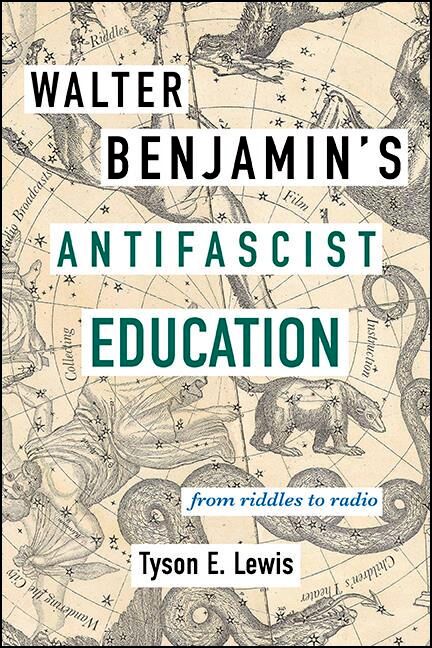
Walter Benjamin's Antifascist Education
\"Walter Benjamin's Antifascist Education is the first comprehensive analysis of educational themes across the entirety of the critical theorist's diverse writings. Starting with Benjamin's early reflections on teaching and learning, Tyson E. Lewis argues that the aesthetic and cultural forms to which Benjamin so often turned-namely, radio broadcasts, children's theatrical productions, collections, cityscapes, public cinemas, and word games-swell with educational potentialities. What emerges from Lewis's reading is a constellational curriculum composed of minor practices such as poor teaching, absentminded learning, and nondurational studying. This curriculum carries political significance, offering an antidote to past and present forms of fascist manipulation, hardness, and coldness. Walter Benjamin's Antifascist Education is a testimony to Benjamin's belief that \"everyone is an educator and everyone needs to be educated and everything is education.\"\"--.
eBook