
Catalogue Search | MBRL


Are you sure you want to remove the book from the shelf?

{{itemTitle}}
17,923
result(s) for
"POLITICAL SCIENCE / Government / Comparative"
Sort by:

Pluralism by default : weak autocrats and the rise of competitive politics
An audacious new explanation for the emergence of political pluralism in weak states. Pluralism by Default explores sources of political contestation in the former Soviet Union and beyond. Lucan Way proposes that pluralism in \"new democracies\" is often grounded less in democratic leadership or emerging civil society and more in the failure of authoritarianism. Dynamic competition frequently emerges because autocrats lack the state capacity to steal elections, impose censorship, or repress opposition. In fact, the same institutional failures that facilitate political competition may also thwart the development of stable democracy.
eBook

Comparative politics : principles of democracy and democratization
By revealing the contextual conditions which promote or hinder democratic development, Comparative Politics shows how democracy may not be the best institutional arrangement given a country's unique set of historical, economic, social, cultural and international circumstances. Addresses the contextual conditions which promote or hinder.
eBook

The Internet and Political Protest in Autocracies
In the aftermath of recent popular uprisings in dictatorships, many observers argued that information and communication technologies, notably the Internet, played a key role in the mobilization of political protest. This book unpacks when and under which circumstances Internet technology can benefit opposition activists aiming to mobilize protests, and when the technology plays into the hands of autocratic governments. Since autocratic governments enjoy a high degree of control over the introduction and expansion of Internet technology and over digital communication ows, the book argues that it should help them keep levels of protest low in the long-term. However, once protest has started, short-term government intervention becomes more difficult, which is why Internet technology can catalyze ongoing episodes of unrest. The book presents detailed empirical analyses of the relationship between the use of Internet technology and protest in autocracies. By leveraging new sub-national data on political protest and Internet penetration, these analysis cover more than sixty autocratic countries at the level of cities. The results show that higher levels of Internet penetration in cities reduce the overall occurrence of protest in dictatorships, but once protest has started, the Internet contributes to the continuation of protest in the same city as well as its diffusion to other locations. By examining the use of the Internet by governments in relation to other means of autocratic repression, the book also demonstrates the technological modernization of autocratic politics, where digital repression via the Internet partly substitutes traditional forms of political control.
eBook

Patterns of democracy : government forms and performance in thirty-six countries
In this updated and expanded edition of his classic text, Arend Lijphart offers a broader and deeper analysis of worldwide democratic institutions than ever before. Examining thirty-six democracies during the period from 1945 to 2010, Lijphart arrives at important-and unexpected-conclusions about what type of democracy works best. Praise for the previous edition: \"Magnificent. . . . The best-researched book on democracy in the world today.\"-Malcolm Mackerras,American Review of Politics \"I can't think of another scholar as well qualified as Lijphart to write a book of this kind. He has an amazing grasp of the relevant literature, and he's compiled an unmatched collection of data.\"-Robert A. Dahl, Yale University \"This sound comparative research . . . will continue to be a standard in graduate and undergraduate courses in comparative politics.\"-Choice
eBook

If Mayors Ruled the World
In the face of the most perilous challenges of our time-climate change, terrorism, poverty, and trafficking of drugs, guns, and people-the nations of the world seem paralyzed. The problems are too big, too interdependent, too divisive for the nation-state. Is the nation-state, once democracy's best hope, today democratically dysfunctional? Obsolete? The answer, says Benjamin Barber in this highly provocative and original book, is yes. Cities and the mayors who run them can do and are doing a better job.
Barber cites the unique qualities cities worldwide share: pragmatism, civic trust, participation, indifference to borders and sovereignty, and a democratic penchant for networking, creativity, innovation, and cooperation. He demonstrates how city mayors, singly and jointly, are responding to transnational problems more effectively than nation-states mired in ideological infighting and sovereign rivalries. Featuring profiles of a dozen mayors around the world-courageous, eccentric, or both at once-If Mayors Ruled the Worldpresents a compelling new vision of governance for the coming century. Barber makes a persuasive case that the city is democracy's best hope in a globalizing world, and great mayors are already proving that this is so.
eBook

Dream Hoarders
America is becoming a class-based society.It's now conventional wisdom to focus on the excesses of the top 1% - especially the top 0.01% - and how the ultra-rich are hoarding income and wealth while incomes for most other Americans are stagnant. But the more important, and widening, gap in American society is between the upper middle class and everyone else.Reeves defines the upper middle class as those whose incomes are in the top 20 percent of American society. Income isn't the only way to measure a society, but in a market economy it is crucial because access to money generally determines who gets the best quality education, housing, health care, and other necessary goods and services.As Reeves shows, the growing separation between the upper middle class and everyone else can be seen in family structure, neighborhoods, attitudes, and lifestyle. Those at the top of the income ladder are becoming more effective at passing on their status to their children, reducing overall social mobility. The result is a fracturing of American society along class lines, not just an economic divide. Upper-middle-class children become upper-middle-class adults.These trends matter because the separation and perpetuation of the upper middle class corrode prospects for more progressive approaches to policy. Various forms of \"opportunity hoarding\" among the upper middle class make it harder for others to rise up to the top rung. Examples include zoning laws and schooling, occupational licensing, college application procedures, and the allocation of internships. Upper middle class opportunity hoarding, Reeves argues, results in a less competitive economy as well as a less open society.Inequality is inevitable and can even be good, within limits. But Reeves argues that society can take effective action to reduce opportunity hoarding and thus promote broader opportunity. This fascinating book shows how American society has become the very class-defined society that earlier Americans rebelled against - and what can be done to restore a more equitable society.
eBook

Digital politics in Western democracies : a comparative study
A comparative analysis of political websites and their users from seven Western democracies. Digital politics is shorthand for how internet technologies have fueled the complex interactions between political actors and their constituents. Cristian Vaccari analyzes the presentation and consumption of online politics in seven advanced Western democracies—Australia, France, Germany, Italy, Spain, the United Kingdom, and the United States—from 2006 to 2010. His study not only refutes claims that the web creates homogenized American-style politics and political interaction but also empirically reveals how a nation's unique constraints and opportunities create digital responses. Digital Politics in Western Democracies is the first large-scale comparative treatment of both the supply and the demand sides of digital politics among different countries and national political actors. It is divided into four parts: theoretical challenges and research methodology; how parties and candidates structure their websites (supply); how citizens use the websites to access campaign information (demand); and how the research results tie back to inequalities, engagement, and competition in digital politics. Because a key aspect of any political system is how its actors and citizens communicate, this book will be invaluable for scholars, students, and practitioners interested in political communication, party competition, party organization, and the study of the contemporary media landscape writ large.
eBook
Nation, Constitutionalism and Buddhism in Sri Lanka
Nation, Constitutionalism and Buddhism in Sri Lanka offers a new perspective on contemporary debates about Sinhalese Buddhist nationalism in Sri Lanka. In this book de Silva Wijeyeratne argues forcefully that 'Sinhalese Buddhism' in the period prior to its engagement with the British colonial State signified a relatively unbounded (although at times boundary forming) set of practices that facilitated both the inclusion and exclusion of non-'Buddhist' concepts and people within a particular cosmological frame. Juxtaposing the premodern against the backdrop of colonial modernity, de Silva Wijeyeratne tells us that in contrast modern 'Sinhalese Buddhism/nationalism' is a much more reified and bounded concept, one imagined through a 19th century epistemology whose purpose was not so much inclusion, but a much more radical exclusion of non-'Buddhist' ideas and people.
In this insightful analysis modern Sinhalese Buddhist nationalism, then, emerges through the conjunction of discourse, power and knowledge at a distinct moment in the trajectory of the colonial State. An intrinsic feature of this modernist moment is that premodern categories (such as the cosmic order) were subject to a bureaucratic re-valuation that generated profound consequences for State-society relations and the wider constitutional/legal imaginary. This book goes onto explore how key constitutional and nation-building moments were framed within the cultural milieu of modern Sinhalese Buddhist nationalism - a nationalism that reveals the power of a re-valued Buddhist cosmic order to still inform the present.
Given the intensification of the Sinhalese Buddhist nationalist project following the defeat of the Tamil Tigers in 2009, this book is of interest to scholars of nationalism, South Asian studies, the anthropology of ritual, and comparative legal history.
eBook
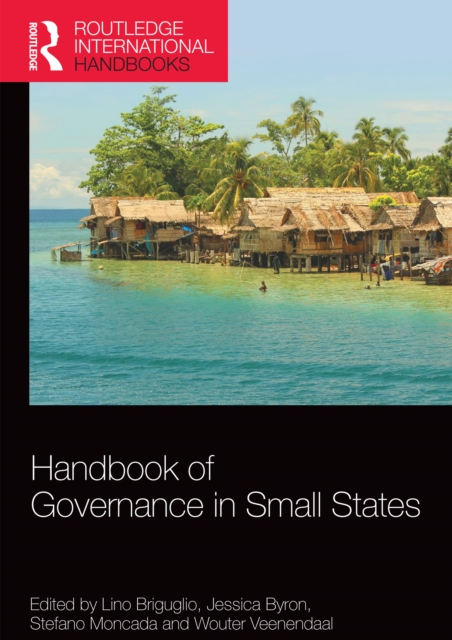
Handbook of Governance in Small States
This volume covers a wide spectrum of governance issues relating to small states in a global context. While different definitions of governance are given in the chapters, most authors associate governance with the setting and implementation of policies aimed at managing a country or territory, and with the related institutional structures and interventions by political actors. Generally, good governance is associated with concepts such as policy effectiveness, accountability, transparency, control of corruption, encouragement of citizens' voice and gender equality-factors which are, in turn, linked with democracy. What emerges from the book is that the societies of small states are being re-shaped by various forces outside their control, including the globalization process and climate change, rendering their governance ever more complex. These problems are not solely faced by small states, but small country size tends to lead to a higher degree of exposure to external factors.
The chapters are grouped into four sections broadly covering political, environmental, social and economic governance. Governance is influenced by many, often intertwined, factors; the division of the book into four parts therefore does not detract from the fact that governance is multifaceted, and such division was based on the primary focus of each particular study and its main disciplinary background. The expert authors have, moreover, used a variety of approaches in the studies, the subject of small states being well suited to scholarly work from different disciplines using qualitative, quantitative and mixed approaches to arrive at useful conclusions.
eBook

Ending Social Promotion Without Leaving Children Behind
The New York City Department of Education asked RAND to conduct an independent longitudinal evaluation of its 5th-grade promotion policy. The findings of that study, conducted between March 2006 and August 2009, provide a comprehensive view of the policy's implementation and its impact on student outcomes, particularly for students at risk of retention and those who were retained in grade.
eBook