
Catalogue Search | MBRL


Are you sure you want to remove the book from the shelf?

{{itemTitle}}
113,448
result(s) for
"POLITICAL SCIENCE / Government / International."
Sort by:

Can Russia Modernise?
In this original, bottom-up account of the evolution of contemporary Russia, Alena Ledeneva seeks to reveal how informal power operates. Concentrating on Vladimir Putin's system of governance - referred to as sistema - she identifies four key types of networks: his inner circle, useful friends, core contacts and more diffuse ties and connections. These networks serve sistema but also serve themselves. Reliance on networks enables leaders to mobilise and to control, yet they also lock politicians, bureaucrats and businessmen into informal deals, mediated interests and personalised loyalty. This is the 'modernisation trap of informality': one cannot use the potential of informal networks without triggering their negative long-term consequences for institutional development. Ledeneva's perspective on informal power is based on in-depth interviews with sistema insiders and enhanced by evidence of its workings brought to light in court cases, enabling her to draw broad conclusions about the prospects for Russia's political institutions.
eBook

Oil, Illiberalism, and War
The United States is addicted to crude oil. In this book, Andrew Price-Smith argues that this addiction has distorted the conduct of American foreign policy in profound and malign ways, resulting in interventionism, exploitation, and other illiberal behaviors that hide behind a facade of liberal internationalism. The symbiotic relationship between the state and the oil industry has produced deviations from rational foreign energy policy, including interventions in Iraq and elsewhere that have been (at the very least) counterproductive or (at worst) completely antithetical to national interests.Liberal internationalism casts the United States as a benign hegemon, guaranteeing security to its allies during the Cold War and helping to establish collaborative international institutions. Price-Smith argues for a reformulation of liberal internationalism (which he termsshadow liberalism) that takes into account the dark side of American foreign policy. Price-Smith contends that the \"free market\" in international oil is largely a myth, rendered problematic by energy statism and the rise of national oil companies. He illustrates the destabilizing effect of oil in the Persian Gulf, and describes the United States' grand energy strategy, particularly in the Persian Gulf, as illiberal at its core, focused on the projection of power and on periodic bouts of violence. Washington's perennial oscillation between liberal phases of institution building and provision of public goods and illiberal bellicosity, Price-Smith argues, represents the shadow liberalism that is at the core of US foreign policy.
eBook

External Intervention and the Politics of State Formation
This book explores ways foreign intervention and external rivalries can affect the institutionalization of governance in weak states. When sufficiently competitive, foreign rivalries in a weak state can actually foster the political centralization, territoriality and autonomy associated with state sovereignty. This counterintuitive finding comes from studying the collective effects of foreign contestation over a weak state as informed by changes in the expected opportunity cost of intervention for outside actors. When interveners associate high opportunity costs with intervention, they bolster sovereign statehood as a next best alternative to their worst fear - domination of that polity by adversaries. Sovereign statehood develops if foreign actors concurrently and consistently behave this way toward a weak state. This book evaluates that argument against three 'least likely' cases - China, Indonesia and Thailand between the late nineteenth and mid-twentieth centuries.
eBook

The Passion of Max von Oppenheim
Born into a prominent German Jewish banking family, Baron Max von Oppenheim (1860-1946) was a keen amateur archaeologist and ethnologist. His discovery and excavation of Tell Halaf in Syria marked an important contribution to knowledge of the ancient Middle East, while his massive study of the Bedouins is still consulted by scholars today. He was also an ardent German patriot, eager to support his country's pursuit of its \"place in the sun\". Excluded by his part-Jewish ancestry from the regular diplomatic service, Oppenheim earned a reputation as \"the Kaiser's spy\" because of his intriguing against the British in Cairo, as well as his plan, at the start of the First World War, to incite Muslims under British, French and Russian rule to a jihad against the colonial powers. After 1933, despite being half-Jewish according to the Nuremberg Laws, Oppenheim was not persecuted by the Nazis. In fact, he placed his knowledge of the Middle East and his connections with Muslim leaders at the service of the regime. Ranging widely over many fields—from war studies to archaeology and banking history—The Passion of Max von Oppenheim tells the gripping and at times unsettling story of one part-Jewish man's passion for his country in the face of persistent and, in his later years, genocidal anti-Semitism.
eBook

The European Union in the Asia-Pacific
Since the mid-1990s, the European Union has defined the Asia-Pacific as one of its key strategic targets on its ambitious road towards global power. The EU has ever since made consistent efforts to implement strategies, policies and activities in the Asia-Pacific. Over the past decades, big changes have taken place on both sides and the wider world. It is high time to evaluate the EU’s performance in its Asian policy. In fact, the EU is at crossroads with its Asia Pacific policy. On several aspects, the EU is compelled to redefine its interests and roles, and rethink its strategies and policies towards the dynamic and ever-important Asia-Pacific region of the contemporary world. This volume addresses this theme, by elaborating the general context, major issues and countries in the EU’s Asia-Pacific policy. It covers issues and areas of traditional security, economy and trade, public diplomacy, and human security and focuses on the EU’s relations with China, Japan, the ASEAN countries and Australasia.
eBook

War and Democratic Constraint
Why do some democracies reflect their citizens' foreign policy preferences better than others? What roles do the media, political parties, and the electoral system play in a democracy's decision to join or avoid a war?War and Democratic Constraintshows that the key to how a government determines foreign policy rests on the transmission and availability of information. Citizens successfully hold their democratic governments accountable and a distinctive foreign policy emerges when two vital institutions-a diverse and independent political opposition and a robust media-are present to make timely information accessible.
Matthew Baum and Philip Potter demonstrate that there must first be a politically potent opposition that can blow the whistle when a leader missteps. This counteracts leaders' incentives to obscure and misrepresent. Second, healthy media institutions must be in place and widely accessible in order to relay information from whistle-blowers to the public. Baum and Potter explore this communication mechanism during three different phases of international conflicts: when states initiate wars, when they respond to challenges from other states, or when they join preexisting groups of actors engaged in conflicts.
Examining recent wars, including those in Afghanistan and Iraq,War and Democratic Constraintlinks domestic politics and mass media to international relations in a brand-new way.
eBook
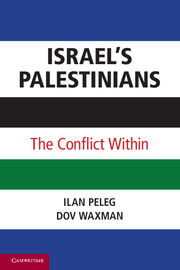
Israel’s Palestinians
Arguing that a comprehensive and lasting solution to the Israeli-Palestinian conflict depends on a resolution of the Jewish-Palestinian conflict within Israel as much as it does on resolving the conflict between Israel and Palestinians in the Occupied Territories, this timely book explores the causes and consequences of the growing conflict between Israel's Jewish majority and its Palestinian-Arab minority. It warns that if Jewish-Arab relations in Israel continue to deteriorate, this will pose a serious threat to the stability of Israel, to the quality of Israeli democracy and to the potential for peace in the Middle East. The book examines the views and attitudes of both the Palestinian minority and the Jewish majority, as well as the Israeli state's historic approach to its Arab citizens. Drawing upon the experience of other states with national minorities, the authors put forward specific proposals for safeguarding and enhancing the rights of the Palestinian minority while maintaining the country's Jewish identity.
eBook

Peacemaking in the twenty-first century
This book provides a range of unique insights into the issues surrounding peacebuilding, delivered by major international figures with direct experience in this area at the highest level, including Bertie Ahern, Kofi Annan and Bill and Hillary Clinton. Based on a series of lectures on the theme of peacekeeping and peacebuilding in the contemporary world, each lecture is presented here with an introduction placing it in its proper context within the discourse on peacemaking. Edited and introduced by Nobel Laureate John Hume, this volume makes an invaluable contribution to the study of peace and conflict studies, international history, international relations and international politics.
eBook
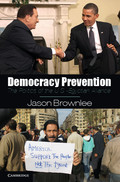
Democracy Prevention
When a popular revolt forced long-ruling Egyptian President Hosni Mubarak to resign on February 11, 2011, US President Barack Obama hailed the victory of peaceful demonstrators in the heart of the Arab World. But Washington was late to endorse democracy - for decades the United States favored Egypt's rulers over its people. Since 1979, the United States had provided the Egyptian regime with more than $60 billion in aid and immeasurable political support to secure its main interests in the region: Israeli security and strong relations with Persian Gulf oil producers. During the Egyptian uprising, the White House did not promote popular sovereignty but instead backed an 'orderly transition' to one of Mubarak's cronies. Even after protesters derailed that plan, the anti-democratic US-Egyptian alliance continued. Using untapped primary materials, this book helps explain why authoritarianism has persisted in Egypt with American support, even as policy makers claim to encourage democratic change.
eBook

Russia and the West from Alexander to Putin
Since Russia has re-emerged as a global power, its foreign policies have come under close scrutiny. In Russia and the West from Alexander to Putin, Andrei P. Tsygankov identifies honor as the key concept by which Russia's international relations are determined. He argues that Russia's interests in acquiring power, security and welfare are filtered through this cultural belief and that different conceptions of honor provide an organizing framework that produces policies of cooperation, defensiveness and assertiveness in relation to the West. Using ten case studies spanning a period from the early nineteenth century to the present day - including the Holy Alliance, the Triple Entente and the Russia-Georgia war - Tsygankov's theory suggests that when it perceives its sense of honor to be recognized, Russia cooperates with the Western nations; without such a recognition it pursues independent policies either defensively or assertively.
eBook