
Catalogue Search | MBRL


Are you sure you want to remove the book from the shelf?

{{itemTitle}}
1,105
result(s) for
"POLITICAL SCIENCE / Government / Judicial Branch."
Sort by:

Citizens, Courts, and Confirmations
In recent years the American public has witnessed several hard-fought battles over nominees to the U.S. Supreme Court. In these heated confirmation fights, candidates' legal and political philosophies have been subject to intense scrutiny and debate.Citizens, Courts, and Confirmationsexamines one such fight--over the nomination of Samuel Alito--to discover how and why people formed opinions about the nominee, and to determine how the confirmation process shaped perceptions of the Supreme Court's legitimacy.
Drawing on a nationally representative survey, James Gibson and Gregory Caldeira use the Alito confirmation fight as a window into public attitudes about the nation's highest court. They find that Americans know far more about the Supreme Court than many realize, that the Court enjoys a great deal of legitimacy among the American people, that attitudes toward the Court as an institution generally do not suffer from partisan or ideological polarization, and that public knowledge enhances the legitimacy accorded the Court. Yet the authors demonstrate that partisan and ideological infighting that treats the Court as just another political institution undermines the considerable public support the institution currently enjoys, and that politicized confirmation battles pose a grave threat to the basic legitimacy of the Supreme Court.
eBook

Building the Judiciary
How did the federal judiciary transcend early limitations to become a powerful institution of American governance? How did the Supreme Court move from political irrelevance to political centrality?Building the Judiciaryuncovers the causes and consequences of judicial institution-building in the United States from the commencement of the new government in 1789 through the close of the twentieth century. Explaining why and how the federal judiciary became an independent, autonomous, and powerful political institution, Justin Crowe moves away from the notion that the judiciary is exceptional in the scheme of American politics, illustrating instead how it is subject to the same architectonic politics as other political institutions.
Arguing that judicial institution-building is fundamentally based on a series of contested questions regarding institutional design and delegation, Crowe develops a theory to explain why political actors seek to build the judiciary and the conditions under which they are successful. He both demonstrates how the motivations of institution-builders ranged from substantive policy to partisan and electoral politics to judicial performance, and details how reform was often provoked by substantial changes in the political universe or transformational entrepreneurship by political leaders. Embedding case studies of landmark institution-building episodes within a contextual understanding of each era under consideration, Crowe presents a historically rich narrative that offers analytically grounded explanations for why judicial institution-building was pursued, how it was accomplished, and what--in the broader scheme of American constitutional democracy--it achieved.
eBook

Checking the courts : law, ideology, and contingent discretion
Examines and measures the extent to which statutory language affects judicial behavior.
eBook
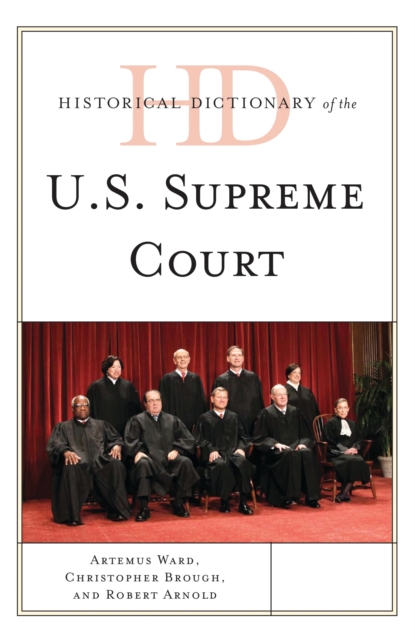
Historical dictionary of the U.S. Supreme Court
The Historical Dictionary of the U.S. Supreme Court covers its history through a chronology, an introductory essay, appendixes, and an extensive bibliography. The dictionary section has over 700 cross-referenced entries on every justice, major case, issue, and process that comprises the Court's work.
eBook
The behavior of federal judges : a theoretical and empirical study of rational choice
Federal judges are not just robots or politicians in robes, yet their behavior is not well understood, even among themselves. Using statistical methods, a political scientist, an economist, and a judge construct a unified theory of judicial decision-making to dispel the mystery of how decisions from district courts to the Supreme Court are made.
eBook
Worse Than Nothing
Why originalism is a flawed, incoherent, and dangerously
ideological method of constitutional interpretation
Originalism, the view that the meaning of a constitutional
provision is fixed when it is adopted, was once the fringe theory
of a few extremely conservative legal scholars but is now a
well-accepted mode of constitutional interpretation. Three of the
Supreme Court's nine justices explicitly embrace the originalist
approach, as do increasing numbers of judges in the lower courts.
Noted legal scholar Erwin Chemerinsky gives a comprehensive
analysis of the problems that make originalism unworkable as a
method of constitutional interpretation. He argues that the framers
themselves never intended constitutional interpretation to be an
inflexible and shows how it is often impossible to know what the
\"original intent\" of any particular provision was. Perhaps worst of
all, though its supporters tout it as a politically neutral and
objective method, originalist interpretation tends to disappear
when its results fail to conform to modern conservative ideology.
eBook

The Constitutional Court and Democracy in Indonesia
The Constitutional Court and Democracy in Indonesia provides detailed, English-language analysis of Indonesia's Constitutional Court. Established in 2003, the Court has been at the forefront of democratic reform in Indonesia, shaping the rules under which Indonesian elections are run, enforcing democracy-related rights, and resolving hundred of electoral disputes. The Court has established itself as an accessible and largely professional body that actively and independently performs its functions and one which does not shy away from difficult cases. It has earned the respect of Indonesian citizens and members of government who comply with the Court's decisions as a matter of course, despite the Court's lack of official enforcement powers. Many of the Court's decisions have been controversial, yet criticism has focused on the perceived unfairness of the outcomes. This book seeks to forge a new path in this debate by offering a balanced critique of the Constitutional Court's jurisprudence and decision-making practices.
eBook

Against the Death Penalty
A landmark dissenting opinion arguing against the death penalty. Does the death penalty violate the Constitution? In Against the Death Penalty, Justice Stephen Breyer argues that it does; that it is carried out unfairly and inconsistently and, thus, violates the ban on \"cruel and unusual punishments\" specified by the Eighth Amendment to the Constitution. “Today’s administration of the death penalty,\" Breyer writes, “involves three fundamental constitutional defects: (1) serious unreliability, (2) arbitrariness in application, and (3) unconscionably long delays that undermine the death penalty’s penological purpose. Perhaps as a result, (4) most places within the United States have abandoned its use.\" This volume contains Breyer's dissent in the case of Glossip v. Gross, which involved an unsuccessful challenge to Oklahoma's use of a lethal-injection drug because it might cause severe pain. Justice Breyer's legal citations have been edited to make them understandable to a general audience, but the text retains the full force of his powerful argument that the time has come for the Supreme Court to revisit the constitutionality of the death penalty. Breyer was joined in his dissent from the bench by Justice Ruth Bader Ginsburg. Their passionate argument has been cited by many legal experts including fellow Justice Antonin Scalia—as signaling an eventual Court ruling striking down the death penalty. A similar dissent in 1963 by Breyer's mentor, Justice Arthur J. Goldberg, helped set the stage for a later ruling, imposing what turned out to be a four-year moratorium on executions.
eBook
The people's courts : pursuing judicial independence in America
In the United States, almost 90 percent of state judges have to run in popular elections to remain on the bench. In the past decade, this peculiarly American institution has produced vicious multi-million-dollar political election campaigns and high-profile allegations of judicial bias and misconduct. The People's Courts traces the history of judicial elections and Americans' quest for an independent judiciary—one that would ensure fairness for all before the law—from the colonial era to the present.
In the aftermath of economic disaster, nineteenth-century reformers embraced popular elections as a way to make politically appointed judges less susceptible to partisan patronage and more independent of the legislative and executive branches of government. This effort to reinforce the separation of powers and limit government succeeded in many ways, but it created new threats to judicial independence and provoked further calls for reform. Merit selection emerged as the most promising means of reducing partisan and financial influence from judicial selection. It too, however, proved vulnerable to pressure from party politics and special interest groups. Yet, as Shugerman concludes, it still has more potential for protecting judicial independence than either political appointment or popular election.
The People's Courts shows how Americans have been deeply committed to judicial independence, but that commitment has also been manipulated by special interests. By understanding our history of judicial selection, we can better protect and preserve the independence of judges from political and partisan influence.
eBook
The Behavior of Federal Judges
Judges play a central role in the American legal system, but their behavior as decision-makers is not well understood, even among themselves. The system permits judges to be quite secretive (and most of them are), so indirect methods are required to make sense of their behavior. Here, a political scientist, an economist, and a judge work together to construct a unified theory of judicial decision-making. Using statistical methods to test hypotheses, they dispel the mystery of how judicial decisions in district courts, circuit courts, and the Supreme Court are made.
The authors derive their hypotheses from a labor-market model, which allows them to consider judges as they would any other economic actors: as self-interested individuals motivated by both the pecuniary and non-pecuniary aspects of their work. In the authors' view, this model describes judicial behavior better than either the traditional \"legalist\" theory, which sees judges as automatons who mechanically apply the law to the facts, or the current dominant theory in political science, which exaggerates the ideological component in judicial behavior. Ideology does figure into decision-making at all levels of the federal judiciary, the authors find, but its influence is not uniform. It diminishes as one moves down the judicial hierarchy from the Supreme Court to the courts of appeals to the district courts. As The Behavior of Federal Judges demonstrates, the good news is that ideology does not extinguish the influence of other components in judicial decision-making. Federal judges are not just robots or politicians in robes.
eBook