
Catalogue Search | MBRL


Are you sure you want to remove the book from the shelf?

{{itemTitle}}
4,534
result(s) for
"POLITICAL SCIENCE / International Relations / Arms Control."
Sort by:

The Legacy of Iraq
The Legacy of Iraq critically reflects on the abject failure of the 2003 intervention to turn Iraq into a liberal democracy, underpinned by free-market capitalism, its citizens free to live in peace and prosperity. It argues that mistakes made by the coalition and the Iraqi political elite set a sequence of events in motion that have had devastating consequences for Iraq, the Middle East and for the rest of the world. Today, as the nation faces perhaps its greatest challenge in the wake of the devastating advance of the Islamic State of Iraq and Syria (ISIS) and another US-led coalition undertakes renewed military action in Iraq, understanding the complex and difficult legacies of the 2003 war could not be more urgent. Ignoring the legacies of the Iraq war and denying their connection to contemporary events couldmeans that vital lessonsare ignored and the same mistakes made again.
eBook

State Behavior and the Nuclear Nonproliferation Regime
This is the first book-length study of why states sometimes ignore, oppose, or undermine elements of the nuclear nonproliferation regime-even as they formally support it. Anchored by the Treaty on the Non-Proliferation of Nuclear Weapons, the nuclear nonproliferation regime is the constellation of agreements, initiatives, and norms that work in concert to regulate nuclear material and technology. The essays gathered here show that attitudes on nonproliferation depend on a \"complex, contingent decision calculus,\" as states continually gauge how their actions within the regime will affect trade, regional standing, and other interests vital to any nation.
The first four essays take theoretical approaches to such topics as a framework for understanding challenges to collective action; clandestine proliferation under the Bush and Obama administrations and its impact on regime legitimacy; threat construction as a lens through which to view resistance to nonproliferation measures; and the debate over the relationship between nuclear disarmament and nonproliferation. Essays comprising the second part of the book use regional and state-specific case studies to look at how U.S. security guarantees affect the willingness of states to support the regime; question the perceived spoiler role of a \"vocal minority\" within the Non-Aligned Movement; challenge notions that Russia is using the regime to build a coalition hostile to the United States; contrast nonproliferation strategies among Latin American countries; and explain the lag in adoption of an Additional Protocol by some Middle East and North African countries.
Getting countries to cooperate on nonproliferation efforts is an ongoing challenge. These essays show that success must be measured not only by how many states join the effort but also by how they participate once they join.
eBook

Coping with a Nuclearizing Iran
Some time in the coming decade, Iran will probably acquire nuclear weapons or the capacity to quickly produce them. This monograph provides a midterm strategy for dealing with Iran that neither begins nor ends at the point at which Tehran acquires a nuclear weapon capability. It proposes an approach that neither acquiesces to a nuclear-armed Iran nor refuses to admit the possibility--indeed, the likelihood--of this occurring.
eBook

Barriers to Bioweapons
[ Barriers to Bioweapons ] is a must-read for
nonproliferation experts and should be a standard text for
understanding biological weapons development for some time to
come. ―David W. Kearn, Perspectives on
Politics
In both the popular imagination and among lawmakers and national
security experts, there exists the belief that with sufficient
motivation and material resources, states or terrorist groups can
produce bioweapons easily, cheaply, and successfully. In
Barriers to Bioweapons , Sonia Ben
Ouagrham-Gormley challenges this perception by showing that
bioweapons development is a difficult, protracted, and expensive
endeavor, rarely achieving the expected results whatever the
magnitude of investment.
Her findings are based on extensive interviews she conducted
with former U.S. and Soviet-era bioweapons scientists and on
careful analysis of archival data and other historical documents
related to various state and terrorist bioweapons programs.
Bioweapons development relies on living organisms that are
sensitive to their environment and handling conditions, and
therefore behave unpredictably. These features place a greater
premium on specialized knowledge. Ben Ouagrham-Gormley posits that
lack of access to such intellectual capital constitutes the
greatest barrier to the making of bioweapons. She integrates
theories drawn from economics, the sociology of science,
organization, and management with her empirical research. The
resulting theoretical framework rests on the idea that the pace and
success of a bioweapons development program can be measured by its
ability to ensure the creation and transfer of scientific and
technical knowledge. The specific organizational, managerial,
social, political, and economic conditions necessary for success
are difficult to achieve, particularly in covert programs where the
need to prevent detection imposes managerial and organizational
conditions that conflict with knowledge production.
In both the popular imagination and among lawmakers and national
security experts, there exists the belief that with sufficient
motivation and material resources, states or terrorist groups can
produce bioweapons easily, cheaply, and successfully. In
Barriers to Bioweapons , Sonia Ben Ouagrham-Gormley
challenges this perception by showing that bioweapons development
is a difficult, protracted, and expensive endeavor, rarely
achieving the expected results whatever the magnitude of
investment. Her findings are based on extensive interviews she
conducted with former U.S. and Soviet-era bioweapons scientists and
on careful analysis of archival data and other historical documents
related to various state and terrorist bioweapons
programs.Bioweapons development relies on living organisms that are
sensitive to their environment and handling conditions, and
therefore behave unpredictably. These features place a greater
premium on specialized knowledge. Ben Ouagrham-Gormley posits that
lack of access to such intellectual capital constitutes the
greatest barrier to the making of bioweapons. She integrates
theories drawn from economics, the sociology of science,
organization, and management with her empirical research. The
resulting theoretical framework rests on the idea that the pace and
success of a bioweapons development program can be measured by its
ability to ensure the creation and transfer of scientific and
technical knowledge. The specific organizational, managerial,
social, political, and economic conditions necessary for success
are difficult to achieve, particularly in covert programs where the
need to prevent detection imposes managerial and organizational
conditions that conflict with knowledge production.
eBook

Nuclear strategy in the modern era
The world is in a second nuclear age in which regional powers play an increasingly prominent role. These states have small nuclear arsenals, often face multiple active conflicts, and sometimes have weak institutions. How do these nuclear states-and potential future ones-manage their nuclear forces and influence international conflict? Examining the reasoning and deterrence consequences of regional power nuclear strategies, this book demonstrates that these strategies matter greatly to international stability and it provides new insights into conflict dynamics across important areas of the world such as the Middle East, East Asia, and South Asia.
Vipin Narang identifies the diversity of regional power nuclear strategies and describes in detail the posture each regional power has adopted over time. Developing a theory for the sources of regional power nuclear strategies, he offers the first systematic explanation of why states choose the postures they do and under what conditions they might shift strategies. Narang then analyzes the effects of these choices on a state's ability to deter conflict. Using both quantitative and qualitative analysis, he shows that, contrary to a bedrock article of faith in the canon of nuclear deterrence, the acquisition of nuclear weapons does not produce a uniform deterrent effect against opponents. Rather, some postures deter conflict more successfully than others.
Nuclear Strategy in the Modern Eraconsiders the range of nuclear choices made by regional powers and the critical challenges they pose to modern international security.
eBook

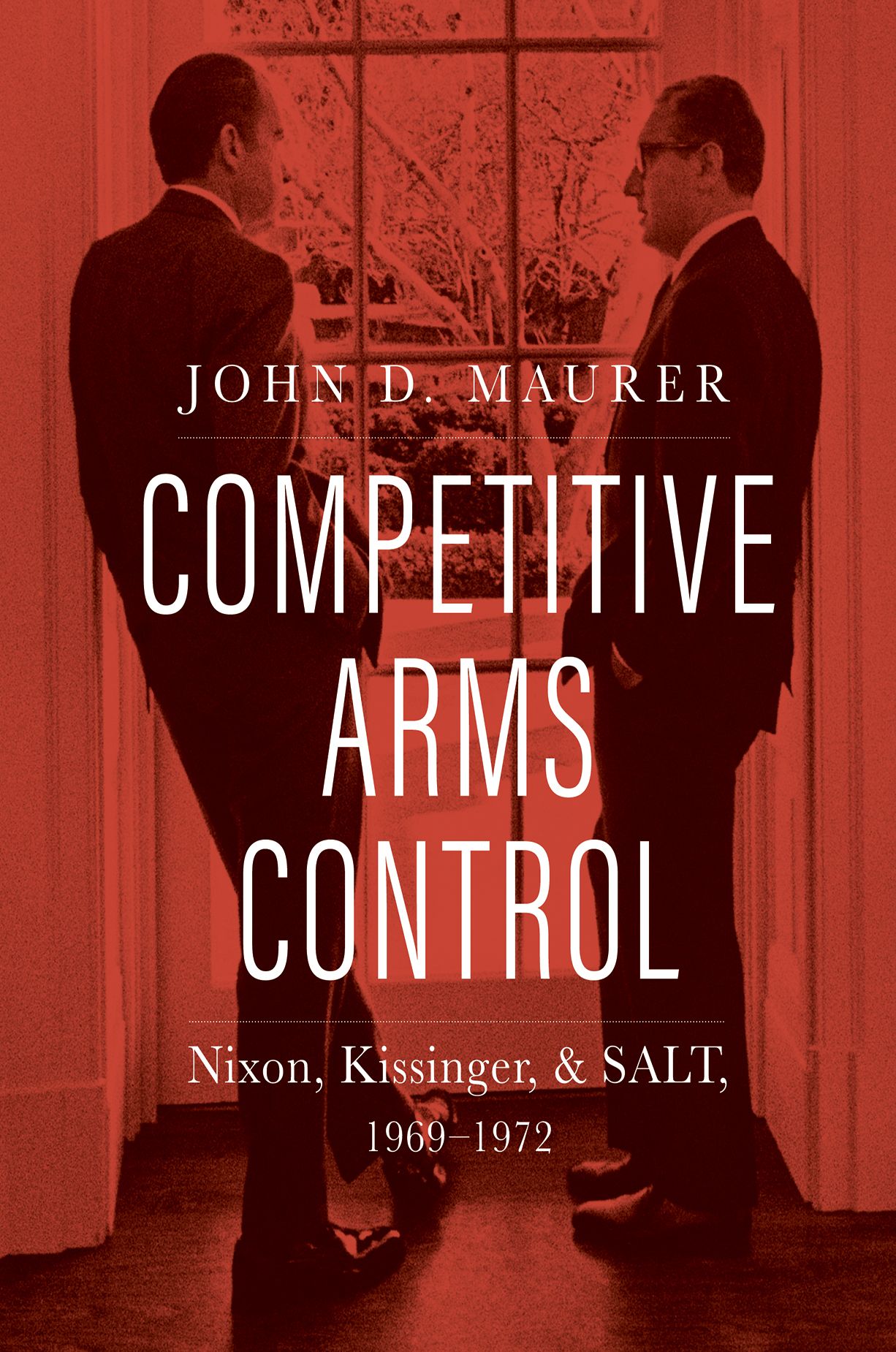
Competitive Arms Control
The essential history of the Strategic Arms Limitation
Talks (SALT) during the Nixon Administration How did
Richard Nixon, a president so determined to compete for strategic
nuclear advantage over the Soviet Union, become one of the most
successful arms controllers of the Cold War? Drawing on newly
opened Cold War archives, John D. Maurer argues that a central
purpose of arms control talks for American leaders was to channel
nuclear competition toward areas of American advantage and not just
international cooperation. While previous accounts of the Strategic
Arms Limitation Talks (SALT) have emphasized American cooperative
motives, Maurer highlights how Nixon, National Security Advisor
Henry Kissinger, and Secretary of Defense Melvin Laird shaped
negotiations, balancing their own competitive interests with
proponents of cooperation while still providing a coherent
rationale to Congress. Within the arms control agreements, American
leaders intended to continue deploying new weapons, and the arms
control restrictions, as negotiated, allowed the United States to
sustain its global power, contain communism, and ultimately prevail
in the Cold War.
eBook

Nuclear Deterrence in Europe
Through a variety of policies and actions--and most recently in a new military doctrine adopted in February 2010--Russia has indicated the types of situations and threats that might cause it to resort to using nuclear weapons. This volume examines Russia's evolving framework for nuclear deterrence and its implications for U.S. military operations in Europe.
eBook

Challenged Hegemony: The United States, China, and Russia in the Persian Gulf
Few issues in international affairs and energy security animate thinkers more than the classic topic of hegemony, and the case of the Persian Gulf presents particularly fertile ground for considering this concept. Since the 1970s, the region has undergone tumultuous changes, with dramatic shifts in the diplomatic, military, and economic roles of the United States, China, and Russia. In this book, Steve A. Yetiv and Katerina Oskarsson offer a panoramic study of hegemony and foreign powers in the Persian Gulf, offering the most comprehensive, data-driven portrait to date of their evolving relations.The authors argue that the United States has become hegemonic in the Persian Gulf, ultimately protecting oil security for the entire global economy. Through an analysis of official and unofficial diplomatic relations, trade statistics, military records, and more, they provide a detailed account of how U.S. hegemony and oil security have grown in tandem, as, simultaneously, China and Russia have increased their political and economic presence. The book sheds light on hegemony's complexities, and challenges and reveals how local variations in power will continue to shape the Persian Gulf in the future.
eBook

Norm Dynamics in Multilateral Arms Control
This volume comprehensively covers a range of issues related to dynamic norm change in the current major international arms control regimes related to nuclear, biological,and chemical weapons; small arms and light weapons; cluster munitions; and antipersonnel mines. Arms control policies of all of the key established and rising state actors are considered, as well as those of nonaligned countries, nongovernmental organizations, and international governing bodies. Recent studies on multilateral arms control tend to focus mostly on \"structure,\" by which opportunities and constraints for action are created. This volume pays equal attention to \"agency,\" through which opportunities and constraints to produce change or maintain the status quo are handled. In addition-and in greater depth than in recent studies-the volume acknowledges the force of moral and ethical impulses (alongside such factors as political, legal, and technological change) in the evolution of arms control norms. The volume begins with a look at the structure of regimes, at the conflicts residing in these structures, and at the dynamic processes in which these conflicts are worked out. The impact of extrinsic factors on norm dynamics is considered next, including technological change and shifts in attitudes and power structures. Essays on the role of agency in driving norm change conclude the volume, with a particular focus on norm entrepreneurship and the importance of acknowledging the competing justice claims surrounding norm-change efforts. Contributors: Una Becker-Jakob, Alexis Below, Marco Fey, Giorgio Franceschini, Andrea Hellmann, Gregor Hofmann, Friederike Klinke, Daniel Müller, Harald Müller, Franziska Plümmer, Carsten Rauch, Judith Reuter, Elvira Rosert, Annette Schaper, Hans-Joachim Schmidt, Tabea Seidler-Diekmann, Simone Wisotzki, Carmen Wunderlich.
eBook