
Catalogue Search | MBRL


Are you sure you want to remove the book from the shelf?

{{itemTitle}}
3,349
result(s) for
"POLITICAL SCIENCE / World / European"
Sort by:

Centre-left parties and the European Union
Does European integration contribute to, or even accelerate, the erosion of intra-party democracy? This book is about improving our understanding of political parties as democratic organisations in the context of multi-level governance. It analyses the impact of European Union (EU) membership on power dynamics, focusing on the British Labour Party, the French Socialist Party (PS), and the German Social Democratic Party (SPD). The purpose of this book is to investigate who within the three parties determines EU policies and selects EU specialists, such as the candidates for European parliamentary elections and EU spokespersons.The book utilises a principal-agent framework to investigate the delegation of power inside the three parties across multiple levels and faces. It draws on over 65 original interviews with EU experts from the three national parties and the Party of European Socialists (PES) and an e-mail questionnaire. This book reveals that European policy has largely remained in the hands of the party leadership. Its findings suggest that the party grassroots are interested in EU affairs, but that interest rarely translates into influence, as information asymmetry between the grassroots and the party leadership makes it very difficult for local activists to scrutinise elected politicians and to come up with their own policy proposals. As regards the selection of EU specialists, such as candidates for the European parliamentary elections, this book highlights that the parties’ processes are highly political, often informal, and in some cases, undemocratic.
eBook

Post-Communist Mafia State
Having won a two-third majority in Parliament at the 2010 elections, the Hungarian political party Fidesz removed many of the institutional obstacles of exerting power. Just like the party, the state itself was placed under the control of a single individual, who since then has applied the techniques used within his party to enforce submission and obedience onto society as a whole. In a new approach the author characterizes the system as the ‘organized over-world’, the ‘state employing mafia methods’ and the ’adopted political family', applying these categories not as metaphors but elements of a coherent conceptual framework.The actions of the post-communist mafia state model are closely aligned with the interests of power and wealth concentrated in the hands of a small group of insiders. While the traditional mafia channeled wealth and economic players into its spheres of influence by means of direct coercion, the mafia state does the same by means of parliamentary legislation, legal prosecution, tax authority, police forces and secret service. The innovative conceptual framework of the book is important and timely not only for Hungary, but also for other post-communist countries subjected to autocratic rules.
eBook

The evolving role of national parliaments in the European Union
The role of national parliaments in the European Union (EU) has developed considerably over time. This book focuses on one parliament as a case study in this regard: the national parliament of Ireland, the Oireachtas. The basic structure of that parliament is modelled on that of the United Kingdom. Like the United Kingdom, Ireland joined the then European Communities on 1 January 1973. Within a relatively short period from the date of Ireland's joining the European Economic Community (EEC) in 1973, it became clear that major structural change to the Communities would be needed if the EEC were ever to fulfil its potential. The book examines the initial adaptations of its parliament to European integration and how Ireland's domestic parliamentary accommodation of membership slowly changed over time. It focuses on the considerable impact on domestic parliamentary arrangements of the recent banking and foreign debt crises and of the Treaty of Lisbon. An assessment of the role of the Oireachtas in European law and policy during the lifetimes of the 30th Dail (2007-11) and the 31st Dail (2011-16) follows. The book discusses the formation of the Joint Oireachtas Committee on European Union Affairs, which held its first meeting in private on 19 July 2016, and its first public meeting on 7 September. However, Ireland's position as a \"slow adaptor\" to European integration has meant that the Oireachtas has had more ground to make up than many other legislatures.
eBook
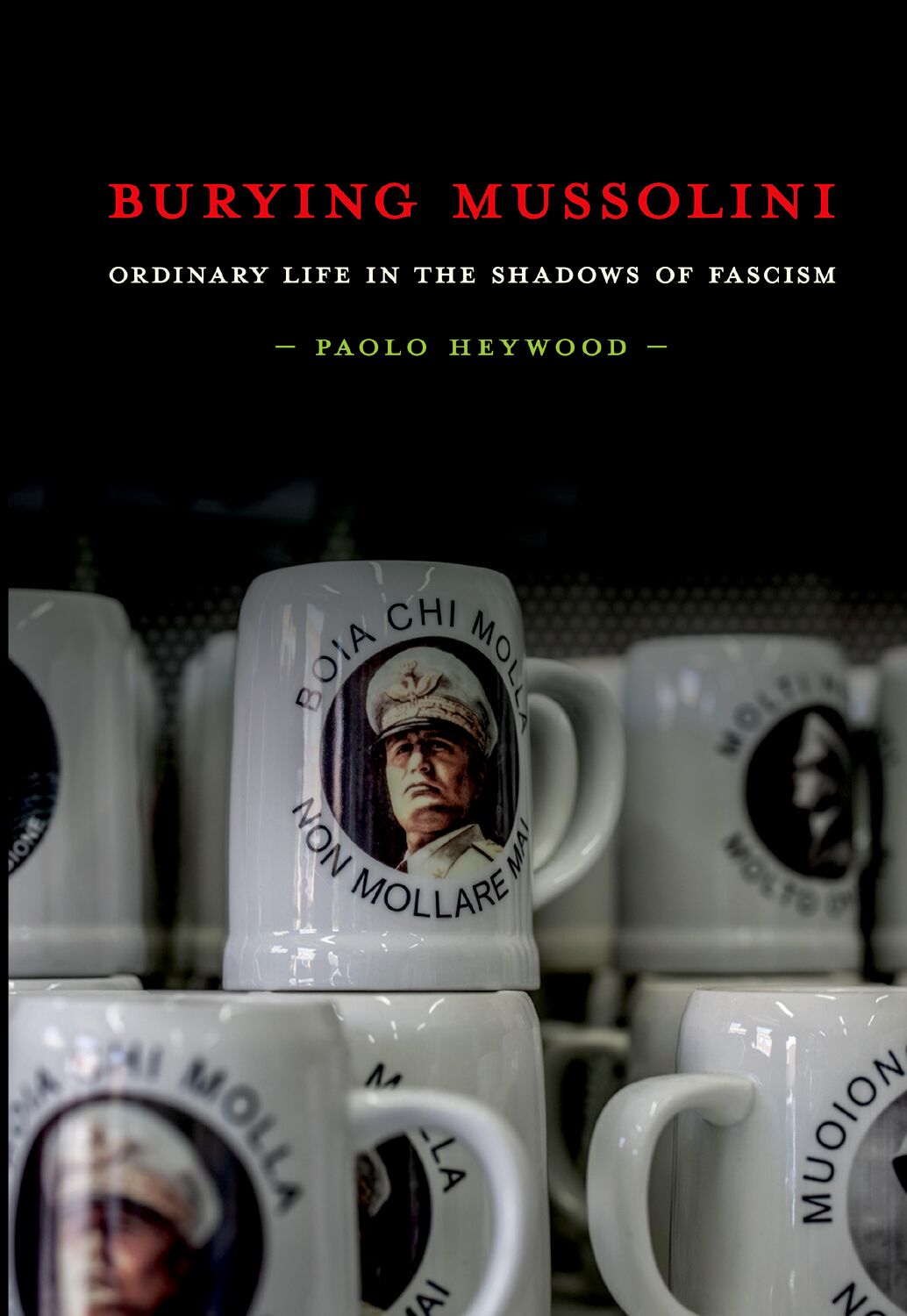
Burying Mussolini
Burying Mussolini addresses
the global resurgence in authoritarian and nationalist populism and
its connection with valorizations of ordinary life.
Predappio is the birthplace and burial site of Benito Mussolini and
Italy's premier neo-fascist tourist site with hundreds of thousands
of fascist sympathizers descending on the town annually. But, Paolo
Heywood asks, what of the people who actually live there? What does
'ordinary life' look like in the shadow of Mussolini's grave?
As politicians, commentators, and social scientists seek to
understand what lies behind new forms of political
authoritarianism, and whether and how they resemble movements once
thought consigned to the past, Burying Mussolini narrates
how people in Predappio cope with the dark heritage of their home
by carefully crafting a sense of 'ordinariness' that is itself
inflected by ghosts of their fascist past.
eBook

Twenty-Five Sides of a Post-Communist Mafia State
The twenty-five essays accompany, illustrate and underpin the conceptual framework elaborated in Post-Communist Mafia State, published in conjunction with this volume. Leading specialists analyze the manifestations of the current political regime in Hungary from twenty-five angles. Topics discussed include the ideology, constitutional issues, social policy, the judiciary, foreign relations, nationalism, media, memory politics, corruption, civil society, education, culture and so on. Beyond the basic features of the economy the domains of taxation, banking system, energy policies and the agriculture are treated in dedicated studies. The essays are based on detailed empirical investigation about conditions in today's Hungary. They nevertheless contribute to the exploration of the characteristic features of post-communist authoritarian regimes, shared by an increasing number of countries in Europe and Central Asia.
eBook

Alarums and Excursions
A revealing and candid portrayal of a Europe improvising its way through a series of crises. Forced into action by a tidal wave of emergencies, Europe has had to reinvent itself, casting off its legal straitjacket and confronting hard issues that threaten its own political identity.
eBook

The Legacy of Division
This volume examines the legacy of the East-West divide since the implosion of the communist regimes in Europe. The ideals of 1989 have largely been frustrated by the crises and turmoil of the past decade. The liberal consensus was first challenged as early as the mid-2000s. In Eastern Europe, grievances were directed against the prevailing narratives of transition and ever sharper ethnic-racial antipathies surfaced in opposition to a supposedly postnational and multicultural West. In Western Europe, voices regretting the European Union's supposedly careless and premature expansion eastward began to appear on both sides of the left-right and liberal-conservative divides. The possibility of convergence between Europe's two halves has been reconceived as a threat to the European project.
In a series of original essays and conversations, thirty-three contributors from the fields of European and global history, politics and culture address questions fundamental to our understanding of Europe today: How have perceptions and misperceptions between the two halves of the continent changed over the last three decades? Can one speak of a new East-West split? If so, what characterizes it and why has it reemerged? The contributions demonstrate a great variety of approaches, perspectives, emphases, and arguments in addressing the daunting dilemma of Europe's assumed East-West divide.
eBook

EU foreign and security policy in Bosnia
This book represents the first ever comprehensive study of the EU’s foreign and security policy in Bosnia. Drawing on a wealth of fresh empirical material, it demonstrates that institutions are a key variable in explaining levels of common foreign security policy (CFSP) coherence and effectiveness over time. In doing so, it also sheds new light on the role that intergovernmental, bureaucratic and local political contestation have played in the formulation and implementation of a European foreign policy. The study concludes that the EU’s involvement in Bosnia has not only had a significant impact on this Balkan country in its path from stabilisation to integration, but has also transformed the EU, its foreign and security policy and shaped the development of the EU’s international identity along the way. The book will be of great interest to researchers and students of EU politics, International Relations and Bosnian politics.
eBook

Dying to Learn
In Dying to Learn
, Michael Hunzeker develops a novel theory to explain how
wartime militaries learn. He focuses on the Western Front,
which witnessed three great-power armies struggle to cope with
deadlock throughout the First World War, as the British, French,
and German armies all pursued the same solutions-assault tactics,
combined arms, and elastic defense in depth. By the end of the war,
only the German army managed to develop and implement a set of
revolutionary offensive, defensive, and combined arms doctrines
that in hindsight represented the best way to fight.
Hunzeker identifies three organizational variables that
determine how fighting militaries generate new ideas, distinguish
good ones from bad ones, and implement the best of them across the
entire organization. These factors are: the degree to which
leadership delegates authority on the battlefield; how effectively
the organization retains control over soldier and officer training;
and whether or not the military possesses an independent doctrinal
assessment mechanism.
Through careful study of the British, French, and German
experiences in the First World War, Dying to Learn
provides a model that shows how a resolute focus on analysis,
command, and training can help prepare modern militaries for
adapting amidst high-intensity warfare in an age of revolutionary
technological change.
eBook

Assassins and Conspirators
Over the course of the German Empire the Social Democrats went from being a vilified and persecuted minority to becoming the largest party in the Reichstag, enjoying broad-based support. But this was not always the case. In the 1870s, government mouthpieces branded Social Democracy the \"party of assassins and conspirators\" and sought to excite popular fury against it. Over time, Social Democrats managed to refashion their public image in large part by contrasting themselves to anarchists, who came to represent a politics that went far beyond the boundaries of acceptable behavior. Social Democrats emphasized their overall commitment to peaceful change through parliamentary participation and a willingness to engage their political rivals. They condemned anarchist behavior—terrorism and other political violence specifically—and distanced themselves from the alleged anarchist personal characteristics of rashness, emotionalism, cowardice, and secrecy. Repeated public debate about the appropriate place of Socialism in German society, and its relationship to anarchist terrorism, helped Socialists and others, such as liberals, political Catholics, and national minorities, cement the principles of legal equality and a vigorous public sphere in German political culture. Using a diverse array of primary sources from newspapers and political pamphlets to Reichstag speeches to police reports on anarchist and socialist activity, this book sets the history of Social Democracy within the context of public political debate about democracy, the rule of law, and the appropriate use of state power. Gabriel also places the history of German anarchism in the larger contexts of German history and the history of European socialism, where its importance has often been understated because of the movement's small size and failure to create a long-term mass movement.
eBook