
Catalogue Search | MBRL


Are you sure you want to remove the book from the shelf?

{{itemTitle}}
1,275
result(s) for
"POLITICAL SCIENCE / World / Middle Eastern"
Sort by:
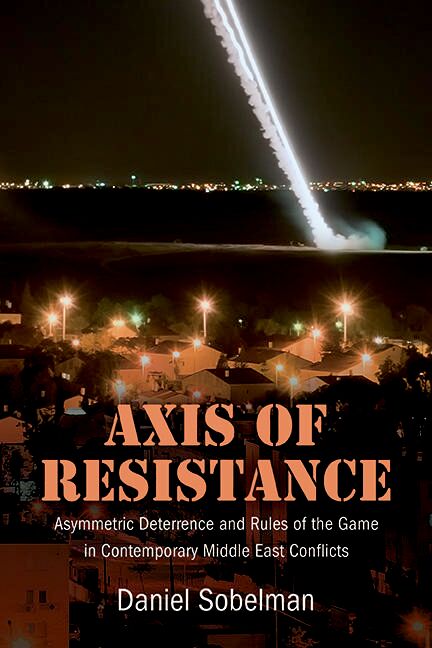
Axis of Resistance
An in-depth analysis of the primary conflicts animating the contemporary struggle over the regional order of the Middle East.
From the conflict between the United States and the Iranian-backed militias in Iraq and Syria to the recent Israel-Hamas war in the Gaza Strip, events in today's Middle East reflect the emergence of what has come to be known as an Iran-led \"axis of resistance.\" A geopolitical network of state- and nonstate actors seeking to promote a new regional order, the \"axis\" primarily includes the Lebanese Hezbollah, Hamas in the Gaza Strip, Yemen's Houthi rebels, Syria, and multiple Iran-supported Shiite militias in Iraq. Drawing on qualitative in-depth research in Hebrew and Arabic, and on exclusive interviews with senior Israeli officials, Axis of Resistance offers the first comprehensive analysis of the evolution of the \"axis\" and its application of a distinct strategic approach to asymmetrical conflicts-that of \"resistance.\" Author Daniel Sobelman shows that the various \"resistance\" forces in the region have pursued an analogous asymmetrical deterrent strategy whose origins trace back to the Israel-Hezbollah conflict in southern Lebanon, whereby the weaker actor attempts to subject the stronger state to limiting \"rules of the game.\"
eBook

The Imperative of Development
The achievements and legacy of the Wolfensohn Center for Development at Brookings The Imperative of Development highlights the research and policy analysis produced by the Wolfensohn Center for Development at Brookings.The Center, which operated from 2006 to 2011, was the first home at Brookings for research on international development.
eBook

End of Days Ethics, Tradition, and Power in Israel
End of Days is both a meditation on Jewish morality in the age of Israeli Jewish power, and a
cri du coeur by an Orthodox Israeli Jew, a former combat officer in the IDF, for Israelis to look into the Jewish religious ethical tradition for an alternative to the secular and religious Zionism that sanctifies power, statehood, and sovereignty. Appealing to a wealth of Jewish sources from the Bible to the present, including medieval Jewish ethical literature, rabbinic sources, Jewish law, and contemporary Israeli thought, the book presents an argument against Israel’s occupation of the Palestinians and the suppression of their rights from the perspective of a modern Israeli religious Jew.
eBook

Return to Point Zero
How did the Turkish-Kurdish Conflict arise? Why have Turks and
Kurds failed for so long to solve it? How can they solve it today?
How can social scientists better analyze this and other protracted
conflicts and propose better prescriptions for sustainable peace?
Return to Point Zero develops a novel framework for
analyzing the historical-structural and contemporary causes of
ethnic-national conflicts, highlighting an understudied dimension:
politics. Murat Somer argues that intramajority group politics
rather than majority-minority differences better explains
ethnic-national conflicts. Hence, the political-ideological
divisions among Turks are the key to understanding the
Turkish-Kurdish Conflict; though it was nationalism that produced
the Kurdish Question during late-Ottoman imperial
modernization, political elite decisions by the Turks created the
Kurdish Conflict during the postimperial nation-state
building. Today, ideational rigidities reinforce the conflict.
Analyzing this conflict from \"premodern\" times to today, Somer
emphasizes two distinct periods: the formative era of 1918-1926 and
the post-2011 reformative period. Somer argues that during the
formative era, political elites inadequately addressed three
fundamental dilemmas of security, identity, and cooperation and
includes a discussion of how the legacy of those political elite
decisions impacted and framed peace attempts that have failed in
the 1990s and 2010s. Return to Point Zero develops new
concepts to analyze conflicts and concrete conflict-resolution
proposals.
eBook

Soldiering Under Occupation
Often, violent behavior or harassment from a soldier is dismissed by the military as unacceptable acts by individuals termed, \"rotten apples.\" In this study, the author argues that this dismissal is unsatisfactory and that there is an urgent need to look at the (mis)behavior of soldiers from a structural point of view. When soldiers serve as an occupational force, they find themselves in a particular situation influenced by structural circumstances that heavily influence their behavior and moral decision-making. This study focuses on young Israeli men and their experiences as combat soldiers in the Israeli Defense Forces (IDF), particularly those who served in the \"Occupied Palestinian Territories\" (OPT) during the \"Al AqsaIntifada,\" which broke out in 2000. In describing the soldiers' circumstances, especially focusing on space, the study shows how processes of numbing on different levels influence the (moral) behavior of these soldiers.
eBook

Beyond Piety and Politics
How do ordinary men and women in Muslim-majority
societies create religion-informed views of political topics such
as democracy and economics?
Beyond Piety and Politics provides a groundbreaking
approach to understanding the depth and variety of political
attitudes held by people who consider themselves to be pious
Muslims. Using survey data on religious preferences and behavior,
the authors argue for the relevance and importance of four outlook
categories-religious individualist, social communitarian, religious
communitarian, and post-Islamist-and use these to explore complex
and nuanced attitudes of devout Muslims toward issues like
democracy and economic distribution. They also reveal how
intrafaith variation in political attitudes is not due simply to
doctrinal differences but is also a product of the social aspects
of religious association operating within political contexts.
By highlighting the dynamic societal and political implications
of religious devotion, Beyond Piety and Politics offers a
fascinating new theoretical perspective on Islam and politics.
eBook

Digital resistance in the Middle East : new media activism in everyday life
This title argues that Internet diffusion and use in the Middle East enables meaningful micro-changes in citizens' lives, even in states where no Arab Spring revolution occurred. Using ethnographic evidence and taking a comparative perspective, it presents a grass roots look at how new media use fits into the practice of everyday life. It explores why citizens use social media to digitally route around state and other forms of power at work in their lives. This increase in citizen civil engagement, supported by new media use, offers the possibility of a new order of things, from redefining patriarchal power relations at home, to reconfigurations of citizens' relationships with the state, broadly defined. The author argues that new media channels offer pathways to empowerment widely and cheaply in the Middle East.
eBook

Rising Powers and the Arab–Israeli Conflict since 1947
What has been the role of rising powers in the Arab–Israeli conflict? What does this tell us about rising powers and conflict management as well as rising powers’ behavior in the world more generally? This book studies the way that five rising powers—Brazil, Russia, India, China and South Africa, the BRICS countries—have approached the conflict since it first became internationalized in 1947. Conflict management consists of different methods, from peacekeeping to mediation and the use of economic incentives and sanctions and (non)enforcement of international legal decisions. What distinguishes them is whether they are active or passive: active measures seek to transform a conflict and resolve it; passive measures seek to ameliorate its worst effects, but do not change their underlying causes. Since 1947 rising powers’ active or passive use of these methods has coincided with their rise and fall and rise again in the international system. Those rises and falls are tied to global changes, including the Cold War, the emergence of the Third World, economic and ideological retrenchment of the 1980s and 1990s and the shift from unipolarity to multipolarity after 2000. In summary, rising powers’ management of the Arab–Israeli conflict has shifted from active to more passive methods since 1947. Their actions have occurred alongside two key changes within the conflict. One is the shift from a primarily state-based conflict between Israel and the Arabs to one that is more ethnic and territorial in scope, between Israel and the Palestinians. The other the emergence of the Oslo framework which has frozen power imbalance between Israel and the Palestinians since 1993. By pursuing the Oslo process, rising powers have separated conflict management from developing ‘normal’ diplomatic and economic exchanges with Israel and the Palestinians. In adopting this more passive conflict management approach, rising powers are disregarding both emerging alternatives that may potentially transform the conflict’s dynamics (including involvement with civil society actors like the Boycott, Divestment and Sanctions movement) and undertaking more active efforts at conflict resolution—and presenting themselves as global powers.
eBook

Women, Islam and resistance in the Arab world
No detailed description available for \"Women, Islam, and Resistance in the Arab World\".
eBook