
Catalogue Search | MBRL


Are you sure you want to remove the book from the shelf?

{{itemTitle}}
111,121
result(s) for
"POLITICAL SCIENCE - Government - International."
Sort by:

Critical perspectives on the crisis of global governance : reimagining the future
\"This volume provides forward-looking, critical perspectives on the crisis of global governance. Featuring new, original and imaginative reflections, world leaders in law, sociology, politics, economics and international studies, interrogate global governance as it is and as it ought to be. It asks: What are the principal forces, structures, movements and ideas shaping global governance under conditions of global crisis? And what are the likely prospects for transformations in the theory and practice of global governance? The contributors highlight alternative imaginaries and social forces harnessing new organizational and political forms to counter and displace dominant strategies of rule. In so doing, they suggest that to meaningfully address intensifying economic, ecological and ethical crises of the early 21st century in ways more consistent with greater social justice, democracy and the integrity biosphere will require far more effective, legitimate and far-sighted forms of global governance\"-- Provided by publisher.
Book

Can Russia Modernise?
In this original, bottom-up account of the evolution of contemporary Russia, Alena Ledeneva seeks to reveal how informal power operates. Concentrating on Vladimir Putin's system of governance - referred to as sistema - she identifies four key types of networks: his inner circle, useful friends, core contacts and more diffuse ties and connections. These networks serve sistema but also serve themselves. Reliance on networks enables leaders to mobilise and to control, yet they also lock politicians, bureaucrats and businessmen into informal deals, mediated interests and personalised loyalty. This is the 'modernisation trap of informality': one cannot use the potential of informal networks without triggering their negative long-term consequences for institutional development. Ledeneva's perspective on informal power is based on in-depth interviews with sistema insiders and enhanced by evidence of its workings brought to light in court cases, enabling her to draw broad conclusions about the prospects for Russia's political institutions.
eBook

The third revolution : Xi Jinping and the new Chinese state
\"In The Third Revolution, eminent China scholar Elizabeth Economy provides an incisive look at the world's most populous country. Inheriting a China burdened with slowing economic growth, rampant corruption, choking pollution, and a failing social welfare system, President Xi has reversed course, rejecting the liberalizing reforms of his predecessors. At home, the Chinese leadership has reasserted the role of the state into society and enhanced Party and state control. Beyond its borders, Beijing has recast itself as a great power and has maneuvered itself to be an arbiter--not just a player--on the world stage. Through an exploration of Xi Jinping's efforts to address top policy priorities--fighting corruption, controlling the internet, reforming state-owned enterprises, improving the country's innovation capacity, reducing the country's air pollution, and elevating its presence on the global stage--Economy identifies the tensions, shortcomings, and successes of Xi's first five years in office. Xi's ambition, she argues, provides new opportunities for the United States and the rest of the world to encourage greater Chinese contribution to global public goods but also necessitates a more proactive and coordinated effort to counter the rapidly expanding influence of an illiberal power within a liberal world order. This is essential reading for anyone interested in both China under Xi and how America and the world should deal with this vast nation in the coming years\"-- Provided by publisher.
Book

Theories of International Relations and Northern Ireland
This book uses the case of Northern Ireland to evaluate theoretical approaches in international relations. It investigates the process of negotiation that led to the signing of the Good Friday or Belfast Agreement and the continuing challenges to peace reconciliation in Northern Ireland. Incorporating the work of leading scholars, it explores a wide range of topics, including the function of deception in promoting peace, the question of partition and how it was reimagined by nationalists such as John Hume, and how the decommissioning process led to a role in internal policing for paramilitaries. The influence of outside actors - notably the United States and the European Union - is also considered, along with the involvement of the Catholic Church and the marginalization of women. This book will be important for academics interested in theories of international relations and to a wider public interested in understanding the Northern Ireland peace process.
eBook

International human rights
\"International Human Rights studies the ways in which states and other international actors have addressed human rights since the end of World War II. This unique textbook features substantial attention to the domestic politics of human rights, as well as an extensive emphasis on theory. The thoroughly updated fifth edition brings the theories and legal issues related to human rights into sharper focus with a streamlined eleven-chapter organization, separate treatments of rights-based theories and international relations theories, and updated case studies. International Human Rights allows readers to understand how and why human rights are violated, what international action can do to address these violations, and why human rights remain such a small part of international relations\"-- Provided by publisher.
Book

External Intervention and the Politics of State Formation
This book explores ways foreign intervention and external rivalries can affect the institutionalization of governance in weak states. When sufficiently competitive, foreign rivalries in a weak state can actually foster the political centralization, territoriality and autonomy associated with state sovereignty. This counterintuitive finding comes from studying the collective effects of foreign contestation over a weak state as informed by changes in the expected opportunity cost of intervention for outside actors. When interveners associate high opportunity costs with intervention, they bolster sovereign statehood as a next best alternative to their worst fear - domination of that polity by adversaries. Sovereign statehood develops if foreign actors concurrently and consistently behave this way toward a weak state. This book evaluates that argument against three 'least likely' cases - China, Indonesia and Thailand between the late nineteenth and mid-twentieth centuries.
eBook

How to do things with international law
\"The description for this book, How to Do Things with International Law, will be forthcoming. \"-- Provided by publisher.
Book
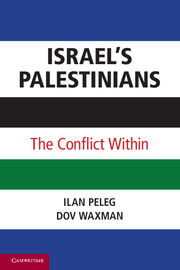
Israel’s Palestinians
Arguing that a comprehensive and lasting solution to the Israeli-Palestinian conflict depends on a resolution of the Jewish-Palestinian conflict within Israel as much as it does on resolving the conflict between Israel and Palestinians in the Occupied Territories, this timely book explores the causes and consequences of the growing conflict between Israel's Jewish majority and its Palestinian-Arab minority. It warns that if Jewish-Arab relations in Israel continue to deteriorate, this will pose a serious threat to the stability of Israel, to the quality of Israeli democracy and to the potential for peace in the Middle East. The book examines the views and attitudes of both the Palestinian minority and the Jewish majority, as well as the Israeli state's historic approach to its Arab citizens. Drawing upon the experience of other states with national minorities, the authors put forward specific proposals for safeguarding and enhancing the rights of the Palestinian minority while maintaining the country's Jewish identity.
eBook

The concept of truth in international relations theory : critical thought beyond post-positivism
This book charts the role played by conceptions of truth in the development of a critical tradition of International Relations theory. Providing a detailed account of the conceptions which have shaped the work of Critical Theorists and Poststructuralists, the book reaffirms the importance of epistemic reflection for the discipline. It argues that the partially abstract character of the main strands of critical IR arises not from their concern with epistemic matters, but from their insistence that truth is purely intersubjective. Drawing on the philosophy of Theodor Adorno, the book argues that IR's critical tradition can be rejuvenated by combining its original politicisation of truth with a critical account of its 'objectivity'. The book will be a valuable resource for scholars and graduate students interested in the future of critical International Relations theory.
Book

The Passion of Max von Oppenheim
Born into a prominent German Jewish banking family, Baron Max von Oppenheim (1860-1946) was a keen amateur archaeologist and ethnologist. His discovery and excavation of Tell Halaf in Syria marked an important contribution to knowledge of the ancient Middle East, while his massive study of the Bedouins is still consulted by scholars today. He was also an ardent German patriot, eager to support his country's pursuit of its \"place in the sun\". Excluded by his part-Jewish ancestry from the regular diplomatic service, Oppenheim earned a reputation as \"the Kaiser's spy\" because of his intriguing against the British in Cairo, as well as his plan, at the start of the First World War, to incite Muslims under British, French and Russian rule to a jihad against the colonial powers. After 1933, despite being half-Jewish according to the Nuremberg Laws, Oppenheim was not persecuted by the Nazis. In fact, he placed his knowledge of the Middle East and his connections with Muslim leaders at the service of the regime. Ranging widely over many fields—from war studies to archaeology and banking history—The Passion of Max von Oppenheim tells the gripping and at times unsettling story of one part-Jewish man's passion for his country in the face of persistent and, in his later years, genocidal anti-Semitism.
eBook