
Catalogue Search | MBRL


Are you sure you want to remove the book from the shelf?

{{itemTitle}}
138,739
result(s) for
"PRESCHOOL EDUCATION"
Sort by:

Common characteristics and unique qualities in preschool programs : global perspectives in early childhood education
In 1999, a group of educators representing 36 countries developed guidelines for establishing minimum standards for preschool programs. A purpose for developing the guidelines was to provide guidance for countries that wished to evaluate and improve their own programs. A second purpose was to help developing countries initiating preschools to have relevant information about quality programs.
Book

Early childhood assessment
The assessment of young children's development and learning has recently taken on new importance. Private and government organizations are developing programs to enhance the school readiness of all young children, especially children from economically disadvantaged homes and communities and children with special needs. Well-planned and effective assessment can inform teaching and program improvement, and contribute to better outcomes for children. This book affirms that assessments can make crucial contributions to the improvement of children's well-being, but only if they are well designed, implemented effectively, developed in the context of systematic planning, and are interpreted and used appropriately. Otherwise, assessment of children and programs can have negative consequences for both. The value of assessments therefore requires fundamental attention to their purpose and the design of the larger systems in which they are used. The book addresses these issues by identifying the important outcomes for children from birth to age 5 and the quality and purposes of different techniques and instruments for developmental assessments. (DIPF/Verlag).
eBook


Effects of professional identity and psychological capital on academic self-efficacy: Learning engagement as a mediator
This study explored the effects of professional identity and psychological capital on the academic self-efficacy of university students majoring in preschool education, as well as the mediating role of learning engagement. University students majoring in preschool education (N
= 986) completed the University Student Professional Identity Questionnaire, the Psychological Capital Questionnaire for Adolescent Students, the University Student Academic Self-Efficacy Questionnaire, and the University Student Learning Engagement Questionnaire. There were significant positive
correlations among professional identity, psychological capital, learning engagement, and academic self-efficacy. Learning engagement partially mediated the relationships of both professional identity and psychological capital with academic self-efficacy. Therefore, at universities the professional
identity education of students majoring in preschool education should be strengthened, their psychological capital level should be improved, and they should be encouraged to actively participate in learning, so as to gain more academic self-efficacy.
Journal Article


The sandbox investment
Listen to a short interview with David L. Kirp Host: Chris Gondek | Producer: Heron & Crane The rich have always valued early education, and for the past forty years, millions of poor kids have had Head Start. Now, more and more middle class parents have realized that a good preschool is the smartest investment they can make in their children's future in a competitive world. AsThe Sandbox Investment shows, their needs are key to the growing call for universal preschool. Writing with the verve of a magazine journalist and the authority of a scholar, David L. Kirp makes the ideal guide to this quiet movement. He crouches in classrooms where committed teachers engage lively four-year-olds, and reveals the findings of an extraordinary longitudinal study that shows the life-changing impact of preschool. He talks with cutting-edge researchers from neuroscience and genetics to economics, whose findings increasingly show how powerfully early childhood shapes the arc of children's lives. Kids-first politics is smart economics: paying for preschool now can help save us from paying for unemployment, crime, and emergency rooms later. As Kirp reports from the inside, activists and political leaders have turned this potent idea into campaigns and policies in red and blue states alike.The Sandbox Investment is the first full story of a campaign that asks Americans to endorse a vision of society that does well by doing good. For anyone who is interested in politics or the social uses of research--for anyone who's interested in the children's futures--it's a compelling read.
eBook


Integrating Game-Based Learning into Preschool Education for Sustainability: Preservice Preschool Teachers’ Experiences and Perspectives
The importance of Education for Sustainability (EfS) in shaping values and fostering responsible sustainable behaviour has been acknowledged from the early years of education. Our research explores Preservice Preschool Teachers’ (PPTs) perceptions of using game-based learning (GBL) activities to teach EfS, and the impact of designing and delivering such activities on their confidence in teaching EfS. The research used qualitative methods. Data were collected from 12 university students, who developed and implemented GBL activities for preschool children on Monachus monachus. Preservice teachers participated in a group interview and filled reflective reports to describe their overall experience. A reflexive thematic analysis was performed using NVivo software. Outcomes indicate that participants appreciate GBL as an effective pedagogical approach in preschool education, given that it is appropriately and pedagogically designed. Participation, emotional engagement and understanding of complex sustainability concepts emerged as benefits from the involvement in GBL activities, both for the children and for the preservice teachers. Other benefits for the research participants concerned the development of their classroom adaptability, collaboration skills, reflection and confidence. Authentic, collaborative experiential approaches in teacher education and actual teaching opportunities can effectively empower preservice teachers’ confidence to teach about sustainability.
Journal Article

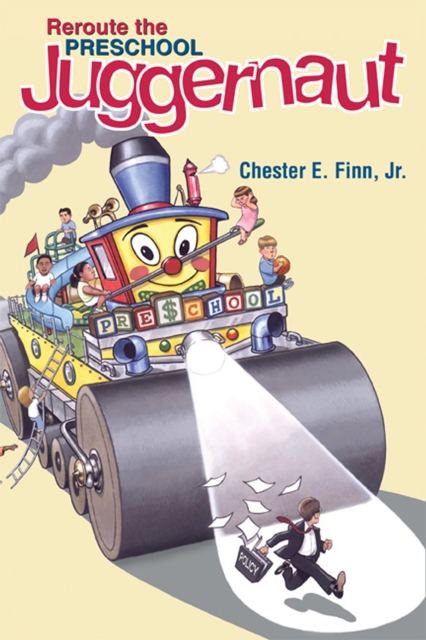
Reroute the preschool juggernaut
Chester E. Finn, Jr. outlines the issues that define, animate, and complicate today's contentious pre-kindergarten debate in American education. He examines such topics as: which children really need it; how many aren't getting it; who should provide it and at what expense; what is the right balance between education and child care; and how to know whether it is succeeding.
eBook