
Catalogue Search | MBRL


Are you sure you want to remove the book from the shelf?

{{itemTitle}}
939
result(s) for
"PROVIDER INCENTIVES"
Sort by:

Increasing Access to Buprenorphine for Opioid Use Disorder in Primary Care: an Assessment of Provider Incentives
Background
Primary care providers (PCPs) are essential to increasing access to office-based buprenorphine medication treatment for opioid use disorder (B-MOUD). Barriers to B-MOUD prescribing are well-documented, but there is little information regarding incentives to overcome these barriers.
Objective
To identify optimal incentives for PCPs to promote B-MOUD prescribing and compare incentive preferences across provider and practice characteristics.
Design
We surveyed PCPs using best-worst scaling (BWS) to prioritize seven potential incentives for B-MOUD prescribing (monetary compensation, paid vacation, protected time, professional development, reduced workload, service recognition, clinical resources). We then used a direct elicitation approach to determine preferred incentive levels (e.g., monetary thresholds) and types (e.g., specific clinical resources).
Participants
Primary care physicians and advanced practice providers (APPs) at a large Department of Veterans Affairs healthcare system.
Main Measures
B-MOUD prescribing incentive preferences and relative preference levels using descriptive statistics and conditional logistic regression with relative importance scale transformation (coefficients sum to 100, higher coefficient=greater importance).
Key Results
Fifty-three PCPs responded (73% response), including 47% APPs and 36% from community-based clinics. Reduced workload (relative importance score=26.8), protected time (18.7), and clinical resources (16.8) were significantly more preferred (
P
s < 0.001) than professional development (10.5), paid vacation (10.3), or service recognition (1.5). Relative importance of monetary compensation varied between physicians (12.6) and APPs (17.5) and between PCPs located at a medical center (11.4) versus community clinic (22.3). APPs were more responsive than physicians to compensation increases of $5000 and $12,000 but less responsive to $25,000; trends were similar for medical center versus community clinic PCPs. The most frequently requested clinical resource was on-demand consult access to an addiction specialist.
Conclusions
Interventions promoting workload reductions, protected time, and clinical resources could increase access to B-MOUD in primary care. Monetary incentives may be additionally needed to improve B-MOUD prescribing among APPs and within community clinics.
Journal Article

Examining the Effectiveness of Provider Incentives to Increase CRC Screening Uptake in Neighborhood Healthcare: A California Federally Qualified Health Center
As an awardee of the Centers for Disease Control and Prevention’s Colorectal Cancer Control Program, the California Department of Public Health partnered with Neighborhood Healthcare to implement evidence-based interventions and provider incentives (incentives offered to support staff, e.g., medical assistants, phlebotomists, front office staff, lab technicians) to improve colorectal cancer screening uptake. The objective of this study was to evaluate the effectiveness and cost of the provider incentive intervention implemented by Neighborhood Healthcare to increase colorectal cancer screening uptake. We collected and analyzed process and cost data to assess fecal immunochemical test (FIT) kit return rates to the health centers and the number of completed FIT kits. We estimated the costs of the preexisting interventions and the new interventions. Analyses were conducted for two time periods: preimplementation and implementation. Most Neighborhood Healthcare health centers experienced an increase in the percentage of FIT kit returns (average of 3.6 percentage points) and individuals screened (an average increase of 111 FIT kits per month) from the baseline period through the implementation period. The cost of the incentive intervention for each additional screen was $66.79. In conclusion, the results indicate that incentive programs can have an overall positive impact on both the percentage of FIT kits returned and the number of individuals screened.
Journal Article

Global budget versus cost ceiling: a natural experiment in hospital payment reform in the Netherlands
Global budget (GB) arrangements have become a popular method worldwide to control the rise in healthcare expenditures. By guaranteeing hospital funding, payers hope to eliminate the drive for increased production, and incentivize providers to deliver more efficient care and lower utilization. We evaluated the introduction of GB contracts by certain large insurers in Dutch hospital care in 2012 and compared health care utilization to those insurers who continued with more traditional production-based contracts, i.e., cost ceiling (CC) contracts. We used the share of GB hospital funding per postal code region to study the effect of contract types. Our findings show that having higher share of GB financing was associated with lower growth in treatment intensity, but it was also associated with higher growth in the probability of having at least one hospital visit. While the former finding is in line with our expectation, the latter is not and suggests that hospital visits may take longer to respond to contract incentives. Our study covers the years of 2010-2013 (2 years before and 2 years following the introduction of the new contracts). Therefore, our results capture only short-term effects.
Journal Article

Provider responses to discontinuous tariffs: evidence from Dutch rehabilitation care
Abrupt jumps in reimbursement tariffs have been shown to lead to unintended effects in physicians’ behavior. A sudden change in tariffs at a pre-defined point in the treatment can incentivize health care providers to prolong treatment to reach the higher tariff, and then to discharge patients once the higher tariff is reached. The Dutch reimbursement schedule in hospital rehabilitation care follows a two-threshold stepwise-function based on treatment duration. We investigated the prevalence of strategic discharges around the first threshold and assessed whether their share varies by provider type. Our findings suggest moderate response to incentives by traditional care providers (general and academic hospitals, rehabilitation centers and multicategorical providers), and strong response by profit-oriented independent treatment centers. When examining the variation in response based on the financial position of the organization, we found a higher probability of manipulation among providers in financial distress. Our findings provide multiple insights and possible indicators to identify provider types that may be more prone to strategic behavior.
Journal Article

Reforming China's rural health system
'Reforming China's Rural Health System' examines the performance and workings of China's rural health system leading up to the reforms of the 2000s, outlines the reforms, and presents some early evidence on their impacts. The authors outline ideas for building on these reforms to further strengthen China's rural health system, covering health financing and health insurance, service delivery, and public health. The authors conclude by using the experiences of the Organisation for Economic Co-operation and Development countries to gaze into China's future, asking not only what China's health system might look like, but also how China might get there from where it is today. 'Reforming China's Rural Health System' will be of interest to health care policy makers, public health officials, university researchers, and others working to improve rural health and health service delivery in China and in other countries especially those in East and South Asia.
eBook

Physician Remuneration Methods for Family Physicians in Canada: Expected Outcomes and Lessons Learned
Canada is a leader in experimenting with alternative, non fee for service provider remuneration methods; all jurisdictions have implemented salaries and payment models that blend fee for service with salary or capitation components. A series of qualitative interviews were held with 27 stakeholders in the Canadian health care system to assess the reasons and expectations behind the implementation of these payment methods for family physicians, as well as the extent to which objectives have been achieved. Results indicate that the main reasons are a need to recruit and retain primary care physicians to rural and remote regions of the country, and the desire to increase collaboration, care continuity, prevention and health promotion. The general perception is that positive results have been observed, but problems are not alleviated. Blended payments have had some positive effects on preventive care delivery, collaboration, and care continuity. Salaries have provided a stable, predictable, and high source of income for physicians, thereby improving recruitment and retention. The implementation of salaries, however, led to concerns with declining physician productivity, and has brought to light a need for improved measurement and monitoring systems.
Journal Article

10 best resources on … health workers in developing countries
Health systems cannot function without trained health workers, yet until recently researchers & policymakers paid relatively little attention to their role in developing countries. This is due in part to the inherent complexities & limited availability of data -- both of which have also held back research in the world's wealthier countries. But in low- & middle-income countries, these difficulties have been exacerbated by a tendency to focus on more visible issues. In recent years, however, this has changed. The need to address health workers in public policy took on particular prominence after 2000 when increased foreign aid for health programmes confronted limited capacity in many developing countries to apply those funds -- often for a lack of skilled personnel. Research was also spurred by concerns that emigration of health workers was exacerbating the scarcity of health workers in many low- & middle-income countries. Consequently, health workforce issues are now attracting a great deal of attention from politicians, donors, practitioners, advocates & researchers (see, for example, Global Health Workforce Alliance 2006). Adapted from the source document.
Journal Article

Effects of Nursing Home Ownership Type and Resident Payer Source on Hospitalization for Suspected Pneumonia
Background: Whether to hospitalize residents with suspected pneumonia is a complex decision determined both by clinical and financial considerations. The decision to hospitalize may be different in for-profit and not-for-profit facilities and for different payment sources. Objective: The objective of this study was to examine the role of proprietary status in the decision to hospitalize residents with suspected pneumonia, controlling for facility- and resident-level factors. Data and Methods: The analysis uses the 1996 Medical Expenditure Panel Survey Nursing Home Component, a nationally representative sample of 5899 nursing home residents in 815 facilities. During the year, 766 elderly residents in the sample were suspected of having pneumonia infections and 224 were hospitalized for them. Logistic regression is used to assess factors affecting the decision to hospitalize among the 766 with pneumonia infections. Main Outcome Measure: Hospitalization for suspected pneumonia. Results: Residents with suspected pneumonia in not-for-profit facilities are hospitalized at a rate half that of for-profit fa. The difference is most pronounced for residents who are older and more cognitively impaired and those who are covered by Medicare or private funds. Medicaid residents are most likely overall to be hospitalized, with higher rates in not-for-profit than for-profit facilities. Conclusion: Risk of hospitalization for suspected pneumonia varies widely by ownership type and resident payer source, with lowest overall risk in not-for-profit facilities. Higher Medicaid hospitalization in not-for-profit facilities is consistent with heterogeneity in the not-for-profit sector, where Medicaid residents are sorted into the lower-quality facilities.
Journal Article
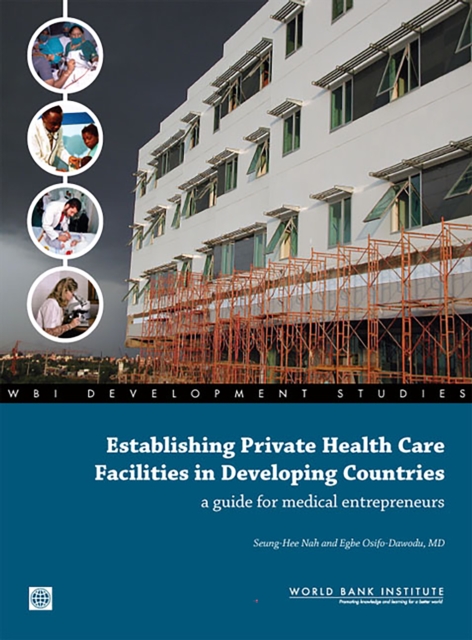
Establishing private health care facilities in developing countries : a guide for medical entrepreneurs
A practical guide for building sustainable healthcare facilities in developing countries. This resource empowers medical professionals and entrepreneurs to navigate the complexities of establishing private healthcare facilities in resource-limited settings.
Are you a medical professional with a vision to improve healthcare in a developing country? This guide provides essential tools for success, covering project concepts, feasibility, financing, and risk management. Learn how to navigate regulatory environments, secure investments, and construct facilities that meet community needs.
* Master feasibility and pre-feasibility analyses.
* Secure financing and manage investments.
* Implement effective marketing and pricing strategies.
* Construct and staff a sustainable facility.
Authored by Seung-Hee Nah and Egbe Osifo-Dawodu, MD, this insightful guide equips you with the knowledge to transform your vision into a thriving, impactful healthcare enterprise.
eBook

Designing and implementing health care provider payment systems : how-to manuals
Strategic purchasing of health services involves a continuous search for the best ways to maximize health system performance by deciding which interventions should be purchased, from whom these should be purchased, and how to pay for them. In such an arrangement, the passive cashier is replaced by an intelligent purchaser that can focus scarce resources on existing and emerging priorities rather than continuing entrenched historical spending patterns. Having experimented with different ways of paying providers of health care services, countries increasingly want to know not only what to do when paying providers, but also how to do it, particularly how to design, manage, and implement the transition from current to reformed systems. 'Designing and Implementing Health Care Provider Payment Systems: How-To Manuals' addresses this need. The book has chapters on three of the most effective provider payment systems: primary care per capita (capitation) payment, case-based hospital payment, and hospital global budgets. It also includes a primer on a second policy lever used by purchasers, namely, contracting. This primer can be especially useful with one provider payment method: hospital global budgets. The volume's final chapter provides an outline for designing, launching, and running a health management information system, as well as the necessary infrastructure for strategic purchasing.
eBook