
Catalogue Search | MBRL


Are you sure you want to remove the book from the shelf?

{{itemTitle}}
15,367
result(s) for
"PSYCHOLOGY / Developmental / General."
Sort by:

Discontinuity in Learning
In this groundbreaking book, Andrea English challenges common assumptions by arguing that discontinuous experiences, such as uncertainty and struggle, are essential to the learning process. To make this argument, Dr English draws from the works of two seminal thinkers in philosophy of education - nineteenth-century German philosopher J. F. Herbart and American pragmatist John Dewey. English's analysis considers Herbart's influence on Dewey, inverting the accepted interpretation of Dewey's thought as a dramatic break from modern European understandings of education. Three key concepts - transformational learning, tact in teaching, and perfectibility - emerge from this analysis to revitalize our understanding of education as a transformational process. Dr English's comparative approach interweaves European and Anglo-American traditions of educational thought with a contemporary scholarly perspective, contributing to a work that is both intellectually rewarding and applicable to a classroom setting. The result is a book that is essential reading for philosophers and scholars of education, as well as educators.
eBook

Depth Psychology, Interpretation, and the Bible
Polka also raises the larger issue of the relationship between modernity, hermeneutics, and biblical ontology. He argues that the origins and structure of modern values can be understood only through a theory of hermeneutics whose ontology overcomes the dualism between the secular and the religious, between philosophy and religion. Polka shows this to be possible when biblical ontology is understood to be at once rational and faithful, secular and religious. He uses the work of Spinoza, Kant, Hegel, and Kierkegaard to articulate the ontological framework that makes clear how typically modern Freud is in being unable to account for the relationship of his thought to biblical religion. Polka argues that Freudian metapsychology, precisely because it cannot account for its own principles of explanation, contradicts the insights of depth psychology. Paradoxically, religion returns in Freud as the repressed, as it does in so much of modern thought. Polka shows that what is therefore required is a hermeneutical theory whose ontological articulation of biblical religion is critically self-conscious.
eBook

Human Development in the Life Course
Drawing on philosophy, the history of psychology and the natural sciences, this book proposes a new theoretical foundation for the psychology of the life course. It features the study of unique individual life courses in their social and cultural environment, combining the perspectives of developmental and sociocultural psychology, psychotherapy, learning sciences and geronto-psychology. In particular, the book highlights semiotic processes, specific to human development, that allow us to draw upon past experiences, to choose among alternatives and to plan our futures. Imagination is an important outcome of semiotic processes and enables us to deal with daily constraints and transitions, and promotes the transformation of social representation and symbolic systems - giving each person a unique style, or 'melody', of living. The book concludes by questioning the methodology and epistemology of current life course studies.
eBook

The Wiley handbook of developmental psychology in practice : implementation and impact
An authoritative new work exploring the themes of communication and implementation of research within developmental psychology – a scientific field with extensive real world value in addressing problems faced by individuals, families and services * Brings together the insights of a stellar group of contributors with personal experience translating developmental psychology research into practice * Accessibly structured into sections exploring family processes and child rearing practices; educational aspects; and clinical applications * Goes beyond traditional reviews of literature in the field to report on practical implementation of research findings, including the challenges faced by authors * Serves as an invaluable resource for developmental psychologists, practitioners working in the field of child development, and policymakers working on issues affecting children and families
eBook

Early Development of Body Representations
Because we engage with the world and each other through our bodies and bodily movements, being able to represent one's own and others' bodies is fundamental to human perception, cognition and behaviour. This edited book brings together, for the first time, developmental perspectives on the growth of body knowledge in infancy and early childhood and how it intersects with other aspects of perception and cognition. The book is organised into three sections addressing the bodily self, the bodies of others and integrating self and other. Topics include perception and representation of the human form, infant imitation, understanding biological motion, self-representation, intention understanding, action production and perception and children's human figure drawings. Each section includes chapters from leading international scholars drawn together by an expert commentary that highlights open questions and directions for future research.
eBook

Evolutionary perspectives on human development
Evolutionary Perspectives on Human Development, Second Edition considers the role of evolutionary theory in the field of developmental psychology to examine key topics of individual human development. This unique book fills an important gap in the literature, applying evolutionary models to human development by focusing on central development issues. The book emphasizes both domain-general evolved psychological mechanisms and domain-specific processes. The text also integrates behavior-genetic research with evolutionary and developmental principles. Evolutionary Perspectives on Human Development provides state-of-the-art groundwork in evolutionary theory as viewed by leading thinkers in the field.
eBook

Sincerity and Authenticity
“A powerful diagram of the moral life from Shakespeare to the present...a book crowded with insights.”—Geoffrey Hartman, New York TimesOne of the twentieth century’s foremost literary critics traces the idea of the self across five hundred years of Western cultural history.“One cannot both be sincere and seem so,” André Gide once wrote. Attempting to inhabit sincerity to satisfy social expectations makes it into a posture or a persona—a self-defeating enterprise. What, then, does the oft-repeated injunction to “be yourself” really mean?In his 1969–1970 Norton Lectures, Lionel Trilling argues that this simple piece of advice has been the source of centuries of moral perplexity. In Elizabethan England, being true to oneself was seen as a means to an end. “To thine own self be true,” Polonius famously advised Laertes in Hamlet, “And it must follow, as the night the day / Thou canst not then be false to any man.” But this vision of the “honest soul,” whose pursuit of self-knowledge brings harmony with external society, gradually collapsed under the weight of modern literature and philosophy. Drawing a line from Rousseau, Robespierre, and Jane Austen through Hegel, Freud, and Joseph Conrad, Trilling brilliantly shows how sincerity was displaced by the more strenuous ideal of authenticity, in which genuine selfhood became a product of alienation and negation, a ceaseless purge of both social artifice and self-deception. In his final lectures, he presciently notes the rising embrace of deliberate inauthenticity, a development that rapidly accelerated after his death.Moving fluidly between philosophy, literature, cultural history, and psychoanalysis, Sincerity and Authenticity is a bravura performance, unraveling our labors of self-definition with the wit and effortless sophistication that made Trilling a foremost literary critic of the twentieth century.
eBook
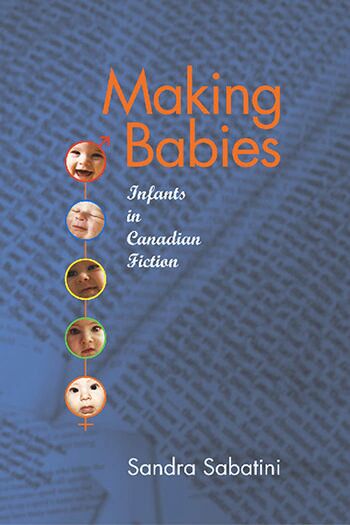
Making Babies
Although the infant has been a consistent figure in literature (and, for many people, a significant figure in personal life), there’s been little attention focused on infants, or on their place in Canadian fiction, until now. In this book, Sandra Sabatini examines Canadian fiction to trace the ideological charge behind the represented infant. Examining writers from L.M. Montgomery and Frederick Philip Grove to Thomas King and Terry Griggs, Sabatini compares women’s writing about babies with the way infants appear in texts by men over the course of a century. She discovers a range of changing attitudes toward babies. After being seen as a source of financial burden, social shame, or sentimental fantasy, infants have increasingly become a source of value and meaning. The book challenges the perception of babies as passive objects of care and argues for a reading of the infant as a subject in itself. It also reflects upon how the representations of infancy in Canadian literature offer an intriguing portrait of how we imagine ourselves.
eBook

Witnessing Witnessing: On the Reception of Holocaust Survivor Testimony
Witnessing Witnessing focuses critical attention on those who receive the testimony of Holocaust survivors. Questioning the notion that traumatic experience is intrinsically unspeakable and that the Holocaust thus lies in a quasi-sacred realm beyond history, the book asks whether much current theory does not have the effect of silencing the voices of real historical victims. It thereby challenges widely accepted theoretical views about the representation of trauma in general and the Holocaust in particular as set forth by Giorgio Agamben, Cathy Caruth, Berel Lang, and Dori Laub. It also reconsiders, in the work of Theodor Adorno and Emmanuel Levinas, reflections on ethics and aesthetics after Auschwitz as these pertain to the reception of testimony. Referring at length to videotaped testimony and to texts by Charlotte Delbo, Primo Levi, and Jorge Semprun, the book aims to make these voices heard. In doing so, it clarifies the problems that anyone receiving testimony may encounter and emphasizes the degree to which listening to survivors depends on listening to ourselves and to one another. Witnessing Witnessing seeks to show how, in the situation of address in which Holocaust survivors call upon us, we discover our own tacit assumptions about the nature of community and the very manner in which we practice it.
eBook

Requiem for the Ego
Requiem for the Ego recounts Freud's last great attempt to 'save' the autonomy of the ego, which drew philosophical criticism from the most prominent philosophers of the period—Adorno, Heidegger, and Wittgenstein. Despite their divergent orientations, each contested the ego's capacity to represent mental states through word and symbol to an agent surveying its own cognizance. By discarding the subject-object divide as a model of the mind, they dethroned Freud's depiction of the ego as a conceit of a misleading self-consciousness and a faulty metaphysics. Freud's inquisitors, while employing divergent arguments, found unacknowledged consensus in identifying the core philosophical challenges of defining agency and describing subjectivity. In Requiem, Tauber uniquely synthesizes these philosophical attacks against psychoanalysis and, more generally, provides a kaleidoscopic portrait of the major developments in mid-20th century philosophy that prepared the conceptual grounding for postmodernism.
eBook