
Catalogue Search | MBRL


Are you sure you want to remove the book from the shelf?

{{itemTitle}}
912
result(s) for
"PSYCHOLOGY / Psychopathology / Compulsive Behavior."
Sort by:
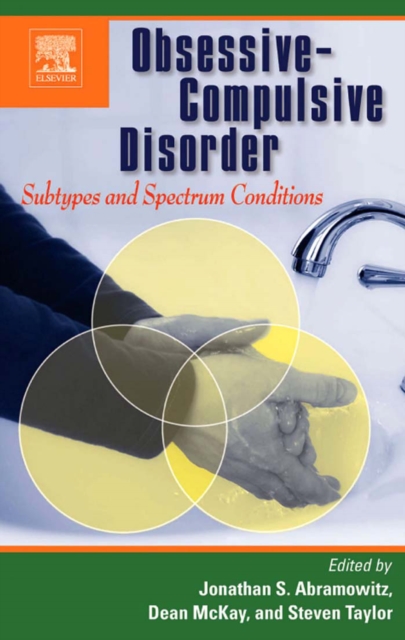
Obsessive-compulsive disorder: subtypes and spectrum conditions
Researchers and clinicians working with Obsessive-Compulsive Disorders (OCD) and related disorders who need the most current information available will find this volume of great use. This work covers contemporary theory, research, and treatment of the various subtypes of OCD and problems often referred to as OCD spectrum disorders. As the mental health field considers the next iteration of the DSM, an entire research agenda is being planned to elucidate issues such as how best to understand and classify OCD. The questions of subtypes and spectrum disorders are at the heart of this issue and will guide how OCD is conceptualized in DSM-V. This volume, dedicated to such diagnostic, theoretical, and treatment issues, helps informs the field of the most up-to-date knowledge and what remains to be resolved. * Deconstructs OCD into its subtypes* Reviews current research and treatment for these problems* Considers how OCD will be conceptualized in DSM-V* Represents an international scope with contributions from field experts in psychology, psychiatry, and social work* Includes critical discussion of the OCD subtype and OCD spectrum concepts
eBook
Youth Gambling
Youth gambling represents a potentially serious public policy and health issue. Nevertheless, the rise in youth gambling issues and problems in the global context is not matched with a parallel increase in research on adolescent gambling. As such, there is an urgent need to conduct more studies on adolescent gambling behaviour. Recently significant advances in the knowledge of the risk factors associated with adolescent problems has emerged. This book addresses issues related to prevalence, assessment, prevention and treatment of youth gambling problems as well as concerns related to technological changes associated with youth problem gambling.
eBook

Understanding OCD
Giving a full overview of childhood obsessive compulsive disorder (OCD) and discussing all major treatment options, including cognitive behavioural therapy and medication, this guide provides the essential information that families, teachers, caregivers, clinicians and mental health professionals need in order to understand and treat childhood OCD. It covers origins, symptoms and related illnesses and explains how OCD is diagnosed. The book also suggests ways to maximise the outcomes of treatment, what to do when treatment doesn't work, and how to help manage OCD in children at school and in the home.
eBook

You Bet Your Life
We are a nation of gamblers: pari-mutuel wagering at horse tracks; blackjack in Las Vegas; the NCAA basketball office pool; even day trading on the internet. Gambling is both our national pastime and our predominant cultural metaphor -- play the field; beat the odds; take a chance on love. Yet gambling poses serious risks to individuals and to society as a whole.
Neil Isaacs -- sports historian, licensed clinical social worker, English professor, and a gambler himself for more than fifty years -- seeks to shatter the myths interfering with our understanding of gambling addiction, its causes, and its treatment. He begins by systematically debunking several commonly held beliefs, demonstrating that there is no such thing as the law of averages, that gambling is not inherently sinful, immoral, or criminal, and that money is not always the prime motivator for gamblers.
Isaacs shows how habitual gambling can lead to compulsive gambling, but avoids oversimplifying this condition. Arguing against a undifferentiated interpretation of pathological gambling as a simple impulse control disorder, he draws examples from fiction, film, and his own practice to demonstrate additional ways gambling can be abused. A radical departure from established views, You Bet Your Life identifies the costs -- in dollars, people, families, and credit ratings -- of society's failure to address adequately the burdens of gambling.
eBook
Thought suppression
Is it possible to ban unwanted thoughts from consciousness?According to the literature on thought suppression, the answer is no.In the 1980s, Wegner and colleges demonstrated that the average person cannot prevent a trivial thought like that of a polar bear from entering consciousness approximately seven times in a five minute period.
eBook

A clinician's guide to psychodrama, third edition
In this update of a popular text, Leveton draws from the works of Moreno, Erickson, Satir, and Perls. She fashions a psychodramatic approach that will help therapists practice more effective group work. New to this edition is material on drama therapy and supervision in institutional settings. \"...a delightful and informative journey into a world of psychodrama for both the experienced and newly-trained timid clinician. Ms. Leveton has clearly vitalized the use of psychodrama.\" --
eBook
Trichotillomania
Trichotillomania (TTM) is a complex disorder that is difficult to treat as few effective therapeutic options exist.Behavior therapy has the greatest empirical support, but the number of mental health providers familiar with TTM and its treatment is quite small.
eBook
Cognitive approaches to obsessions and compulsions : theory, assessment, and treatment
Contemporary studies have found cognitive therapy to be an effective treatment for obsessive compulsive disorder (OCD). This volume brings together the writings of the main researchers in the field of obsessive compulsive disorder.
eBook
Structured group psychotherapy for bipolar disorder
This updated and substantially revised edition not only incorporates the expansion of the pharmacological armamentarium available for treatment but also integrates the explosion of evidence-based data for psychosocial interventions. The authors, a psychiatrist-nurse team, have fine-tuned their two-phase treament program and present a clear and concise approach to improving illness self-management skills, as well as social and occupational functioning.
eBook