
Catalogue Search | MBRL


Are you sure you want to remove the book from the shelf?

{{itemTitle}}
12,830
result(s) for
"PSYCHOLOGY / Reference."
Sort by:

The Wiley Blackwell handbook of positive psychological interventions
Collating for the first time a range of techniques in positive psychology, this handbook introduces topics such as courage, empathy and humor, and spans areas as diverse as gratitude, forgiveness and strengths. It also explores special considerations such as ethics and motivation, and offers informed conjecture on future directions in research and practice. * Comprehensive content summarizes theory and research on many areas of positive psychology intervention for the first time and provides essential updates on established interventions * Features contributions from an array of leading researchers, including Bob Emmons, Sonja Lyubomirsky and Shane Lopez * Covers established interventions – for instance, coaching and family therapy – as well as newly developed interventions – such as schizophrenia or stopping smoking
eBook

The Not-Two
InThe Not-Two, Lorenzo Chiesa examines the treatment of logic and God in Lacan's later work. Chiesa draws for the most part from Lacan's Seminars of the early 1970s, as they revolve around the axiom \"There is no sexual relationship.\" Chiesa provides both a close reading of Lacan's effort to formalize sexual difference as incompleteness and an assessment of its broader implications for philosophical realism and materialism.
Chiesa argues that \"There is no sexual relationship\" is for Lacan empirically and historically circumscribed by psychoanalysis, yet self-evident in our everyday lives. Lacan believed that we have sex because we love, and that love is a desire to be One in face of the absence of the sexual relationship. Love presupposes a real \"not-two.\" The not-two condenses the idea that our love and sex lives are dictated by the impossibility of fusing man's contradictory being with theheterosof woman as a fundamentally uncountable Other. Sexual liaisons are sustained by a transcendental logic, the so-called phallic function that attempts to overcome this impossibility.
Chiesa also focuses on Lacan's critical dialogue with modern science and formal logic, as well as his dismantling of sexuality as considered by mainstream biological discourse. Developing a new logic of sexuation based on incompleteness requires the relinquishing of any alleged logos of life and any teleological evolution.
For Lacan, the truth of incompleteness as approached psychoanalytically through sexuality would allow us to go further in debunking traditional onto-theology and replace it with a \"para-ontology\" yet to be developed. Given the truth of incompleteness, Chiesa asks, can we think such a truth in itself without turning incompleteness into another truth about truth, that is, into yet another figure of God as absolute being?
eBook

The Trouble with Pleasure
An investigation into the strange and troublesome relationship to pleasure that defines the human being, drawing on the disparate perspectives of Deleuze and Lacan.
Is pleasure a rotten idea, mired in negativity and lack, which should be abandoned in favor of a new concept of desire? Or is desire itself fundamentally a matter of lack, absence, and loss? This is one of the crucial issues dividing the work of Gilles Deleuze and Jacques Lacan, two of the most formidable figures of postwar French thought. Though the encounter with psychoanalysis deeply marked Deleuze's work, we are yet to have a critical account of the very different postures he adopted toward psychoanalysis, and especially Lacanian theory, throughout his career. In The Trouble with Pleasure, Aaron Schuster tackles this tangled relationship head on. The result is neither a Lacanian reading of Deleuze nor a Deleuzian reading of Lacan but rather a systematic and comparative analysis that identifies concerns common to both thinkers and their ultimately incompatible ways of addressing them. Schuster focuses on drive and desire—the strange, convoluted relationship of human beings to the forces that move them from within—“the trouble with pleasure.\"
Along the way, Schuster offers his own engaging and surprising conceptual analyses and inventive examples. In the “Critique of Pure Complaint” he provides a philosophy of complaining, ranging from Freud's theory of neurosis to Spinoza's intellectual complaint of God and the Deleuzian great complaint. Schuster goes on to elaborate, among other things, a theory of love as “mutually compatible symptoms”; an original philosophical history of pleasure, including a hypothetical Heideggerian treatise and a Platonic theory of true pleasure; and an exploration of the 1920s “literature of the death drive,” including Thomas Mann, Italo Svevo, and Blaise Cendrars.
eBook
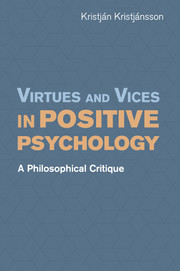
Virtues and Vices in Positive Psychology
Positive psychology is one of the biggest growth industries in the discipline of psychology. At the present time, the subfield of 'positive education' seems poised to take the world of education and teacher training by storm. In this first book-length philosophical study of positive psychology, Professor Kristján Kristjánsson subjects positive psychology's recent inroads into virtue theory and virtue education to sustained conceptual and moral scrutiny. Professor Kristjánsson's interdisciplinary perspective constructively integrates insights, evidence and considerations from social science and philosophy in a way that is easily accessible to the general reader. He offers an extended critique of positive psychology generally and 'positive education' in particular, exploring the philosophical assumptions, underpinnings and implications of these academic trends in detail. This provocative book will excite anyone interested in cutting-edge research on positive psychology and on the virtues that lie at the intersection of psychology, philosophy of mind, moral philosophy, education, and daily life.
eBook

Investigating the Psychological World
A broad theory of research methodology for psychology and the behavioral sciences that offers a coherent treatment of a range of behavioral research methods.
This book considers scientific method in the behavioral sciences, with particular reference to psychology. Psychologists learn about research methods and use them to conduct their research, but their training teaches them little about the nature of scientific method itself. In Investigating the Psychological World, Brian Haig fills this gap. Drawing on behavioral science methodology, the philosophy of science, and statistical theory, Haig constructs a broad theory of scientific method that has particular relevance for the behavioral sciences. He terms this account of method the abductive theory of method (ATOM) in recognition of the importance it assigns to explanatory reasoning. ATOM offers the framework for a coherent treatment of a range of quantitative and qualitative behavioral research methods, giving equal treatment to data-analytic methods and methods of theory construction.
Haig draws on the new experimentalism in the philosophy of science to reconstruct the process of phenomena detection as it applies to psychology; he considers the logic and purpose of exploratory factor analysis; he discusses analogical modeling as a means of theory development; and he recommends the use of inference to the best explanation for evaluating theories in psychology. Finally, he outlines the nature of research problems, discusses the nature of the abductive method, and describes applications of the method to grounded theory method and clinical reasoning. The book will be of interest not only to philosophers of science but also to psychological researchers who want to deepen their conceptual understanding of research methods and methodological concerns.
eBook

Do Apes Read Minds?
An argument that as folk psychologists humans (and perhaps other animals) don't so much read minds as see one another as persons with traits, emotions, and social relations.
By adulthood, most of us have become experts in human behavior, able to make sense of the myriad behaviors we find in environments ranging from the family home to the local mall and beyond. In philosophy of mind, our understanding of others has been largely explained in terms of knowing others' beliefs and desires; describing others' behavior in these terms is the core of what is known as folk psychology. In Do Apes Read Minds? Kristin Andrews challenges this view of folk psychology, arguing that we don't consider others' beliefs and desires when predicting most quotidian behavior, and that our explanations in these terms are often inaccurate or unhelpful. Rather than mindreading, or understanding others as receptacles for propositional attitudes, Andrews claims that folk psychologists see others first as whole persons with traits, emotions, and social relations.
Drawing on research in developmental psychology, social psychology, and animal cognition, Andrews argues for a pluralistic folk psychology that employs different kinds of practices (including prediction, explanation, and justification) and different kinds of cognitive tools (including personality trait attribution, stereotype activation, inductive reasoning about past behavior, and generalization from self) that are involved in our folk psychological practices. According to this understanding of folk psychology—which does not require the sophisticated cognitive machinery of second-order metacognition associated with having a theory of mind—animals (including the other great apes) may be folk psychologists, too.
eBook

A research guide to psychology
This authoritative research guide volume uses a problem-solving approach to presenting print and electronic resources. Ranging from background sources to current research, it features a wide range of sources including encyclopedias, handbooks, databases, careers, tests, dissertations, bibliographies, book reviews, diagnostic systems, and museums
eBook

Introductory Lectures on Lacan
Lacan developed his theory and practice of psychoanalysis on the basis of Freud's original work. In his \"return to Freud\" he not only elaborated and revised some of Freud's innovative ideas, but turned to important questions and problems in Freud's theory that had remained obscure and unresolved, and provided a new way of articulating these issues and their implication for psychoanalytic theory and practice. This book offers a selection of chapters about some of the fundamental concepts of psychoanalysis. The authors aim to explore the trajectory of the development of these concepts from their original basis in Freud's work to their elaboration by Lacan. The book will be of interest to readers from different backgrounds, including the clinical and academic field, social and cultural studies and the arts, for whom psychoanalytic ideas may be a relatively new field to explore, or who are looking for new perspectives to develop their ideas about psychoanalysis.
eBook
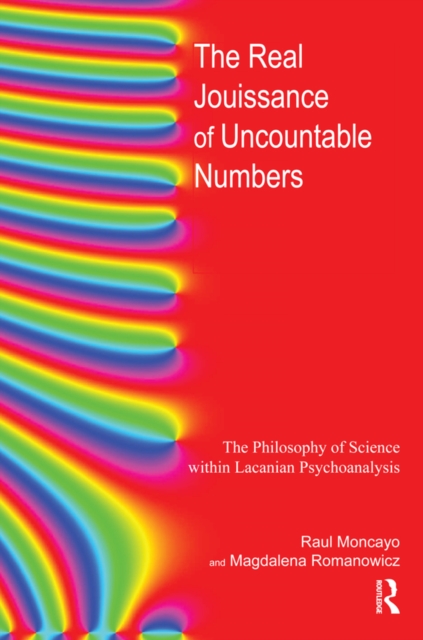
The Real Jouissance of Uncountable Numbers
Lacan critiqued imaginary intuition for confusing direct perception with unconscious pre-conceptions about people and the world. The emphasis on description goes hand in hand with a rejection of theory and the science of the unconscious and a belief in the naive self-transparency of the world. At the same time, knowing in and of the Real requires a place beyond thinking, multi-valued forms of logic, mathematical equations, and different conceptions of causality, acausality, and chance. This book explores some of the mathematical problems raised by Lacan's use of numbers and the interconnection between mathematics and psychoanalytic ideas. Within any system, mathematical or otherwise, there are holes, or acausal cores and remainders of indecidability. It is this senseless point of non-knowledge that makes change, and the emergence of the new, possible within a system. This book differentiates between two types of void, and aligns them with the Lacanian concepts of a true and a false hole and the psychoanalytic theory of primary repression.
eBook

For the Love of Psychoanalysis
This book is about what exceeds or resists calculation--in life and in death. Its two parts and nine chapters highlight, in their coupling of Freud and Derrida (\"Freuderrida\"), the accidents both in and of psychoanalytic writing, and the philosophical question of what limits the openness of our horizon.
eBook