
Catalogue Search | MBRL


Are you sure you want to remove the book from the shelf?

{{itemTitle}}
14,772
result(s) for
"Pacific studies"
Sort by:


Living Kinship in the Pacific
Unaisi Nabobo-Baba observed that for the various peoples of the Pacific, kinship is generally understood as \"knowledge that counts.\" It is with this observation that this volume begins, and it continues with a straightforward objective to provide case studies of Pacific kinship. In doing so, contributors share an understanding of kinship as a lived and living dimension of contemporary human lives, in an area where deep historical links provide for close and useful comparison. The ethnographic focus is on transformation and continuity over time in Fiji, Tonga, and Samoa with the addition of three instructive cases from Tokelau, Papua New Guinea, and Taiwan. The book ends with an account of how kinship is constituted in day-to-day ritual and ritualized behavior.
eBook


Pacific Realities
Throughout the Pacific region, people are faced with dramatic changes, often described as processes of \"glocalization\"; individuals and groups espouse multilayered forms of identity, in which global modes of thinking and doing are embedded in renewed perceptions of local or regional specificities. Consequently, new forms of resistance and resilience - the processes by which communities attempt to regain their original social, political, and economic status and structure after disruption or displacement - emerge. Through case studies from across the Pacific which transcend the conventional \"local-global\" dichotomy, this volume aims to explore these complex and interwoven phenomena from a new perspective.
eBook


Lured by the American Dream
Starting in 1952, the United States Navy and Coast Guard actively
recruited Filipino men to serve as stewards--domestic servants for
officers. Oral histories and detailed archival research inform P.
James Paligutan's story of the critical role played by Filipino
sailors in putting an end to race-based military policies.
Constrained by systemic exploitation, Filipino stewards responded
with direct complaints to flag officers and chaplains, rating
transfer requests that flooded the bureaucracy, and refusals to
work. Their actions had a decisive impact on seagoing military's
elimination of the antiquated steward position. Paligutan looks at
these Filipino sailors as agents of change while examining the
military system through the lens of white supremacy, racist
perceptions of Asian males, and the motives of Filipinos who joined
the armed forces of the power that had colonized their nation.
Insightful and dramatic, Lured by the American Dream is
the untold story of how Filipino servicepersons overcame tradition
and hierarchy in their quest for dignity.
eBook

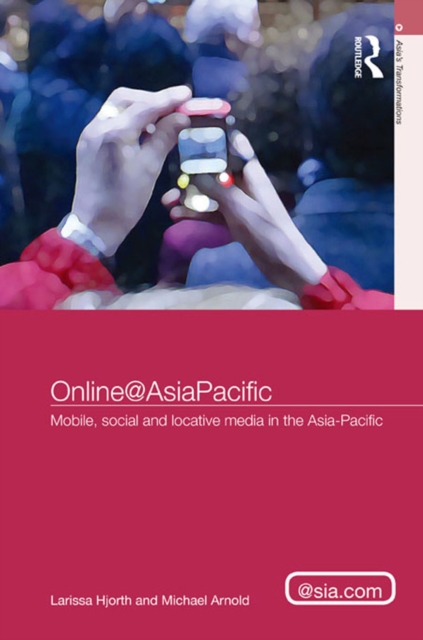
Online@AsiaPacific
Media across the Asia-Pacific region are at once social, locative and mobile. Social in that these media facilitate public and interpersonal interaction, locative in that this social communication is geographically placed, and mobile in so much as the media is ever-present. The Asia-Pacific region has been pivotal in the production, shaping and consumption of personal new media technologies and through social and mobile media we can see emerging certain types of personal politics that are inflected by the local.
The six case studies that inform this book-Seoul, Tokyo, Shanghai, Manila, Singapore and Melbourne-offer a range of economic, socio-cultural, and linguistic differences, enabling the authors to provide new insights into specific issues pertaining to mobile media in each city. These include social, mobile and locative media as a form of crisis management in post 3/11 Tokyo; generational shifts in Shanghai; political discussion and the shifting social fabric in Singapore; and the erosion of public and private, and work and leisure paradigms in Melbourne. Through its striking case studies, this book sheds new light on how the region and its contested and multiple identities are evolving, and concludes by revealing the impact of mobile media on how place is shaped, as well as shaping, practices of mobility, intimacy and a sense of belonging.
Employing comprehensive, cross-disciplinary frameworks from theoretical approaches such as media sociology, ethnography, cultural studies and media and communication studies, Online@AsiaPacific will be of huge interest to students and scholars of Asian culture and society, cybercultures, new media studies, communication studies and internet studies.
eBook


Berths and Anchorages: Pacific Cultural Studies from Oceania
The canoe has been a dominant metaphor constituting the discursive growth of Pacific studies in its transformation from a multidisciplinary to interdisciplinary project. In the first half of this essay I grapple with extending the canoe metaphors discussed by Vicente Diaz and J Këkaulani Kauanui in their 2001 article \"Native Pacific Cultural Studies on the Edge,\" and in the latter part I discuss programming at the Oceania Centre for Arts and Culture and Pacific Studies at the University of the South Pacific. Not wholly rejecting the \"seductive metaphor\" of Pacific studies as an interdisciplinary canoe between fields of study, my intention rather is to seek how to expand the metaphor productively toward anchorages and berths to produce homegrown theorizing of our intellectual practices, including creative practices. Practice-based research paradigms are increasingly being utilized in Pacific studies, and this kind of re-engagement with the discourse is productive. For a more holistic and pragmatic as well as intellectual and political Pacific studies, the canoe must make landfall, to complete a hermeneutic circle that began with the theoretical placing of the canoe as the animus of the interdisciplinary project in 2001.
Journal Article