
Catalogue Search | MBRL


Are you sure you want to remove the book from the shelf?

{{itemTitle}}
33
result(s) for
"Pahlavi language."
Sort by:

Sasanian coins, Middle-Persian etymology and the Tabarestهan archive
Avant-propos -- Une collection de monnaies sassanides de billon, de cuivre et de plomb / Rika Gyselen et Malek Iradj Mochiri, avec la collaboration de Hendrik Hameeuw -- Zu Lesung und Interpretation sasanidischer Monogramme / Rèudiger Schmidt -- The Use of micro-XRF for the elemental analysis of Sasanian lead coins from the collections of the Royal Museums of Art and History in Brussels / Alicia Van Ham-Meert, Bruno Overlaet, Philippe Claeys and Patrick Degryse -- Pahlavi legal documents from Tabarestan on lease, loan and compensation : a philological study / Dieter Weber -- Pahlavi legal documents from Tabarestan on lease, loan and compensation : the juristic context / Maria Macuch.
Book
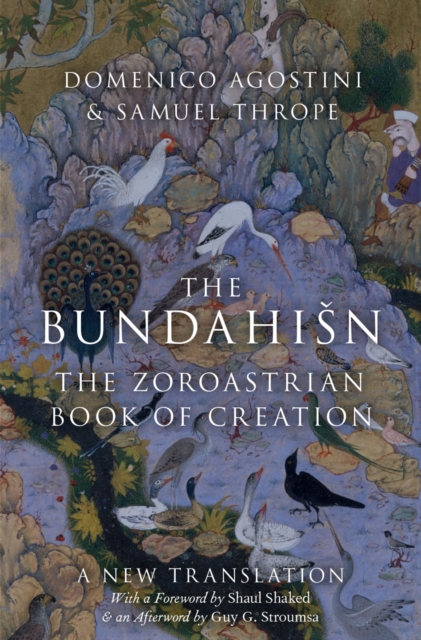
The Bundahišn : the Zoroastrian book of Creation
The Bundahišn, meaning primal or foundational creation, is the central Zoroastrian account of creation, cosmology, and eschatology and one of the most important of the surviving testaments to Zoroastrian literature and pre-Islamic Iranian culture. Touching on geography, cosmogony, anthropology, zoology, astronomy, medicine, legend, and myth, the Bundahišn can be considered a concise compendium of Zoroastrian knowledge.
The Bundahišn is well known in the field as an essential primary source for the study of ancient Iranian history, religions, literature, and languages. It is one of the most important texts composed in Zoroastrian Middle Persian, also known as Zoroastrian Book Pahlavi, in the centuries after the fall of the Sasanian Empire to the invading Arab and Islamic forces in the mid seventh century. The Bundahišn provides scholars with a particularly profitable window on Zoroastrianism’s intellectual and religious history at a crucial transitional moment: centuries after the composition of the Avesta, the Zoroastrian sacred scriptures, and before the transformation of Zoroastrianism into a minority religion within Iran and adherents’ dispersion throughout Central and South Asia. However, the Bundahišn is not only a scholarly tract. It is also a great work of literature in its own right and ranks alongside the creation myths of other ancient traditions: Genesis, the Babylonian Emunah Elish, Hesiod’s Theogony, and others. Informed by the latest research in Iranian Studies, this translation aims to bring to the fore the aesthetic quality, literary style, and complexity of this important work.
eBook

A Concise Pahlavi Dictionary
First published in 2004. Routledge is an imprint of Taylor & Francis, an informa company.
eBook

A concise Pahlavi dictionary
First published in 2004. The purpose of this dictionary is to provide the student with a representative vocabulary of Pahlavi in which such uncertain words have been reduced to a minimum and marked. It includes the commonest 4,000 simple words.
eBook
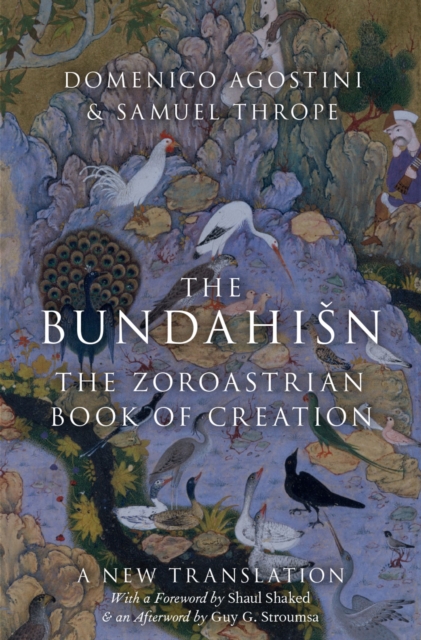
The Bundahi%sn
The Bundahisn, meaning primal or foundational creation, is the central Zoroastrian account of creation, cosmology, and eschatology. Compiled sometime in the ninth century CE, it is one of the most important surviving testaments to Zoroastrian literature in the Middle Persian language and to pre-Islamic Iranian culture. Despite having been composed some two millennia after the Prophet Zoroaster's revelation, it is nonetheless a concise compendium of ancient Zoroastrian knowledge that draws on and reshapes earlier layers of the tradition. Well known in the field of Iranian Studies as an essential primary source for scholars of ancient Iran's history, religions, literatures, and languages, the Bundahisn is also a great work of literature in and of itself, ranking alongside the creation myths of other ancient traditions. The book's thirty-six diverse chapters, which touch on astronomy, eschatology, zoology, medicine, and more, are composed in a variety of styles, registers, and genres, from spare lists and concise commentaries to philosophical discourses and poetic eschatological visions. This new translation, the first in English in nearly a century, highlights the aesthetic quality, literary style, and complexity and raises the profile of pre-Islamic Zoroastrian literature.
eBook


Zoroastrian ritual and exegetical traditions: the case of the Iranian Pahlavi Yasna
The manuscripts of the Iranian Pahlavi Yasna contain two consecutive colophons, the second of which relates the story of how their common ancestor manuscript, which combines the Avestan text of the Yasna with its Pahlavi version, was created. It is argued that Rōstahm Dād-Ohrmazd produced the first Pahlavi Yasna manuscript by taking the Avestan text from one manuscript and the Pahlavi text of a manuscript by Farrbay Srōšayār. Furthermore, it is argued that Rōstahm Dād-Ohrmazd wrote this manuscript both for himself and for Mahayār Farroxzād, who was from the province of Bīšāpuhr. The manuscript of Rōstahm Dād-Ohrmazd was then copied by Māhwindād Narmāhān, who composed the second colophon. This article also discusses the first colophon as it appears in the Iranian Pahlavi Yasna manuscript T54, which differs from other manuscripts of this group as it includes a passage written by a scribe called Kāyūs. It is argued that T54 was produced by Kāyūs, who added this passage to its first colophon. Furthermore, variant readings of these two colophons in two manuscripts of the Iranian Pahlavi Yasna, which also include Kāyūs's passage, are discussed. Unlike T54, Kāyūs's passage forms a separate colophon in these two manuscripts. It is suggested the two colophons are corrected according to the mindset of their respective scribes.
Journal Article
Mādayān ī Wīrāzagān: a newly discovered Middle Persian text: transliteration, transcription, and translation
In 2017, the editio princeps of a newly discovered Middle Persian text, the “Mādayān ī Wīrāzagān” or simply “Wīrāzagān”, was published by Raham Asha. This text, which is important not only from a literary and religious perspective, but also from a mythological point of view, was previously unknown to the scholarly community. The Middle Persian original of the text is found in the Codex TD 26 (49r-62v), preserved in the library of the K.R. Cama Oriental Institute, Mumbai. The manuscript was first discovered and studied by R. Asha in March 2011. The preliminary remarks on the Mādayān ī Wīrāzagān and other texts contained in the Codex TD 26 (Ms. R 494) were published in 2012 in the journal of the same institution. Here I present a translation (accompanied by the transliteration and transcription) of the original text published on pages 3–16 of Asha's book.
Journal Article
Pahlavi tōšn (tušn) in Denkard VII
Denkard VII which considered as the “Legend of Zoroaster” has been the subject of several investigations. The first translation was by E.W. West (1897: The Sacred Books of the East. Vol. 47. Clarendon: Oxford University Press: 26); Many years later Marijan Molé (1967) published a French version of Book VII; in Persian, Ahmad Tafazzolī and Žāleh Āmūzgār (1993: 55–110) translated some parts of the book VII; the last version which is in Persian belongs to Rashed Muhassel (2012: Denkard VII. Tehran: Pažuheshgāh-e olūm-e ensāni). Chapter two, sentence 34 of Denkard VII contains a word transcribed as tōšn/tušn of which this essay aims to have a critical view.
Journal Article