
Catalogue Search | MBRL


Are you sure you want to remove the book from the shelf?

{{itemTitle}}
18
result(s) for
"Pakistan Languages Political aspects."
Sort by:


The Pity of Partition
Saadat Hasan Manto (1912-1955) was an established Urdu short story writer and a rising screenwriter in Bombay at the time of India's partition in 1947, and he is perhaps best known for the short stories he wrote following his migration to Lahore in newly formed Pakistan. Today Manto is an acknowledged master of twentieth-century Urdu literature, and his fiction serves as a lens through which the tragedy of partition is brought sharply into focus. InThe Pity of Partition, Manto's life and work serve as a prism to capture the human dimension of sectarian conflict in the final decades and immediate aftermath of the British raj.
Ayesha Jalal draws on Manto's stories, sketches, and essays, as well as a trove of his private letters, to present an intimate history of partition and its devastating toll. Probing the creative tension between literature and history, she charts a new way of reconnecting the histories of individuals, families, and communities in the throes of cataclysmic change. Jalal brings to life the people, locales, and events that inspired Manto's fiction, which is characterized by an eye for detail, a measure of wit and irreverence, and elements of suspense and surprise. In turn, she mines these writings for fresh insights into everyday cosmopolitanism in Bombay and Lahore, the experience and causes of partition, the postcolonial transition, and the advent of the Cold War in South Asia.
The first in-depth look in English at this influential literary figure,The Pity of Partitiondemonstrates the revelatory power of art in times of great historical rupture.
eBook

Metaphorical framing of the COVID-19 pandemic in Pakistan: A corpus driven critical analysis of war metaphors in news media
Metaphors are an essential part of how humans process and understand the world. Cognitive linguistics does not view metaphors as merely linguistic or rhetorical devices; rather, they are conceptual in nature and are central to the thought process. Therefore, the present research investigates the metaphorical depiction of the Covid-19 health emergency through the conceptual metaphor of WAR in three renowned Pakistani English Newspapers i.e. Dawn, The Express Tribune, and The News. Critical Metaphor Analysis (CMA) is specifically selected to uncover the covert and possibly unconscious intentions of language users in Newspaper discourse. Fifty (50) editorials on the subject of Covid-19 are specifically chosen and their language is meticulously observed by making a specialized Corpus PakNCovid-19. The size of the corpus is 17621 words. Moreover, Monoconc Corpus Tool is utilized to analyze the metaphorical depiction of Covid-19 as a WAR in Pakistani Newspaper discourse. The study highlights the explicit deployment of military concepts like BATTLE, ENEMY, WAR, SOLDIERS, FIGHT, and VICTORY to create the conception of WAR and to create SELF Vs OTHER distinctions between the Pakistani people and the medical illness of Covid-19. The inquiry demonstrates that to create a sense of urgency and to mobilize masses against the deadly virus, the metaphors of War have been used deliberately. The military concepts have been purposely employed to present Covid-19 as an ‘alien’, ‘outsider’, as well as an ‘enemy’ entity.
Journal Article
Gender stereotypes and education: A comparative content analysis of Malaysian, Indonesian, Pakistani and Bangladeshi school textbooks
Using government secondary school English language textbooks from Malaysia, Indonesia, Pakistan and Bangladesh, we conducted a quantitative content analysis in order to identify gender stereotypes in school education. In total, 21 categories of exclusion and quality of representation were used to study gender stereotypes. Our analysis confirms a pro-male bias in textbooks: the aggregate female share is 40.4% in textual and pictorial indicators combined. Female occupations are mostly traditional and less prestigious while the characters are predominantly introverted and passive in terms of personality traits. Women are also shown to be mostly involved in domestic and in-door activities while men have a higher presence in professional roles. Systematic underrepresentation of females is evident regardless of whether we look at the text or pictures. A cross-country analysis shows that the female share in picture content is only 35.2% in Malaysia and Bangladesh. Overall, the proportion of female to male characters (text and pictures combined) is balanced in Malaysia and Indonesia (44.4% and 44.1% respectively) while this share is only 24.4% and 37.3% in Pakistani and Bangladeshi textbooks respectively. The finding of underrepresentation of women in Pakistani textbooks, in terms of quality and quantity, is robust to the selection of province-, grade- and subject-specific textbooks, as well as the range and type of categories used.
Journal Article

Sociocultural determinants of health-associated quality of life among Afghan refugees in Pakistan: evidence from a multi-stage cross-sectional study
Background
In the past few decades, there has been a significant increase in the number of refugees worldwide. Every individual deserves access to the fundamental right to health, and migration can have a substantial beneficial or detrimental effect on one’s health. Foreign invasions and political instability in Afghanistan affected neighboring countries with the large influx of refugees. Discrepancies in quality of life between the host and refugee populations may lead to health inequalities. Investigations in Pakistan on the quality of life of Afghan refugees were scarce despite more than four decades of refugee status. Therefore, this study was initiated to assess the sociocultural determinants influencing health-associated quality of life among Afghan refugees in Pakistan.
Methods
The Punjab province and Khyber Pakhtunkhwa province refugee populations were selected as the study population for cross-sectional research based on the inclusion criteria of majority refugee representation and female participation. Quantitative research methodology with pre-validated WHOQOL-BREF questionnaires was used for data collection via multi-stage probability sampling techniques. We collected data from 1,185 study participants and applied univariate and bivariate analyses. Inferential analyses included independent t-tests and ANOVA.
Results
The average scores for the entire sample of Afghan refugees were highest for the social domain (58.78 ± 22.74), followed by the physical domain (53.29 ± 19.46), the general health domain (50.44 ± 20.10), the environmental domain (48.43 ± 16.30), and the psychological domain (46.52 ± 14.78). Age, marital status, family setup, mother language, number of years in the host country, residence type, family monthly income, access to health care, current health status, chronic health illness, substance abuse (smoking), cultural compatibility, linguistic barriers, and social inclusion were non-significant with all the subdomains in the inferential analysis using the independent t-test and analysis of variance.
Conclusion
The Afghan refugees’ average scores across all health-associated quality-of-life domains were lower than Pakistan’s host population and the standard cutoff criteria (< 60 indicates poor quality of life). The development of a national policy to include refugees in health insurance programs seems essential to improve the health-associated quality of life among Afghan refugees in Pakistan.
Journal Article

Revisiting geographies of nationalism and national identity in Bangladesh
On 15 August 1947, the subcontinent of undivided India was partitioned into India and Pakistan (West and East Pakistan) using the two-nation theory. However, approximately 24 years after, Bangladesh was carved out of East Pakistan. The key purpose of this study is to revisit the geographies of nationalism and national identity in Bangladesh, which emerged at the cost of colossal sacrifice during its 1971 Liberation War against Pakistani forces when its people derived gargantuan inspiration from ‘creole nationalism’ stemming from their language and culture. There is a severe dearth of literature by geographers on nationalism in Bangladesh. Hence, this study deploys a collage of both rich and grey literature from interdisciplinary subjects, including geography. Following the independence of Bangladesh, Bengali nationalism and Bengali identity were enshrined in the Constitution.Nevertheless, both nationalism and national identity based on ‘creole nationalism’ were shifted within four years of the Liberation War and were transformed into Bangladeshi nationalism and Bangladeshi national identity. This new nationalism was a product of the renewed form of ‘two-nation theory’, separating Bangladeshis from other Bengalis, especially those living in the state of West Bengal, India. Besides, Bangladeshi nationalism emphasized ‘Muslim identity’ of Bengali Muslim instead of Bengali identity. Although the current Awami League government has reinstated Bengali nationalism into the Constitution, the false dichotomy between Bengali and Bangladeshi constructed by the ruling elites continues in current Bangladesh. Bengali language and culture are an integral part of independent Bangladesh. Simultaneously, Muslim identity and the identity of the indigenous population remains intrinsic in the current context of the country. This study argues that geographies of inclusiveness remain paramount in addressing nationalism and national identity in Bangladesh.
Journal Article
Framing South Asian politics: An analysis of Indian and Pakistani English print media discourses regarding Kartarpur corridor
This paper aims to analyze the divergent perspectives of Indian and Pakistani English print media on opening the Kartarpur corridor. It is a four-kilometer-long cordoned-off strip from the Indo-Pak international border to the Gurdwara Darbar Sahib Kartarpur located in Pakistan. The basic purpose of establishing this corridor is to give easy access to the Indian Sikh community. The initiative was taken into account in August 2018, which resulted in the appearance of a vast quantity of contemplations in the national print media of both countries, especially until the opening of the corridor in November 2019. Print media plays a key role in building knowledge and framing the general public’s opinion through interpreting an issue. The data were taken from Dawn , The News International (Pakistan), The Times of India , and Hindustan Times (India) from August 2018 to March 2020 using Lexus Nexus Library. The corpus analysis was carried out by applying the lexical study of Natural Language Processing (NLP) through its Latent Dirichlet Allocation (LDA) tool to find out the general patterns or topics in the print media of both countries. It was found that Pakistani print media terms the Kartarpur corridor as a sign of regional peace, religious tourism, mediation, and diplomatic efforts. In contrast, Indian print media focuses on apprehensions related to traveling modalities, pilgrimage facilities, and tensions between the two states.
Journal Article

An empirical analysis of social media usage, political learning and participation among youth: a comparative study of Indonesia and Pakistan
Youth participation in political matters has gained attention among people around the globe where youth involvement in certain political activities has been witnessed (of public in Indonesia and Pakistan). Keeping in view this scenario, the current study aimed to identify the sway of social media in enhancing youth involvement in political learning, political participation and political efficacy. This quantitative study was conducted through online and offline survey in both countries at the time of general elections. The data was gathered from both countries in systematic manner where the data was collected from Pakistan (General Elections, 2018) firstly and then from Indonesia (National Elections, 2019). A total of four hundred respondents (200 from each country) gave their opinions through structured questionnaires. The results revealed that the youth being considered as millennial has a significant role in contributing to the discourse of politics. The results show that the use of social media facilitates youth to participate in political activities and those activities enhance their knowledge, provide a chance to participate and build the capacity of political efficacy. It is to conclude that youth has actively engaged and use to discuss the political matters on social media to sensitize the public. As such, the role of youth, to some extent, has changed the political situations in both countries.
Journal Article

The Representation of Women Politicians in Pakistani English-Language Newspapers
Gender representation, in terms of both narratives and images of women in the public sphere, is an indicator of gender equality in a society. In particular, mass media plays a significant role in shaping the perceptions of the public towards women. Our present study aims to investigate the representation of women politicians in two Pakistani English-language newspapers in 2012, 2017, and 2022: Dawn and The Nation. With the rise of quotas reserved for women in both the National and Provincial Assemblies in Pakistan, our study hopes to analyze how often and in which news genre that women politicians are represented. By employing a content analysis approach, our findings reveal that women politicians are greatly underrepresented in both Dawn and The Nation newspapers compared to men politicians. They are usually depicted in shorter, hard news stories rather than given more in-depth portrayals in features or editorial sections. In addition, there was no significant change found throughout the ten-year period investigated, despite the country's law to reserve 20% of parliamentary seats for women. Limited representation in media can affect the political careers of women politicians, by limiting their chances of being elected on open merit seats in general elections and also undermining their importance in the eyes of the public. Therefore, it is imperative that the media should have balanced reporting on women politicians. This is especially of concern in a society where women are already facing considerable challenges in all aspects of life due to the sociopolitical contexts of the country.
Journal Article
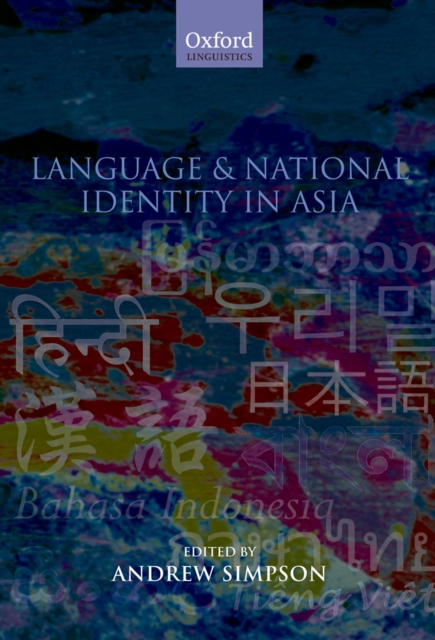
Language and national identity in Asia
Language and National Identity in Asia is a comprehensive introduction to the role of language in the construction and development of nations and national identities in Asia. Leading scholars from all over the world investigate the role languages have played and now play in the formation of the national and social identity in countries throughout South, East, and Southeast Asia. They consider the relation of the regions' languages to national, ethnic, and cultural identity, and examine the status of and interactions between majority, official, and minority languages. Illustrated with maps and accessibly written this book will interest all those concerned to understand the dynamics of social change in some of the most important countries in the world. It will appeal to all those studying, researching, or teaching issues in Asian society, language, and politics from a comparative perspective.
eBook