
Catalogue Search | MBRL


Are you sure you want to remove the book from the shelf?

{{itemTitle}}
7,233
result(s) for
"Paleontology History."
Sort by:

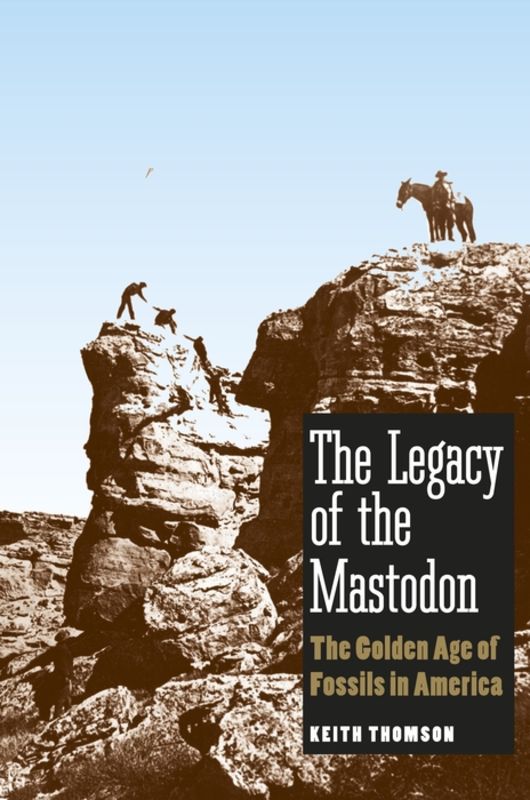
The Legacy of the Mastodon
The uncovering in the mid-1700s of fossilized mastodon bones and teeth at Big Bone Lick, Kentucky, signaled the beginning of a great American adventure. The West was opening up and unexplored lands beckoned. Unimagined paleontological treasures awaited discovery: strange horned mammals, birds with teeth, flying reptiles, gigantic fish, diminutive ancestors of horses and camels, and more than a hundred different kinds of dinosaurs. This exciting book tells the story of the grandest period of fossil discovery in American history, the years from 1750 to 1890.
The volume begins with Thomas Jefferson, whose keen interest in the American mastodon led him to champion the study of fossil vertebrates. The book continues with vivid descriptions of the actual work of prospecting for fossils--a pick in one hand, a rifle in the other--and enthralling portraits of Joseph Leidy, Ferdinand Hayden, Edward Cope, and Othniel Marsh among other major figures in the development of the science of paleontology. Shedding new light on these scientists' feuds and rivalries, on the connections between fossil studies in Europe and America, and on paleontology's contributions to America's developing national identity,The Legacy of the Mastodonis itself a fabulous discovery for every reader to treasure.
eBook


The First Fossil Hunters
Griffins, Cyclopes, Monsters, and Giants--these fabulous creatures of classical mythology continue to live in the modern imagination through the vivid accounts that have come down to us from the ancient Greeks and Romans. But what if these beings were more than merely fictions? What if monstrous creatures once roamed the earth in the very places where their legends first arose? This is the arresting and original thesis that Adrienne Mayor explores inThe First Fossil Hunters. Through careful research and meticulous documentation, she convincingly shows that many of the giants and monsters of myth did have a basis in fact--in the enormous bones of long-extinct species that were once abundant in the lands of the Greeks and Romans.
As Mayor shows, the Greeks and Romans were well aware that a different breed of creatures once inhabited their lands. They frequently encountered the fossilized bones of these primeval beings, and they developed sophisticated concepts to explain the fossil evidence, concepts that were expressed in mythological stories. The legend of the gold-guarding griffin, for example, sprang from tales first told by Scythian gold-miners, who, passing through the Gobi Desert at the foot of the Altai Mountains, encountered the skeletons of Protoceratops and other dinosaurs that littered the ground.
Like their modern counterparts, the ancient fossil hunters collected and measured impressive petrified remains and displayed them in temples and museums; they attempted to reconstruct the appearance of these prehistoric creatures and to explain their extinction. Long thought to be fantasy, the remarkably detailed and perceptive Greek and Roman accounts of giant bone finds were actually based on solid paleontological facts. By reading these neglected narratives for the first time in the light of modern scientific discoveries, Adrienne Mayor illuminates a lost world of ancient paleontology.
eBook

Digging for Brachiosaurus
\"Provides an annotated timeline of the discovery of Brachiosaurus, including details on the scientists, dig sites, fossils, and other findings that have shaped our knowledge of this dinosaur\"-- Provided by publisher.
Book

Why museums should repatriate fossils
The legacy of a palaeontology expedition into Native American lands 150 years ago should prompt a rethink of where and how fossil collections are curated.
The legacy of a palaeontology expedition into Native American lands 150 years ago should prompt a rethink of where and how fossil collections are curated.
Journal Article

Discovering the mammoth : a tale of giants, unicorns, ivory, and the birth of a new science
\"Today, we know that a mammoth is an extinct type of elephant that was covered with long fur and lived in the north country during the ice ages. But how do you figure out what a mammoth is if you have no concept of extinction, ice ages, or fossils? Long after the last mammoth died and was no longer part of the human diet, it still played a role in human life. Cultures around the world interpreted the remains of mammoths through the lens of their own worldview and mythology. When the ancient Greeks saw deposits of giant fossils, they knew they had discovered the battle fields where the gods had vanquished the Titans. When the Chinese discovered buried ivory, they knew they had found dragons' teeth. But as the Age of Reason dawned, monsters and giants gave way to the scientific method. Yet the mystery of these mighty bones remained. How did Enlightenment thinkers overcome centuries of myth and misunderstanding to reconstruct an unknown animal? The journey to unravel that puzzle begins in the 1690s with the arrival of new type of ivory on the European market bearing the exotic name \"mammoth.\" It ends during the Napoleonic Wars with the first recovery of a frozen mammoth. The path to figuring out the mammoth was traveled by merchants, diplomats, missionaries, cranky doctors, collectors of natural wonders, Swedish POWs, Peter the Great, Ben Franklin, the inventor of hot chocolate, and even one pirate. McKay brings together dozens of original documents and illustrations, some ignored for centuries, to show how this odd assortment of characters solved the mystery of the mammoth and, in doing so, created the science of paleontology.\"-- Dust jacket.
Book

Understanding 6th-century barbarian social organization and migration through paleogenomics
Despite centuries of research, much about the barbarian migrations that took place between the fourth and sixth centuries in Europe remains hotly debated. To better understand this key era that marks the dawn of modern European societies, we obtained ancient genomic DNA from 63 samples from two cemeteries (from Hungary and Northern Italy) that have been previously associated with the Longobards, a barbarian people that ruled large parts of Italy for over 200 years after invading from Pannonia in 568 CE. Our dense cemetery-based sampling revealed that each cemetery was primarily organized around one large pedigree, suggesting that biological relationships played an important role in these early medieval societies. Moreover, we identified genetic structure in each cemetery involving at least two groups with different ancestry that were very distinct in terms of their funerary customs. Finally, our data are consistent with the proposed long-distance migration from Pannonia to Northern Italy.
The Longobards invaded and conquered much of Italy after the fall of the Western Roman Empire. Here, the authors sequence and analyze ancient genomic DNA from 63 samples from two cemeteries associated with the Longobards and identify kinship networks and two distinct genetic and cultural groups in each.
Journal Article

Digging for Tyrannosaurus rex
\"Provides an annotated timeline of the discovery of Tyrannosaurus rex including details on the scientists, dig sites, fossils, and other findings that have shaped our knowledge of this dinosaur\"-- Provided by publisher.
Book
Rereading the fossil record
Rereading the Fossil Record presents the first-ever historical account of the origin, rise, and importance of paleobiology, from the mid-nineteenth century to the late 1980s. Drawing on a wealth of archival material, David Sepkoski shows how the movement was conceived and promoted by a small but influential group of paleontologists and examines the intellectual, disciplinary, and political dynamics involved in the ascendency of paleobiology. By tracing the role of computer technology, large databases, and quantitative analytical methods in the emergence of paleobiology, this book also offers insight into the growing prominence and centrality of data-driven approaches in recent science.
eBook